Last Year 'Head-Shaving and Hunger Strike,' This Time an 'Innovation Task Force' … Provincial Council PPP: 'We Will Scrutinize Under a Microscope'
The People Power Party (PPP) in the Gyeonggi Provincial Council, which last year went so far as to shave their heads and stage an indefinite hunger strike protest against Gyeonggi Province's welfare budget cuts, has this time set its sights on the 770 billion won supplementary budget cut announced by Gyeonggi Governor Choo Mi-ae.
According to the Gyeonggi Provincial Council and other sources on the 10th, the PPP plans to verify the targets and scale of the cuts on a program-by-program basis as soon as the supplementary budget bill is submitted. The aim is to prevent livelihood programs from being cut once again on the grounds of financial difficulties.
On the 5th, Governor Choo defined the province's finances as "effectively in a state of default" and announced an expenditure restructuring of about 770 billion won. The plan is to halt one-off and populist events and non-urgent, nonessential programs, and to reevaluate research services, private consignment and agency programs, and others.
The PPP plans to check the detailed breakdown during the standing committee and Special Committee on Budget and Accounts reviews once the supplementary budget bill arrives. Bang Sung-hwan, floor leader of the PPP in the Provincial Council, said, "We will pick apart one by one how they intend to cut 770 billion won," adding, "We will obtain the detailed breakdown of exactly which programs are being cut and by how much, and verify it thoroughly."
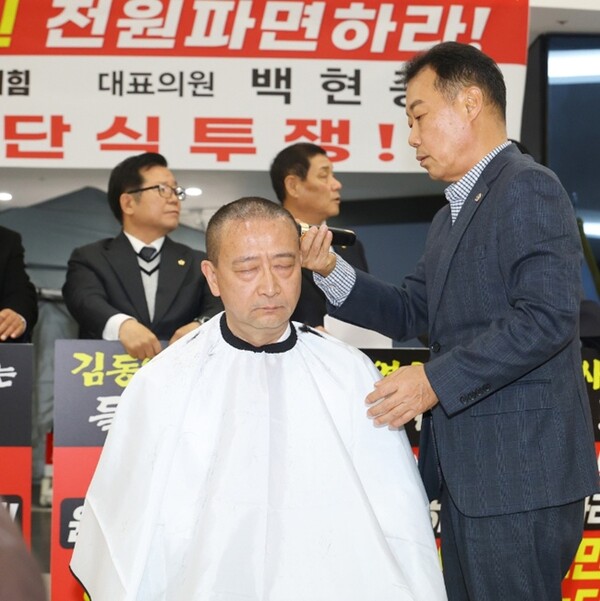
This is not the first time the PPP has taken issue with budget cuts. During the process of drafting the 2026 main budget last year, about 446.5 billion won was cut from the previous year, centered on the social welfare and women's sectors, sparking a controversy over "welfare budget cuts," and then-floor leader Baek Hyun-jong went on a head-shaving protest and an indefinite hunger strike.
This time, however, the scope of verification is being expanded. The intent is to examine not only the breakdown of cuts by program but also the overall fiscal situation that caused the cuts.
Floor leader Bang said, "If the cause lies elsewhere but the solution is to make actual program cuts and just say, 'It's because we are effectively in a state of default,' then livelihood budgets are sacrificed," adding, "We plan to analyze thoroughly and keep watch so that programs that are genuinely necessary are not sacrificed."
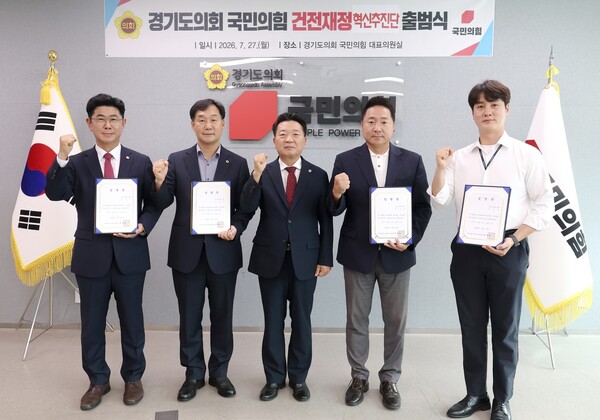
On the 7th, the PPP launched the "Sound Finance Innovation Task Force." The idea is not to seek the cause of the province's financial difficulties solely in the scale of expenditure, but to check whether the tax revenue estimation method led to budget planning that was inflated beyond actual revenue.
According to data presented by the PPP, the settlement amounts of local tax revenue fell short of the main budget by about 1.4 trillion won in 2022, about 1.3 trillion won in 2023, and about 700 billion won in 2025. The PPP believes that despite large-scale revenue shortfalls recurring since 2022, the province did not sufficiently adjust its revenue forecasts.
They also take issue with the estimation method. Over the past three years, rather than using the average of all institutions' forecasts or the average of the median values after excluding the highest and lowest, the province adopted its own estimation, and for 2026 it applied the "average of the top three institutions."
The PPP plans to trace its investigation back to the 7th popularly elected administration. This is based on the judgment that the province's finances rely heavily on real estate transactions, contain elements that do not align with central policy, and suffer repeated tax revenue estimation errors, making the structure itself fragile. The party plans to jointly examine the tax revenue estimation standards from the 7th to the 8th popularly elected administrations, actual revenue, and the fiscal management process following the revenue shortfalls.
Floor leader Bang said, "It is a 'man-made disaster' in which revenue shortfalls were condoned for the sake of politically expansionary finance, ignoring market trends and the principles of statistics," and declared, "We will completely overhaul the botched tax revenue estimation system."