Choo Mi-ae: 'We Must Keep Speaking Out on 'Comfort Women' Suffering Through International Civic Solidarity'
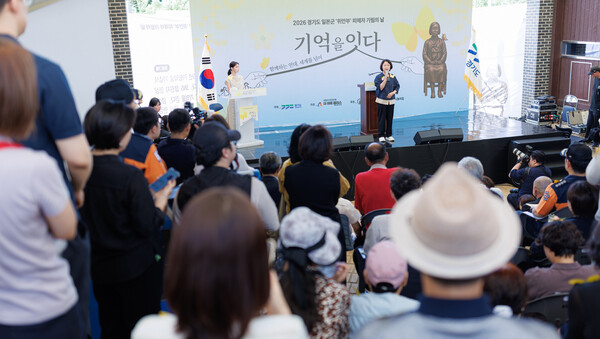
Gyeonggi Governor Choo Mi-ae attended the '2026 Memorial Day Ceremony for Victims of Japanese Military 'Comfort Women'' held at the House of Sharing in Gwangju on the 8th, where she emphasized the importance of civic solidarity in carrying forward remembrance.
Governor Choo Mi-ae said, “Yesterday was the day to honor the victims of the Hiroshima atomic bombing, and today we are honoring the 'comfort women' grandmothers. Whenever I come to the House of Sharing, I always feel guilty and sorry,” adding, “The young girls who inevitably become the first victims when the nation is in hardship found comfort here at this haven, even if late, but their final wish was likely that the state would understand, even a little, their desire to speak out to the world with dignity.”
Governor Choo went on to recount how, when the girl statue in Berlin was in danger of being removed under pressure from Japan, she personally traveled to Germany to explain the statue's meaning to the chair of the German Bundestag's Committee on Family, Senior Citizens, Women and Youth. “After hearing my explanation, the chair said Germany would take the lead in spreading the message that victims of wartime sexual violence must never again arise anywhere on the globe. I felt firsthand that as we make efforts, our voice is growing louder,” she said.
Governor Choo emphasized, “Our goal is solidarity. If the state cannot properly step up, we must keep speaking out through international civic solidarity,” adding, “I hope that through today's gathering, a resolve will emerge to make that outcry resound even louder as a voice of solidarity. Today we will see the bust of grandmother Kang Il-chul, and we will not forget her.”
In September 2024, Governor Choo Mi-ae visited Berlin, Germany, to convey Korean public opinion to German society in an effort to preserve the 'Statue of Peace,' which was at risk of removal. The girl statue honoring victims of Japanese military 'comfort women' was installed in Berlin's Mitte district in September 2020. It was forcibly removed in October 2025 but was reinstalled in January this year, returning to the hands of the citizens.
Memorial Day (August 14) is a national commemorative day established to raise awareness of the Japanese military 'comfort women' issue both at home and abroad and to honor the victims. Gyeonggi Province has held a commemorative ceremony every year since 2016. Under the theme of 'Carrying Forward Remembrance,' the ceremony featured various programs aimed not only at remembering the lives and courage of the victims but also at carrying that memory forward as values of peace and human rights.
First, a Gyeonggi Governor's Commendation for contributing to the revitalization of the commemorative project was presented to Kim Hyang-mi, co-representative of Suwon Peace Butterfly, who has worked for the restoration of honor of Japanese military 'comfort women' victims and the inheritance of historical memory. Co-representative Kim has led the Suwon Wednesday Cultural Festival for over 12 years and promoted Memorial Day commemorative projects in the Suwon area, working to raise awareness of the victims' history and the values of peace and human rights.
Next, awards were presented to the winners of the 'Messages of Peace, Human Rights, and Remembrance' contest, held for the first time this year. The contest covered the fields of poetry, painting, and original composition, and a total of 150 entries were submitted.
The Grand Prize went to the musical work 'Wind,' and Gyeonggi Governor's Awards were also presented to the winners of the highest and excellence awards in each field. The winners spanned various generations, from middle school and university students to the general public, and participated from across the country, including not only Gyeonggi but also Seoul, Gyeongnam, and Gyeongbuk, expressing the memory of Japanese military 'comfort women' victims and messages of peace and human rights through poetry, painting, and music.
In particular, an unveiling ceremony was held at the venue for a bust honoring the life and courage of the late grandmother Kang Il-chul, who passed away on March 28. After reflecting on Kang's activities during her lifetime, attendees unveiled the bust and paid tribute to the deceased with the laying of flowers and a moment of silence.
Grandmother Kang Il-chul was born in Sangju, Gyeongbuk, in 1928, and at the age of 17 in 1944, she was forcibly mobilized to a Japanese military 'comfort station' in Heilongjiang Province, China, where she suffered. She later returned to her homeland and participated in Wednesday demonstrations at home and abroad as well as the Asian Solidarity Conference, working to raise awareness of the truth of the Japanese military 'comfort women' suffering and the importance of war and women's human rights. Her painting 'Burning Maidens' also served as the motif for the production of the film 'Spirits' Homecoming.'