Gyeonggi Province Fiscal Crisis Response TF Begins Discussions on Revenue and Institutional Reform
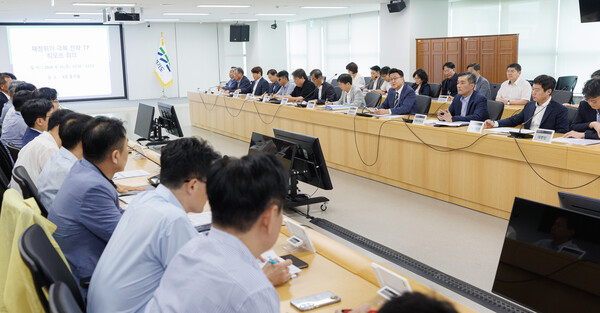
Following Gyeonggi Province Governor Choo Mi-ae's declaration of a fiscal emergency situation for the province, the 'Fiscal Crisis Response Strategy Task Force (TF)' established in Gyeonggi Province has begun full-scale operations.
The task force plans to prepare a comprehensive strategy for normalizing the province's finances by the end of August, ranging from short-term expenditure restructuring to mid- and long-term revenue and institutional reform.
Gyeonggi Province held the first meeting of the Fiscal Crisis Response Strategy TF on the 10th at the Gyeonggi Provincial Government, presided over by Economic Vice Governor Joo Hyung-chul, and discussed these response strategies.
Economic Vice Governor Joo Hyung-chul said, “The governor declared a 'Gyeonggi Province fiscal emergency situation' on August 5. This is not just a problem for this year, and because conditions will not improve next year either, if we do not act now, the crisis will become permanent,” adding, “We must accurately identify the cause to come up with a proper solution. The most fundamental cause is an outdated local finance system.”
He explained that as the AI era has arrived, the forms of industry and the ways value is created have changed, and welfare demand has surged, yet the local finance system is still tailored to the development era.
Vice Governor Joo continued, “The governor instructed us to immediately activate the TF and prepare effective countermeasures by the end of this month. Within three weeks, we will create an effective implementation system to protect the lives of residents and the future of Gyeonggi Province,” and presented four core tasks.
The four core tasks are △strong project and fiscal restructuring △expanding revenue for the AI era △strengthening solidarity and cooperation △voluntary savings by all members.
Looking at the main content of each task, first, strong and bold project and fiscal restructuring will begin. The 2027 main budget will be reviewed from scratch within the scope of available resources, and the roles of the central government, cities and counties, and the private sector, as well as the role of Gyeonggi Province, will be reexamined and readjusted. Special accounts, funds, and public institution resources will also be reviewed. The province plans to protect livelihood and safety projects through 'pinpoint adjustments' without mechanical across-the-board cuts, and to maintain the level of public services through innovation in project methods.
Second, standards suited to the AI era will be created and revenue expanded. The province plans to redesign the structure for allocating affairs and finances between the national and local governments so that local affairs for future growth can be properly carried out, and to establish the principle that when national affairs are transferred to local governments, finances follow along. Discovering additional local taxes and non-tax revenue and re-estimating revenue resources that can be additionally secured within the year are also included in the implementation tasks.
Third, in solidarity with the 31 cities and counties and other metropolitan local governments facing the same problems as Gyeonggi Province, the province will urge the government and the National Assembly to reform the outdated fiscal system. It plans to proceed with each process while communicating with the Gyeonggi Provincial Council, as well as to share the progress with residents.
The final task is the voluntary efforts of all public officials. All members of the provincial government and public institutions, as fiscal actors, were called upon to eliminate habitual waste factors and to consolidate their capabilities so that budgets are invested in a timely manner in livelihood and future investment.
The Fiscal Crisis Response Strategy Task Force (TF) is headed by Vice Governor Joo Hyung-chul and involves a total of 50 people, including the director of the Planning and Coordination Office, bureau and division directors, and an external expert advisory panel, and is operated through four subcommittees: △expenditure △revenue and tax system reform △communication and public relations △external cooperation.
After holding a second meeting on the 13th, the province plans to complete the countermeasures by the end of August and to launch a '(tentatively named) Fiscal Crisis Response Implementation Committee' in September to continue reviewing the progress of the initiatives.