Mayor Jeong Myeong-geun Holds ‘Metropolitan Area Agrivoltaic Groundbreaking Ceremony’ with Minister Song Mi-ryung
Hwaseong Special City (Mayor Jeong Myeong-geun) has taken the first step in its ‘Metropolitan Area Resident-Participatory Agrivoltaic Pilot Project,’ which aims to preserve farmland while boosting farm household income by leveraging its characteristics as an urban-rural complex city that holds the largest farmland area in Gyeonggi Province.
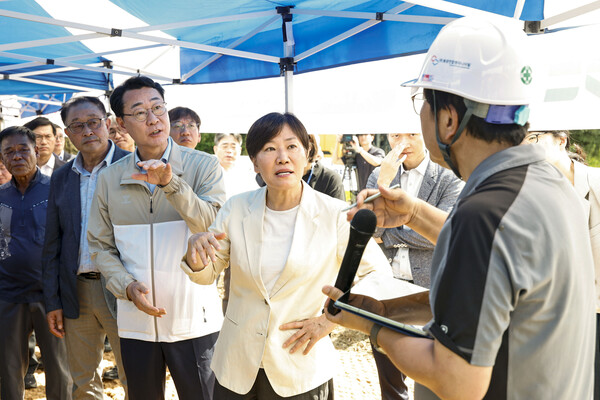
On the morning of the 13th, the city held the ‘Metropolitan Area Agrivoltaic Pilot Groundbreaking Ceremony’ in the area of 700 Sagot-ri, Seosin-myeon, Manse-gu. About 20 people attended the ceremony, including Minister of Agriculture, Food and Rural Affairs Song Mi-ryung and Hwaseong Special City Mayor Jeong Myeong-geun, along with officials from Gyeonggi Province, the Korea Rural Community Corporation, and the Korea Energy Agency, as well as local residents, all wishing for the successful implementation of the project.
This project was launched after Sagot-ri in Hwaseong Special City was finally selected, along with Songjuk Village in Anseong, as a metropolitan area pilot site in a public competition held by the Ministry of Agriculture, Food and Rural Affairs late last year.
The project is led by the ‘Sagot Social Cooperative,’ established directly by local residents. Of the total 169 households, 119 participated, recording a resident consent rate of 70%, thereby establishing a public-private cooperation system based on high resident acceptance.
In particular, unlike existing project methods led by external operators, this project is significant in that a cooperative established by residents participates directly as the project’s main entity. Rather than distributing the profits generated from solar power generation to individuals, the funds will be accumulated as a village common fund and used as financial resources for revitalizing the local community, including welfare for the elderly, improvement of the village environment, and joint projects.
Through this pilot project, a 1-megawatt (MW) scale solar power generation facility will be built on a site of about 2.4 hectares (ha). The city plans to complete facility construction and a power purchase agreement (PPA) by October and begin full-scale commercial operation from November.
The groundbreaking ceremony that day proceeded in order, with a Part 1 site inspection and a first shovel-turning demonstration, followed by a Part 2 residents’ meeting held at the Sagot-ri Village Community Center.
Following the groundbreaking ceremony, Minister Song Mi-ryung and Mayor Jeong Myeong-geun also attended the residents’ meeting, where they heard about the on-site difficulties and suggestions experienced during the project’s implementation from Sagot Social Cooperative executives and residents, and discussed measures to improve laws and systems for revitalizing agrivoltaic projects.
At the meeting, the city proposed the following to the government to protect farmers’ rights and interests and to resolve institutional difficulties arising during project implementation: △institutionalizing profit-sharing and equity participation for tenant farmers △providing alternative farmland and compensating for farming losses △abolishing the designated use of agricultural infrastructure that has lost its function (such as ditches) △approving use for purposes other than intended for the installation of solar power generation facilities.
Hwaseong Special City Mayor Jeong Myeong-geun said, “This project is highly significant in that residents themselves become the main players in the project, preserving farmland while sharing the profits generated from solar power generation with the local community,” adding, “We will actively cooperate with the government so that the residents’ opinions raised on-site can lead to institutional improvements, and we will provide support so that the Sagot-ri project can establish itself as a model case for ‘Sunlight Income Villages’ nationwide, beyond the metropolitan area.”