Gyeonggi Province Hosts 8th Clean Air International Forum…Seeking Joint Response in Asia-Pacific Region
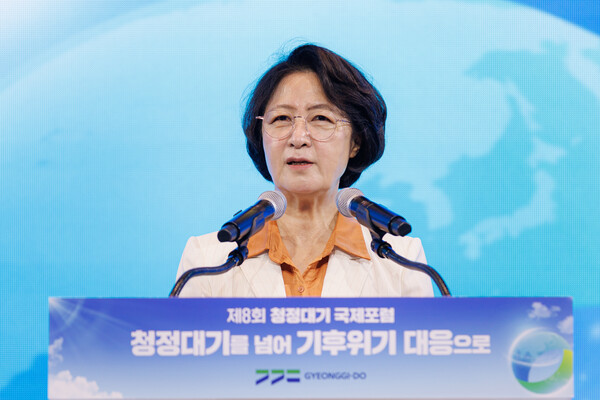
Gyeonggi Province discussed cooperation measures with local governments and international organizations in the Asia-Pacific region to jointly respond to climate crisis and air pollution.
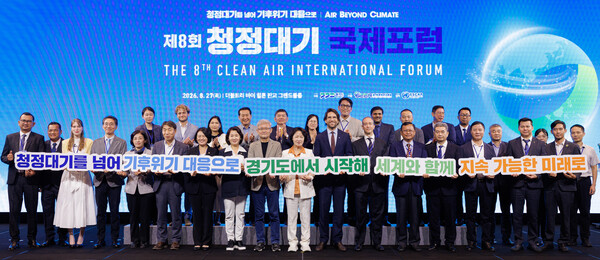
Gyeonggi Province announced on the 27th that it held the "8th Clean Air International Forum 2026" with the attendance of around 200 participants including domestic and international local governments, international organizations, experts, and residents.
The forum, held under the theme of "Beyond Clean Air to Climate Crisis Response (Air·Beyond·Climate)," was attended by local governments from four regions in three countries—Jiangsu and Guangdong provinces in China, Kampot Province in Cambodia, and Ulaanbaatar in Mongolia—as well as officials from the United Nations Economic and Social Commission for Asia and the Pacific (UN ESCAP) and the World Health Organization Asia-Pacific Centre for Environmental Health (WHO ACE).
Governor Choo Mi-ae defined climate crisis in her opening remarks as a matter of social inequality beyond natural disasters, emphasizing that countries and regions that have benefited from industrialization by emitting more greenhouse gases bear greater responsibility.
Governor Choo stated, "Even the same heat waves and heavy rainfall affect children, elderly people, those with poor health, and economically disadvantaged people more severely and earlier," adding "The climate crisis is both a crisis of nature and a crisis that reveals inequality in our society."
She continued, "Climate justice is not a matter of charity helping struggling countries and people, but a matter of fairly dividing responsibility for growth and reversing the burdens passed on to future generations," and announced, "Gyeonggi Province will take the lead in action for cleaner air, safer climate, and a better future."
Governor Choo introduced three examples of Gyeonggi Province's climate justice policies: "Gyeonggi Sunshine Village," which returns solar power generation profits to residents; "Gyeonggi Climate Insurance," which guarantees health protection for residents affected by climate disasters; and "Gyeonggi Climate Platform," which integrates climate, energy, and environmental data.
At the forum, Park Tae-woong, chairman of the Green Society Forum, delivered a keynote speech on the topic of "AI Rewriting Carbon Governance." This was followed by an insight session covering "Climate and Air, One Crisis," and an international session discussing policy cases and cooperation measures of Asia-Pacific local governments.
Experts participating in the insight session addressed the connection between climate change and air quality, as well as the impacts of increased electricity demand and carbon emissions resulting from the spread of artificial intelligence data centers on daily life related to climate, air quality, and artificial intelligence.
In the international session, officials from local governments in China, Cambodia, and Mongolia shared their regional climate and air quality policies. Officials from UN ESCAP, WHO ACE, and Cambodia's Ministry of Environment discussed cooperation strategies among local governments to improve air quality in Asia-Pacific cities and enhance climate resilience, as well as air quality monitoring tasks.
Prior to the forum, Gyeonggi Province operated a "Gyeonggi Province Climate Crisis and Air Pollution Reduction Best Practice Dissemination Cooperation Program" with UN ESCAP for two days starting from the 25th. Participants visited Gyeonggi Province's climate and air quality policy sites and explored policies applicable to their respective regions and joint cooperation projects.
Gyeonggi Province plans to expand cooperation with international organizations and Asia-Pacific local governments, sharing its experience in air quality improvement and data-based climate policies to jointly respond to climate crisis and air pollution issues.