Kim Min-seok Elevates Jang Dong-hyuk … Will 'Top Two Politics' Between Ruling and Opposition Parties Emerge?
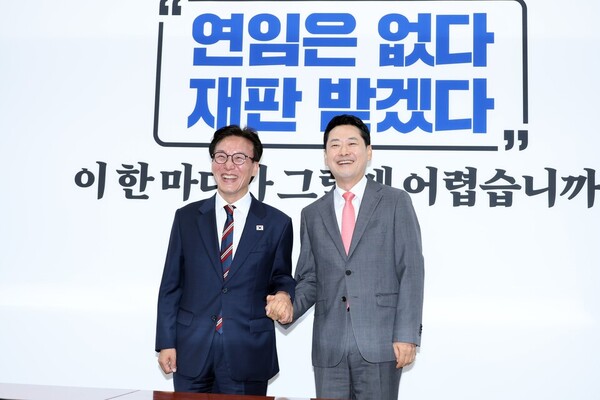
Democratic Party Leader Kim Min-seok and People Power Party Leader Jang Dong-hyuk recognized each other as political opponents from their first official meeting, yet revealed clear differences in stance on major issues. Attention is focused on whether ‘top two politics’, where ruling and opposition party leaders lead political affairs through repeated confrontation and negotiation, will take shape.
According to political circles on the 24th, Leader Kim visited the National Assembly People Power Party headquarters to pay a courtesy call to Leader Jang. This came just one week after Kim was elected party leader at the Democratic Party convention on the 17th.
From the first meeting, Leader Kim actively praised Leader Jang. Kim said he “genuinely likes” Jang and evaluated him as “an essential leader in current Korean politics.” He emphasized that while there are areas where their political views differ, there are also ‘areas of intersection’ where they shared views, such as in the process of lifting martial law.
He added, “As long as politics continues in the Republic of Korea, aren't Leader Jang and I the two people who must not let go of the thread of dialogue?” and proposed, “Usually we talk about ‘regularization’ or ‘normalization,’ but what if we go beyond that to ‘flexible scheduling’?”
Leader Jang responded positively, saying, “I actively agree with the proposal to meet directly and converse flexibly.”
When Leader Kim mentioned the photographs of former Presidents Syngman Rhee, Park Chung-hee, and Kim Young-sam hanging in the People Power Party leader's office, saying “(the distance between the two parties) is not that far,” Leader Jang reciprocated by saying, “The distance between the ruling and opposition party leaders' offices is not that great.”
Compared to former Democratic Party Leader Jung Cheong-rae, who did not hold courtesy meetings with the People Power Party, Leader Kim has engaged in restoring dialogue with the main opposition party immediately after taking office.
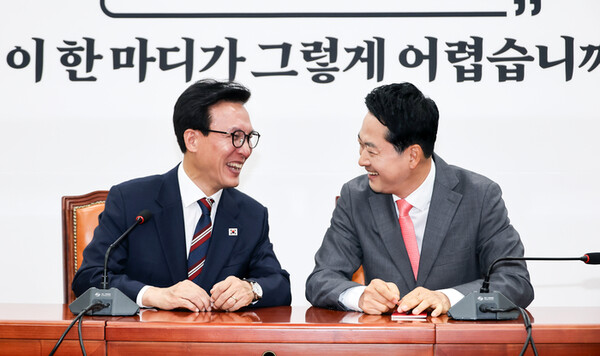
Leader Jang asked Leader Kim to support the President's state affairs while also joining forces with the opposition party when the National Assembly checks the administration.
If Leader Kim recognized Leader Jang as a political counterpart for the main opposition party, Leader Jang demanded that Leader Kim play the role of a ruling party leader who can maintain a certain distance from the government.
However, their stance differences on current issues were clear.
Regarding the controversy over Supreme Court Chief Justice Cho Hee-dae’s recent nomination of Supreme Court justices, Leader Jang cited an example from the Roh Moo-hyun administration.
Leader Jang stated, “In 2003, when Supreme Court Chief Justice Choi Jong-young recommended Supreme Court justice candidates, the Blue House expressed displeasure, but former President Roh Moo-hyun accepted it based on the conviction that judicial independence must be protected,” and asked for action from the perspective of protecting judicial independence and rule of law.
Leader Kim countered, “After 21 years have passed, it's not a matter of one side's decision but rather all levels, including the entire procedure, must be normalized.”
Leader Jang immediately followed up, “We shouldn't place too much weight on procedural issues,” and raised the matter of public trust in future Supreme Court appointments and trials.
From the first meeting, while recognizing each other, the two leaders exchanged immediate rebuttals and counter-rebuttals on judicial issues.
On livelihood and economic issues, they found common ground.
When Leader Jang emphasized the need for fiscal control regarding the government's future response fund and proposed using approximately 50 percent of excess tax revenues for the middle class, ordinary citizens, and youth, Leader Kim replied, “There are many parts I can fully agree with.”
On real estate policy, they left room for dialogue.
While Leader Jang pointed out inconsistencies in government policy, he welcomed Leader Kim's submission of revised opinions on the government's tax restructuring plan.
Leader Kim said, “I will make efforts based on respecting the market as much as possible while supplementing market failures,” and proposed creating a framework for discussing real estate issues with both parties and the public.
They confronted each other on judicial and political issues while confirming room for negotiation on livelihood and economic issues.
There have been past cases of ruling and opposition party leaders directly negotiating major issues. In 2015, New Frontiers Party Leader Kim Moo-sung and New Politics Alliance for Democracy Leader Moon Jae-in held leader meetings attended by party floor leaders to jointly respond to the MERS crisis.
However, the meeting between Leaders Kim Min-seok and Jang Dong-hyuk differs in that they agreed to ‘flexibly schedule’ leader-to-leader dialogue from the start, beyond simply sitting down due to a specific issue. If the two leaders actually lead direct negotiations and confrontations on every major issue, there is potential for development into a new political axis centered on ruling and opposition party leaders.
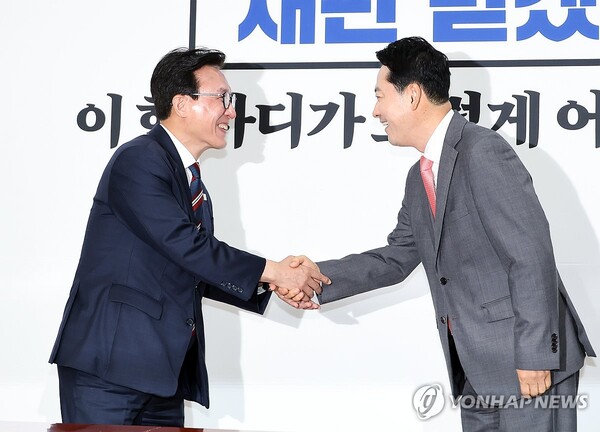
Political circles have raised the possibility that the two could become ‘competitive partners’ who expand each other's political space.
For Leader Kim, Leader Jang is a counterpart who can demonstrate politics of external expansion and integration. By engaging in dialogue with the opposition while adhering to the Democratic Party's stance on major political issues, he can simultaneously gain expansiveness toward the centrist electorate and clarity within the party.
Leader Jang, in turn, can enhance his presence as the main opposition party leader not merely by criticizing the government and ruling party, but by directly negotiating major state affairs with the ruling party leader.
Particularly significant is that Leader Kim evaluated Leader Jang as “an essential leader in Korean politics” from their first meeting, which has the effect of acknowledging Jang as a negotiator for the main opposition party while positioning himself as the ruling party's negotiator sitting across from him.
Ultimately, the key question is whether "flexible scheduling" translates into actual ongoing negotiation relations rather than mere rhetoric. If the two leaders repeatedly meet directly, clash, and produce results on issues where agreement is possible whenever issues arise, ‘top two politics’ could establish itself as a political structure.
A political insider stated, “Political partners are not people who think alike but rather those who represent different interests yet can negotiate when necessary,” and added, “If the two leaders, who have recognized each other as negotiating partners, clearly confront each other on issues where they should fight and produce results on issues where agreement is possible, there is a possibility that the ruling and opposition political structure could be reorganized into a ‘top two system’ centered on Leaders Kim Min-seok and Jang Dong-hyuk.”