[Analysis] A Look Inside Gyeonggi Province's 'Effectively Bankrupt' Finances … Not a Legal 'Crisis,' but the Margin Has Shrunk
Although Gyeonggi Province Governor Choo Mi-ae has characterized the province's finances as being "effectively bankrupt," applying the current fiscal figures to the standards under the Local Finance Act shows that they are a considerable distance from the legal fiscal crisis level.
That said, as the scale of debt and repayment burden increase year by year and the share of essential expenditures remains at a high level, a trend of shrinking actual fiscal management capacity is also confirmed.
According to calculations by the Suwon Ilbo based on materials provided by Gyeonggi Province and the Gyeonggi Provincial Council, the province's debt-to-budget ratio as of the end of June this year is 15.57%. This is the value obtained by dividing the outstanding debt of 6.2368 trillion won by this year's main budget of 40.0577 trillion won. It is 9.43 percentage points lower than the fiscal caution threshold (exceeding 25%) set by Article 65-3 of the Enforcement Decree of the Local Finance Act.
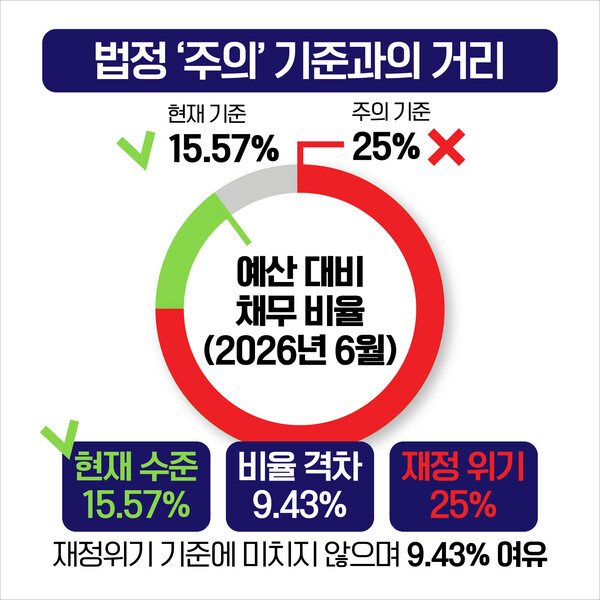
By a simple calculation based on the main budget, the outstanding debt would have to reach 10.0144 trillion won to touch the fiscal caution threshold line. This means it would have to increase by another 3.78 trillion won from the current level, four times the 943 billion won in local bonds the province issued last year.
Even assuming the roughly 7 trillion won in 'debt to be repaid' presented by Governor Choo's side as debt outright, the ratio comes to 17.47%, which also falls short of the fiscal caution threshold.
However, the 7 trillion won cited by Governor Choo's side and debt under the Local Finance Act are not the same concept. The amount disclosed by Governor Choo's side includes not only fund borrowings and local bond principal but also interest to be borne in the future. In contrast, the outstanding debt the province submitted to the Provincial Council is a figure based on official debt management standards. Because Governor Choo's side has not disclosed the detailed calculation breakdown, the exact difference between the two figures is difficult to confirm based on currently available public data alone.
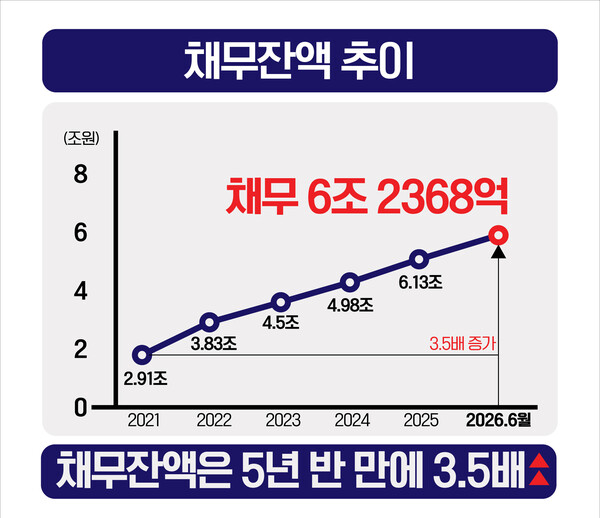
Looking only at the absolute level, the province is a distance from a legal fiscal crisis. But the direction of the debt is different. According to materials the province submitted to the Gyeonggi Provincial Council, outstanding debt rose from 1.7693 trillion won at the end of 2020 to 2.9112 trillion won in 2021, 3.8362 trillion won in 2022, 4.5067 trillion won in 2023, 4.9848 trillion won in 2024, and 6.1357 trillion won at the end of 2025. As of the end of June this year, it reached 6.2368 trillion won. That is a 3.5-fold increase in five and a half years.
The same trend appears in the Local Finance 365 disclosures. The province's debt-to-budget ratio rose every year, from 4.53% in 2020 to 6.28% in 2021, 9.12% in 2022, 11.61% in 2023, and 11.95% in 2024. The province's tally for 2025 is 12.55%.
However, this figure and the 15.57% calculated by this newspaper are difficult to compare directly because their denominators differ. The Local Finance 365 disclosures use the final budget amount, which reflects supplementary budgets, as the denominator, whereas this newspaper applied the confirmed main budget. The smaller the denominator, the higher the calculated ratio. Still, by any standard, the trend of the ratio rising every year is the same.
The repayment burden is also growing. As of 2024, the province's managed debt repayment ratio was 8.39%, lower than the Ministry of the Interior and Safety's fiscal diagnosis standard of 12%. But it nearly quadrupled in three years, from 2.19% in 2021 to 4.31% in 2022, 7.27% in 2023, and 8.39% in 2024. In its comprehensive report on local government fiscal analysis, the Ministry of the Interior and Safety pointed to the need to minimize new local bond issuance amid rising regional development bond issuance and to conduct prior appropriateness assessments.
An indicator worth watching more closely is the ordinary account balance ratio. The ordinary account balance ratio is the proportion of ordinary expenditures, such as personnel and welfare costs, out of the revenue that comes in repeatedly each year. The higher this ratio, the smaller the fiscal capacity available for new projects or policies.
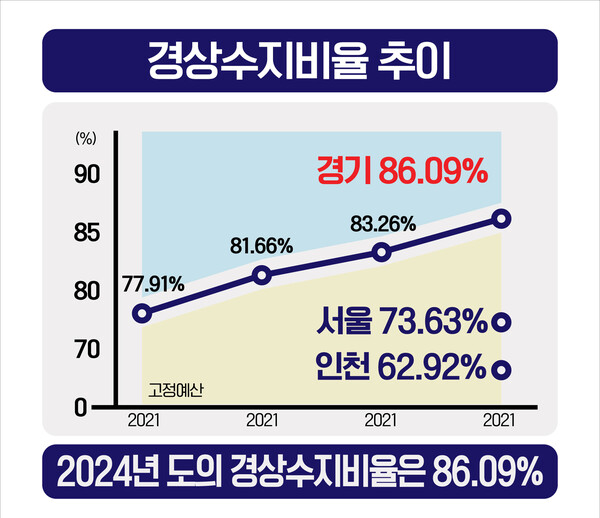
In 2024, the province's ordinary account balance ratio was 86.09%. This is higher than Seoul's 73.63% and Incheon's 62.92%. It means that 86% of the money coming in is already earmarked for spending. This ratio also continued to rise, from 77.91% in 2021 to 81.66% in 2022, 83.26% in 2023, and 86.09% in 2024.
Local tax collection this year is also weaker than projected. According to the province's local tax collection status, acquisition tax collected from January to July was 4.5656 trillion won, a collection rate of 56.0%. Considering that more than half the period has passed, this falls 2.3 percentage points short of the appropriate collection rate of 58.3%. The province forecasts that provincial taxes will fall about 300 billion won short of the target by the end of the year.
The two indicators show different things. The debt-to-budget ratio shows how much of the current debt is relative to the overall budget. The ordinary account balance ratio and revenue structure show how much money is left over to spend each year. Even if the legal indicators fall short of the fiscal caution level, if essential expenditures rise and revenue declines, available resources can shrink by any degree.
In fact, last year the province issued 943 billion won, most of its local bond issuance ceiling, and drew 558.8 billion won from various funds into its integrated account. This year, some public livelihood and essential projects had only nine months' worth of their annual required amount reflected in the main budget.
Taken together, the numbers reveal two faces of the province's finances at the same time. Under current law, it does not qualify as a fiscal caution or crisis body, and its debt ratio is considerably lower than the threshold. On the other hand, outstanding debt and the repayment burden have continued to grow over the past several years, and actual management capacity is narrowing due to the share of essential expenditures and revenue volatility.
Based on the figures currently confirmed, it is difficult to view the province's finances as being at a 'bankruptcy' level. However, if the increase in debt and the expansion of fiscal rigidity continue, the management burden going forward is bound to grow even greater.