[81st Anniversary of Liberation] "Flower of Hope" - Suwon's Boys Who Filled a Day for Liberation
On August 15, 1945, liberation came to Suwon as well. People poured into the streets. Hands holding the Taegeuk flag raised toward the sky and fluttered amid shouts of "Manse."
Yet not everyone who dreamed of liberation could enjoy that joy. There was a boy in Suwon who came forward earnestly but ultimately could not be there on that day.
Fifteen years before liberation, on May 4, 1930, a Children's Day event was held in Suwon.
"Let us not forget that we are flowers of hope and fruits of future happiness." Some 1,500 children and residents departed from a sports field inside Suwon Hwaseong Fortress and marched through Maehwa Bridge, Jangan Gate, Jongno, and Paldalmun Gate.
Leading that procession were Suwon Youth Alliance officials Kim Jang-seong and Hong Jong-geun. The Suwon Youth Alliance was an organization that advocated for youth rights, protection of working youth, and literacy education.
That summer, Hong Jong-geun came to Kim Jang-seong with a newspaper in hand. It was an article covering proclamation incidents that had been spreading nationwide following the Gwangju Student Independence Movement.
"Why don't we try it here in Suwon?" Kim Jang-seong nodded.
They set the date for action as October 12, a day when many people would gather for the Hwaseong Academy fall athletic meet. Hwaseong Academy was the predecessor of present-day Suwon High School.
On October 11, the day before, the two wrote the proclamation at Hong Jong-geun's house. It totaled 16 pages.
The message was clear: "Overthrow the oppressive colonial rule of the Governor-General of Joseon."
In the early morning of October 12, the two boys took to the streets. They posted the proclamation at crossroads outside Paldalmun Gate, at Paldalmun Gate itself, Sugu Gate, utility poles around Hwaseong Academy, Joseon Grain Company, and the Suwon Youth Alliance sports field.
When dawn broke, Suwon was in turmoil. Japanese colonial police monitored the athletic meet and searched social organization offices, Hwaseong Academy, and homes of youth activists. Yet throughout this, the two boys continued to post proclamations on utility poles and billboards throughout the streets. Everywhere they posted, people stopped and read the writings.
Japanese colonial police arrested some 30 people related to social organizations in Suwon in succession. But those who actually wrote and posted the proclamation were neither prominent independence activists nor renowned intellectuals. They were eighteen-year-old boys.
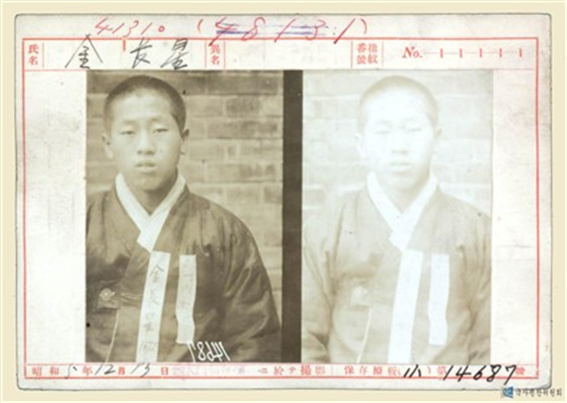
In November, the investigation reached Kim Jang-seong and Hong Jong-geun, and they were ultimately arrested. Kim Jang-seong was imprisoned at Seodaemun Prison. Inmate number 1672. Eighteen years old. Occupation: fish vendor.
In 1931, he was convicted of violating the Public Peace Preservation Act and sentenced to one year in prison, then transferred to Gimcheon Youth Prison.
Hong Jong-geun was released in January 1932 upon completion of his sentence. However, Kim Jang-seong contracted an illness in prison and was released on parole with just 20 days remaining on his sentence. But he soon passed away. He was nineteen years old. His comrades held his funeral as a "comrades' funeral" and buried him in Suwon Municipal Cemetery.
Thirteen years later, on August 15, 1945, the liberation Kim Jang-seong had longed for finally came. At Paldalmun Gate where he had posted proclamations, and on streets where people had gathered to read his words, there was no longer a need to post proclamations. Yet Kim Jang-seong himself could not witness the liberated Suwon.
On Children's Day, the boy who called himself a "flower of hope" picked up a brush that autumn, cried out for freedom against oppression and persecution, and passed away before seeing the day of liberation he had dreamed of.
In 2010, the government posthumously awarded Kim Jang-seong the Order of Merit for National Foundation, Patriotic Service Medal.
Liberation Day did not arrive suddenly one day. Before that, there were people who took to the streets, uncertain if they would live to see liberation.
In Suwon, boys like Kim Jang-seong and Hong Jong-geun were filling each day for liberation.