President Lee's Approval Rating Falls to 30s for First Time … Defecting Voters Not Moving to People Power Party
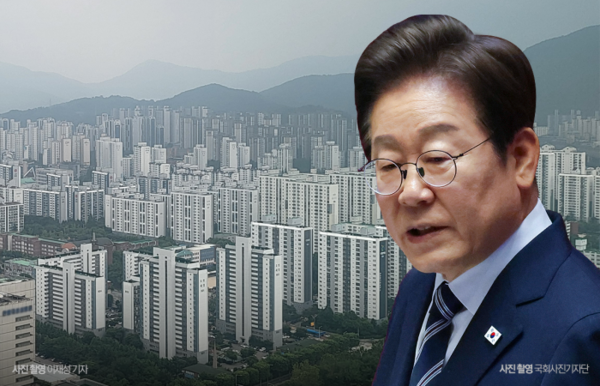
A poll has shown that President Lee Jae-myung's approval rating for state affairs has fallen into the 30s for the first time since taking office. The defecting public sentiment from the president is not showing signs of shifting toward the People Power Party.
According to a poll conducted by Jowoori C&I from August 22-24 on 2,001 men and women aged 18 and older nationwide, President Lee's approval rating for state affairs stands at 38.9%, while disapproval is at 57.9%.
Compared to the previous survey conducted August 8-10, approval dropped 4.0 percentage points from 42.9%, while disapproval rose 3.8 percentage points from 54.1%. The gap between approval and disapproval widened from 11.2 percentage points to 19.0 percentage points.
This is the first time in Jowoori C&I's regular surveys that President Lee's approval has fallen below 40% since taking office. In recent surveys, the rating has dropped consecutively: from 49.4% on July 11-13 to 47.4% on July 25-27, 42.9% on August 8-10, and 38.9% in this survey. The rating has fallen 10.5 percentage points in just over a month.
The collapse below the 40% threshold has sparked concern even within pro-government circles. On August 17, pro-government broadcaster Kim Eo-jun stated on his YouTube program, referencing historical presidential approval trends, "No president has recovered after hitting the 30s," and "40% approval is a psychological Maginot Line." At that time, President Lee's approval was still in the 40s, but the current survey shows it has actually fallen into the 30s.
However, examining historical presidential approval trends, entering the 30s does not necessarily mean irreversible decline. Former President Lee Myung-bak dropped to the 10s early in his term before recovering to the 40s, while former President Park Geun-hye fell to the 30s in 2015 before rising above 40% again. Former President Moon Jae-in also dropped to the 20s in a 2021 Gallup Korea survey before rebounding to the 40s near the end of his term.
Rather, what stands out in this survey is that the public sentiment defecting from President Lee is not shifting toward the main opposition People Power Party.
In the same survey, the Democratic Party's support dropped 2.5 percentage points from 46.4% to 43.9%. Meanwhile, the People Power Party remained at 37.3%, unchanged from the previous survey.
President Lee -4.0%p, Democratic Party -2.5%p, People Power Party ±0.0%p.
While approval ratings fell simultaneously for both the president and ruling party, the main opposition has failed to gain from the spillover effect. The People Power Party's support rose from 36.0% on July 25-27 to 37.3% on August 8-10, then remained at 37.3% in this survey.
This gap also appears among independent voters. Independent voters' assessment of President Lee shows 42.9% approval and 55.1% disapproval, with disapproval 12.2 percentage points higher. However, in party support, the Democratic Party leads 46.8% to 28.7% for the People Power Party, a 18.1 percentage point advantage.
Independent voters' negative assessment of the president is not translating into expanded support for the People Power Party.
However, the fact that not only the president's but also the Democratic Party's approval ratings have fallen simultaneously presents a burden for the ruling camp. Whether the negative sentiment concentrated on the president spreads to the ruling party, and whether the People Power Party can absorb the defecting public sentiment, will likely determine future public opinion trends.
This survey was commissioned by Straight News and conducted by Jowoori C&I from August 22-24 on 2,001 men and women aged 18 and older nationwide using 100% mobile phone RDD ARS methodology. The response rate was 3.8%, and the margin of sampling error is ±2.2 percentage points at the 95% confidence level. For details, refer to the Central Election Poll Deliberation Committee website.