[Kim Woo-young's Gwanggyo Column] Hoping the Concern About Depopulation in Suwon's Haengung-dong Area Does Not Become Reality
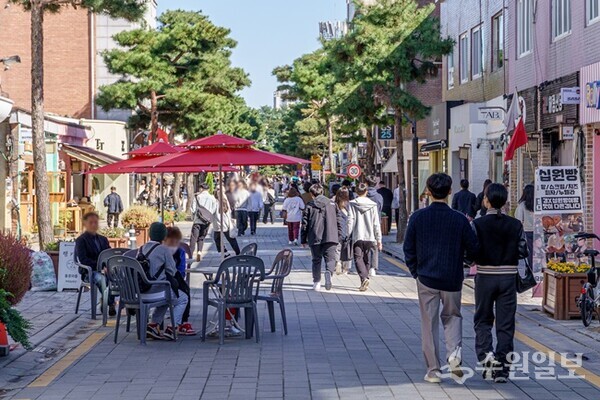
After finishing lunch outside, I returned to the office to find it empty.
Later I learned that everyone had gone to Daewang Kalguksu, an old-established restaurant on Jongno, to eat kongguksu, and they had to wait for quite some time because there were many customers.
I noticed there were many young Southeast Asian women wearing headscarves, and it seemed they were likely tourists who came to see the filming location of the drama 'Sell Your Haunted House.' I agreed with this assessment.
As I wrote in a column in the July 23rd edition of Suwon Ilbo titled 'Was the filming location of the drama 'Sell Your Haunted House' here?', the number of foreign tourists visiting Haengung-dong has significantly increased since the drama aired. The house where Seonjae and Sol lived in the drama, nearby alleys, Hwahongmun Gate where they dated, and Yongnyeon where they rode bicycles are becoming attractions.
As someone who loves Hwaseong and has been living near Jongno, these scenes are fascinating to me.
I frequently encounter reports that K-dramas and K-pop are gaining worldwide popularity.
A few years ago during trips to Indonesia and Uzbekistan, I also met locals who expressed their fondness for Korea.
However, seeing people travel all the way to Suwon, the filming location, because of a drama I have not even watched, I cannot help but think, 'It is true that K-culture is truly remarkable.'
The Haengung-dong area is called 'Haengni-danggil' and 'Haengung-dungi.' As I have mentioned in other columns, I dislike the nickname 'Haengni-danggil.' It is inappropriate to attach the suffix '~ni-dang' derived from Seoul's Gyeongni-danggil to the historically significant Haengung-dong, which is home to Hwaseong, a UNESCO World Heritage site that encompasses Hwaseong Haenggung.
I do not know who first started calling it this way, but I believe the area should now be called 'Haengung Alley Street,' 'Hwaseong Seong-an Street,' the official district name 'Shinpoong-dong Street,' or a nickname like 'Haengung-dungi.'
This area was once the center of Suwon where kings stayed and prominent figures conducted administration, featuring Haenggung, government offices, and bell pavilions, but it remained underdeveloped for a long time due to cultural heritage protection regulations.
Then, centered around this area, the '2013 Eco-Mobility Suwon' festival and 'Suwon Cultural Heritage Night Walk' were held, and it became what people now call a 'hot place.'
At the same time, deposits and monthly rents rose significantly.
Recently, Suwon City announced the results of a commissioned study, stating that the commercial district in Jangan and Shinpoong-dong has reached the 'alert' stage of gentrification, with average annual rent increases approaching 15%. There is also deep concern that if the economy slows down when more general commercial facilities (restaurants, cafes, etc.) move into the area, regional depopulation could occur.
In response, Suwon City is pushing forward with designating a regional coexistence zone in Haengung-dong together with local residents. In this context, the 'Haengung-dong Regional Coexistence Council' was launched on May 28th. Prior to this, Suwon proclaimed itself a 'city protecting local commercial districts.'
In an editorial on June 3rd titled 'Concern About Depopulation in Suwon's Haengung-dong Area, Regional Coexistence Needed,' Suwon Ilbo reported that the council includes participants such as the Haengung-dong Residents' Autonomy Association, Haengung-dong Merchants Association, Haengung-dong Heads of Tong Council, and research members from the Suwon Research Institute. It also explained that the 'regional coexistence zone' is a privately-led commercial district based on the 'Local Commercial District Act' enacted in 2021, centered around a regional coexistence council composed of merchants, landlords, and landowners, where coexistence agreements are concluded to stabilize rents, and the entry of large franchise chains is restricted to preserve the character of the commercial district.
Then, on July 23rd, a residents' briefing session was held at the Haengung-dong Administrative Welfare Center, attended by the (provisional) regional coexistence council promoting the designation of Haengung-dong as a regional coexistence zone, Suwon City, landlords and tenants within the zone, and officials from the Small Venture Business Administration and Suwon City, where the coexistence agreement proposal was introduced to landlords and tenants within the regional coexistence zone.
We do not want to see the Haengung-dong commercial district collapse. We hope that the vitality that has come to Haengung-dong will be maintained and developed.
For this to happen, Haengung-dong merchants and landlords, as well as Suwon City and the local community, must take even deeper interest and make greater efforts to resolve the problems of the Haengung-dong commercial district.