Curbing Local Governments' and Councils' 'Favoritism-Based Private Contracts'... Blocking Embezzlement of Public Funds
Going forward, a brake has been put on the practice of local governments and councils awarding private contracts to favored companies under the pretext of expediting projects.
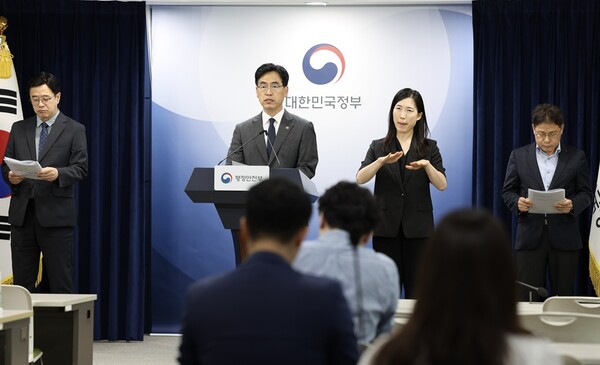
The Ministry of the Interior and Safety (Minister Yoon Ho-jung) announced on the 13th that, in response to recent allegations of preferential private contracts arising from some local council members abusing their influence and cases of embezzlement of public funds by local government accounting officials, it will completely overhaul the system by newly establishing limits on private contracts for the same company, and will significantly strengthen a comprehensive inspection of public fund management at local governments nationwide as well as controls over disbursement systems.
These measures were prepared to fundamentally block improper favoritism in private contracts and weaknesses in accounting management, thereby establishing a transparent local finance system that residents can trust.
The private contract system is a method by which local governments determine and conclude contracts with counterparties without going through bidding when contracting for construction, services, and the purchase of goods; it is mainly used for small-value contracts (20 million won or less, 50 million won or less) or when projects need to be pursued quickly.
To prevent the abuse of private contracts, local contract laws specify concrete grounds for private contracts and prohibit local council members and heads of local governments from concluding private contracts with the relevant local government. For example, the heads of local governments and local council members themselves, their spouses, direct ascendants and descendants, and affiliated companies cannot conclude private contracts with the relevant local government.
However, as cases have recently arisen in which local council members exercised influence to arrange private contracts with companies effectively related to themselves, such as those owned by relatives, the need was raised to block such irregularities and to fundamentally eliminate the possibility of the private contract system being abused in its operation.
Accordingly, the Ministry of the Interior and Safety will introduce limits on single-quote private contracts with the same company in order to prevent the fair contracting order from being undermined through favoritism such as concentrating private contracts on specific companies. Basic local governments (including Sejong and Jeju) cannot conclude private contracts with the same company exceeding 5 times or 200 million won per year, and metropolitan local governments cannot exceed 7 times or 300 million won per year.
The subject of the restriction, in the case of general companies, is single-quote private contracts with an estimated price of 20 million won or less, and for youth startups, women's, and disabled persons' companies, single-quote private contracts of 50 million won or less are also included.
Each local government will autonomously set its own limits within the maximum ceiling, but the results of the contract review committee's deliberations on exceptions to the limits must be disclosed on their website, thereby granting local governments both autonomy and accountability. In addition, the results of deliberations must be reported to higher-level agencies on a quarterly basis, and higher-level agencies are required to verify the accuracy of the reported content and take measures such as audits when necessary.
Along with this, the Ministry of the Interior and Safety will include provisions to prevent improper private contracts in the ‘Local Council Act,’ whose enactment is being pursued within the year, thereby significantly strengthening the ethics of local council members. First, an ‘Ethics Review Advisory Committee’ composed of civilian members will conduct a detailed review of the connection between local council members' declared concurrent positions and their profit-making activities, and will be able to recommend leaves of absence from concurrent positions and prohibit assignment to relevant standing committees.
The Ministry of the Interior and Safety announced that, to prevent the recurrence of misappropriation and embezzlement of public funds that have recently occurred at some frontline sites, it will conduct a comprehensive inspection of public fund management at local governments nationwide and will prepare and pursue a ‘measure to prevent the recurrence of embezzlement of public funds’ that uses systems to block arbitrary changes to vendor account numbers and abnormal disbursements of public funds.
These measures focus on improving the vulnerabilities in public fund management identified in recent embezzlement cases, such as accounting officials' arbitrary changes to vendor account numbers, fraudulent use of ordinary deposit accounts held in the name of local governments, and insufficient internal controls.
Yoon Ho-jung, Minister of the Interior and Safety, said, “Improper private contracts and embezzlement of public funds are serious problems that undermine residents' trust in local governments,” adding, “Through these measures, we will fundamentally address the vulnerabilities across contract management and public fund disbursement, creating a structure in which corruption is difficult to occur.”