[Exclusive] Children's Product Recall ... Government Says "Hazardous," Coupang Says "Refund Request Unavailable"
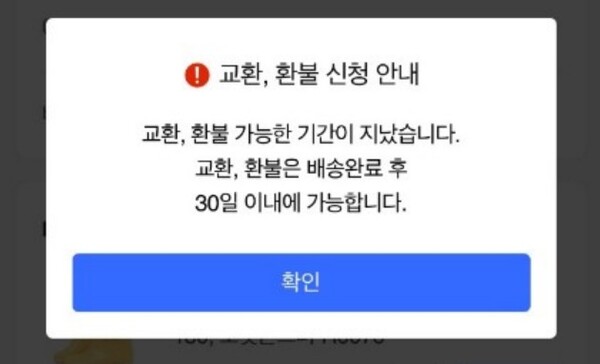
The government issued a "collection and exchange order" after lead levels exceeding safety standards by more than 11 times were detected in children's products sold on Coupang, but it has been confirmed that even exchange or refund requests for the products cannot be made on Coupang itself.
According to Coupang and the Fair Trade Commission on the 21st, the National Institute of Technology and Standards included a total of 53 products, including children's rain boots, in recall targets on the 23rd of last month and issued collection and other directive measures.
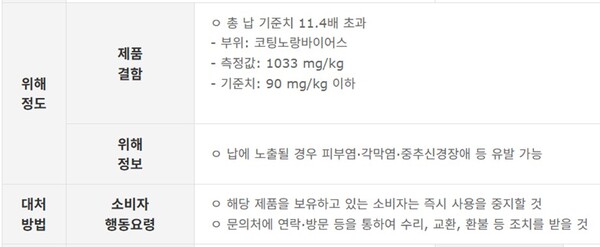
Among these, the total lead detected in children's rain boots was 1,033 mg/kg, which is 11.4 times higher than the standard of 90 mg/kg or less. The Product Safety Information Center advised that exposure to lead could cause skin inflammation, keratitis, and central nervous system disorders.
The Product Safety Information Center instructed consumers with the recalled product to immediately cease use and contact or visit the company to receive repair, exchange, or refund measures.
Coupang also sent an email to purchasers of the product notifying them of the recall. The email specified not only the product name and seller name, but also the purchaser's order number and order date, and included information about potential health hazards from lead exposure.
The problem arose in the subsequent collection and refund process.
When a purchaser attempted to return the product from their Coupang order history, the request itself was impossible due to more than 30 days having passed since purchase. Coupang instructed purchasers to contact the seller directly to receive guidance on product collection and refund.
In the email, Coupang stated, "If you confirm that the product currently in your possession is subject to collection, please immediately cease consumption or use, and regardless of whether it has been used, please contact the seller to receive detailed guidance on product collection and refund."
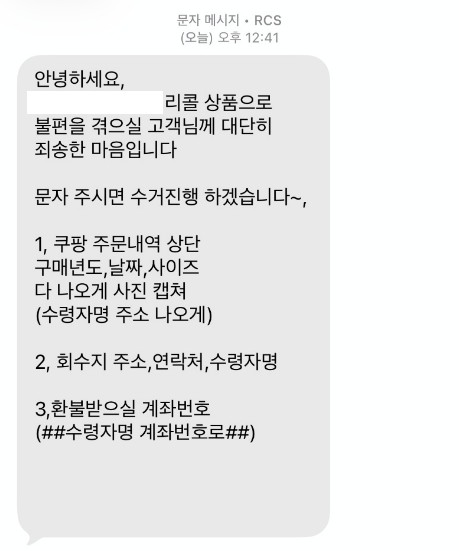
When the purchaser contacted the seller, the company requested screenshots of the Coupang order history. In addition to the address and contact information for product collection and the recipient's name, the seller separately requested the bank and account number for the refund.
This was because the seller would refund the money by directly transferring it to the purchaser's account instead of canceling the existing payment made through Coupang.
In this process, the purchaser did not receive separate notice regarding the purpose of collection and use of personal information such as account numbers or the retention period.
Article 15 of the Personal Information Protection Act establishes requirements for collecting and using personal information, and when consent is obtained, it requires that the collection purpose, items, and retention and usage periods be notified to the information subject.
The purchaser searched for and paid for the product through Coupang, and subsequently received a recall notice from Coupang identifying their order number. However, at the stage of returning the product and receiving a refund, they had to follow separate procedures outside the Coupang system.
The purchaser stated, "I have no choice but to provide information to receive the refund, so I will provide my account number, but I am anxious because I cannot know how that information will be managed afterward," and added, "I purchased the product through Coupang and paid for it, and even with a recall order from the government, it is difficult to understand why I must follow a separate refund procedure with the seller outside of Coupang."
Current law separately regulates government recall measures for hazardous products and the offer cancellation and refund procedures that consumers can exercise in online transactions.
A "collection order" from the National Institute of Technology and Standards was issued for the product in question. The Product Safety Information Center instructed consumers with the product to immediately cease use and contact or visit the company to receive repair, exchange, or refund measures.
Consumer rights in online transactions are separately regulated by the E-commerce Law. Article 17, Paragraph 3 of the E-commerce Law allows consumers to cancel offers within 3 months from the date of supply of goods if the content differs from advertising or marketing or if performance differs from the contract terms, and within 30 days from when they knew or could have known of such fact.
This product had not reached 3 months from when the purchaser received it, and less than 30 days had passed since receiving the recall notice from Coupang and learning of the safety standard non-compliance.
However, on Coupang, exchange and refund requests themselves were impossible due to more than 30 days having passed since purchase. Unlike the E-commerce Law, which sets standards of 3 months from the product supply date and 30 days from when the problem is known, Coupang's exchange and return request pathway was closed.
The refund procedure following offer cancellation is also regulated by law.
Article 18, Paragraph 2 of the E-commerce Law regulates the refund obligation following offer cancellation, and the scope of "distance seller" includes "a person who received payment for goods from a consumer or a person who concluded a distance sales contract with a consumer."
Paragraph 3 of the same article stipulates that when a consumer makes payment using a payment method specified by law, such as a credit card, the distance seller must request that the payment provider stop or cancel the payment request. Paragraph 11 states that when the distance seller and the person who received the payment or the person who concluded the contract with the consumer are not the same person, they bear joint liability for performance of obligations under Article 18.
However, the refund of the recalled product was not done by canceling the existing payment made through Coupang. Coupang instructed the purchaser to contact the seller directly, and the seller obtained the purchaser's account number separately and transferred the refund directly.
As a result, separate from the seller's collection and exchange measures following the government's recall order, even though the E-commerce Law provides offer cancellation and refund procedures for online transactions, Coupang identified the recalled product purchaser and their order number and notified them directly, while simultaneously blocking exchange and return pathways through the Coupang system and refund pathways through the original payment method.
Coupang stated that beyond its existing explanation that the seller handles collection and refund in connection with recalls, it has "no separate official response" regarding the application of relevant laws and Coupang's responsibility.