


[Suwon Ilbo=Reporter Seo Dong-young] Suwon City announced on the 19th that it has published the 2020 Suwon Sustainability Report after evaluating the sustainability of overall city administration and conducting citizen monitoring and performance reviews of Sustainable Development Goals indicators and implementation tasks.
Sustainable development refers to an agenda agreed upon as a common goal for all nations to achieve by 2030 at the UN General Assembly in September 2015. It means development in which economic growth, social stability and integration, and environmental conservation are balanced within the limits that humans and nature can sustain.
The city jointly declared the 'Suwon 2030 Sustainable Development Goals' with citizens in November 2017 and enacted foundational ordinances.
The following November, the city agreed on 152 projects across 10 major goals with the Suwon Sustainable Development Committee and Suwon Sustainable Development Council, and officially announced 100 implementation tasks in February 2019.
The city explained that the distinctive feature of this report is that citizens actively conducted mid-term reviews to continuously achieve these indicators jointly declared by the public and private sectors, with results visualized through charts and graphs for easy comprehension at a glance.
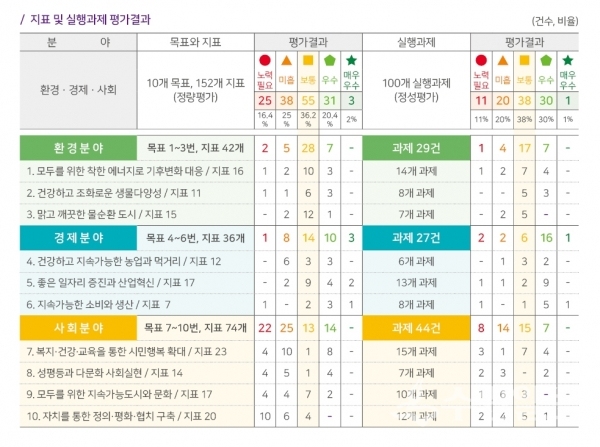
In the quantitative evaluation of 152 indicators, results were classified as: 25 requiring effort, 38 needing improvement, 55 fair, 31 good, and 3 excellent.
Indicators rated as excellent include ▲employment rate for creating quality jobs ▲budget support for technology development to build industrial innovation infrastructure ▲public agency green product purchase rate to expand purchase of green products.
In contrast, ▲energy social return contributions from shared solar power plants ▲number of classes adopting biodiversity education in Suwon City ▲frequency of sustainable cultural tourism governance operations are assessed as requiring considerable further effort.
In particular, in the social sector, indicators for Suwon's happiness index, qualitative strengthening of gender equality education, cultural enjoyment and civic culture activation, and strengthening district-level autonomous capacity were evaluated as requiring more effort.
The city plans to utilize this as basic data for city administration and raise broader understanding and interest in sustainable development.
The report is available for viewing and download by anyone on the City's homepage e-book resource promotion center (http://www.suwon.go.kr).
A city official stated, "Through this report, we will establish conditions and environment for a sustainable society with vibrant community consciousness. We will also promote the concept and awareness of sustainable development and widely utilize it in policy establishment and decision-making."