


Suwon Leading 'Carbon Neutrality,' Targeting 'Zero' Fossil Fuels by 2050
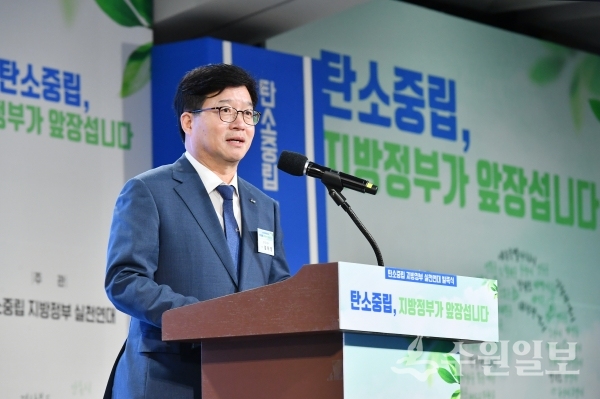
[Suwon Ilbo=Reporter Seo Dong-young] Suwon City is taking the lead in aggressive greenhouse gas reduction efforts, with local government actively participating and implementing initiatives, solidifying its position as an "environmental capital."
This stems from expert analysis indicating that limiting global temperature rise to 1.5 degrees above pre-industrial levels is the "Maginot Line," with "carbon neutrality" presented as the solution. The city is demonstrating firm resolve to respond to climate change and take the lead in greenhouse gas reduction.
◆Systematically Managing Greenhouse Gas Reduction
Suwon City's climate change response began in February 2011 with the establishment of the First Comprehensive Climate Change Response Plan.
In September of the same year, the city set targets to reduce emissions by 20% by 2020 and 40% by 2030, using 2005 as the baseline year. Subsequently, the city has continuously established phased detailed implementation plans, fulfilling its role as a leading city in preparing for climate change.
Throughout this process, citizen forums and empathy talk shows have engaged experts and citizens in sharing greenhouse gas reduction targets and participating in policy processes, moving closer to "creating an environmental capital Suwon with citizens."
Policies implemented for greenhouse gas reduction are showing tangible results. Renewable energy increased 324% compared to 2011, while eco-friendly building certifications rose 438%. Park area increased 157% compared to 2009. In Suwon, 92.1% of public buildings have been converted to LED, and 68% of apartment building underground parking lots have been replaced with LED lighting.
As a result, per capita greenhouse gas emissions in the city decreased from 5.53 tons in 2005 to 4.66 tons in 2018, achieving a 15.6% reduction.
The key to greenhouse gas management policy is the accuracy of the "greenhouse gas inventory," the tool enabling precise measurement of greenhouse gas generation and reduction volumes. From the beginning, the city independently calculated its greenhouse gas emissions, showing similar trends to results from the Korea Environment Institute. Moreover, it was recognized as an excellent case of local government international standard protocol inventory construction.
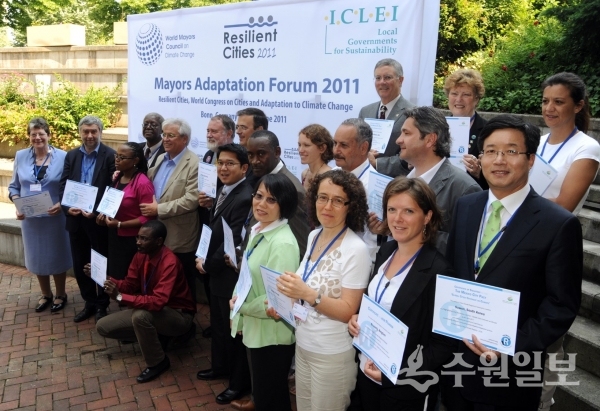
Consequently, in 2018, the city received final certification from the Global Covenant of Mayors for Climate & Energy (GCoM), verifying greenhouse gas inventory construction, reduction targets, and completion of phased implementation plans. This was the second certification after Seoul and the first for a basic local government.
◆Leading Carbon-Neutral City as 'Strongest Local Government'
The city could not stop there. The ultimate destination is "carbon neutrality (Net Zero)."
Following the "Paris Climate Change Agreement," a climate response accord involving the entire world from 2021 onward, carbon neutrality represents the most powerful direction for greenhouse gas reduction amid the inevitable transition to a new climate regime.
In line with this, Suwon City led 226 basic local governments in proclaiming the "Declaration of Climate Crisis Emergency by Basic Local Governments of the Republic of Korea" on June 5, Environment Day, and established the "Carbon Neutrality Local Government Action Alliance" on July 7 with participation from 80 metropolitan and basic local governments nationwide, reaffirming the local government's commitment to action.
By setting quantitative targets by detailed sector based on data and establishing implementation strategies, the city is moving closer to achieving carbon neutrality, a task that is realistically difficult to accomplish.
In particular, Suwon City, with a concentrated population exceeding 1.2 million and distinctive characteristics, established an urban strategy based on accurate greenhouse gas and energy-related analytical data. This is the "Basic Strategy for Fostering Carbon-Neutral City 2050."
The basic strategy includes three strategies: phased model implementation for carbon neutrality, leading energy transition based on hydrogen fuel, and sustainable development through urban integrated policy. In concrete figures, the city aims to reduce greenhouse gas emissions by 80% compared to 2005 and offset the remaining 20%, achieving zero fossil fuels by 2050.
Carbon neutrality means minimizing greenhouse gas generation and offsetting unavoidably generated greenhouse gases through eco-friendly energy. In other words, for the city to achieve carbon neutrality by 2050, fossil fuel usage including coal and petroleum must be zero, all vehicles must be eco-friendly, and all buildings must be green buildings.
To achieve these goals, the city has identified tasks in seven areas: ▲energy transition ▲transportation ▲buildings ▲waste ▲green infrastructure ▲international cooperation and citizen awareness ▲systematic verification and research. Additionally, a roadmap has been prepared to reduce fossil fuel usage rates, greenhouse gas emissions, and energy consumption, while increasing power self-sufficiency, renewable energy generation rates, and green hydrogen uptake rates.
◆Leading Green New Deal with Electric and Hydrogen Vehicles
Among the city's greenhouse gas reduction strategies, the most notable area is eco-friendly vehicle infrastructure construction.
This aligns with the government's Green New Deal strategy, announced as part of the Korean New Deal in response to the post-COVID era, described as "designing Korea's new 100 years."
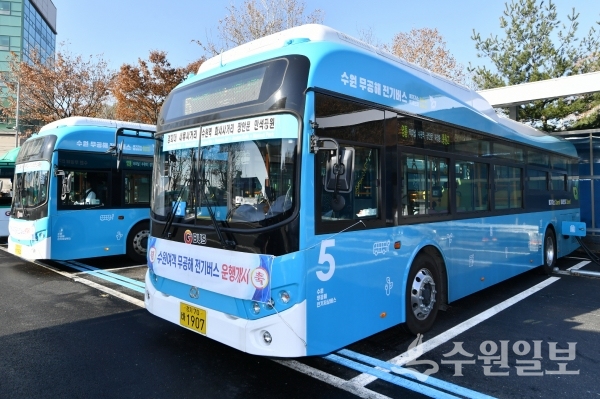
Suwon City introduced 100 electric buses at the end of last year, marking the dawn of the electric bus era. Furthermore, the plan is to convert virtually all city buses to electric buses by 2022, dramatically reducing fine dust and greenhouse gas emissions.
Hydrogen, recognized as the ultimate energy to replace carbon, is being actively utilized as an energy source, with concrete plans for building a hydrogen economy ecosystem underway.
The goal is to supply 150 hydrogen vehicles this year, described as "becoming cleaner the more they drive," and expand to over 1,500 units by 2022. Additionally, discussions with manufacturers are underway to enable pilot projects in the public transportation sector, including hydrogen buses and hydrogen taxis.
To facilitate smooth hydrogen vehicle usage, the city plans to establish a hydrogen charging station at the Eastern Public Parking Lot in Hadong, Yeongtong-gu, during the second half of the year to enhance convenience for Suwon citizens and build a hydrogen charging infrastructure network in the western, southern, and northern regions to secure user accessibility.
Furthermore, active preparations are underway to establish a "Suwon-type hydrogen economy ecosystem."
Expert advisory groups are being secured, and the Suwon Research Institute is conducting a feasibility study to establish a Suwon-type hydrogen ecosystem model. Various sectors utilizing hydrogen as an energy source are included: ▲decentralized hydrogen production base construction ▲eco-friendly public transportation pilot city projects for hydrogen taxis and buses ▲small-scale pilot supply project for hydrogen construction equipment in industrial complexes ▲small-scale pilot supply project for residential fuel cells.
Suwon Mayor Yeom Tae-young stated, "Carbon neutrality is the most effective climate action to overcome climate crisis," and emphasized "local governments must take the initiative in responding, innovate urban structure and lifestyles, and begin carbon neutrality efforts."