


Suwon Sustainable City Foundation Launches Housing Upgrade Support Program for Non-Housing Residents
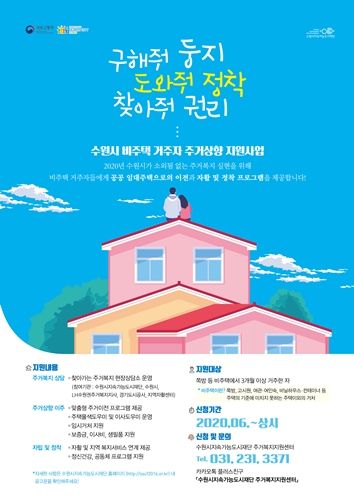
[Suwon Ilbo=Reporter Seo Dong-young] The Suwon Sustainable City Foundation announced on the 6th that it will launch the "2020 Suwon Non-Housing Residents Housing Upgrade Support Program" to help residents living in "non-housing" accommodations such as gosiwons and banjibangs relocate to public rental housing.
The Suwon Non-Housing Residents Housing Upgrade Support Program is an initiative being pursued after Suwon was selected as a local government for the Ministry of Land, Infrastructure and Transport's "Non-Housing Residents Housing Upgrade Support Recruitment Project." The program provides comprehensive support to help non-housing residents relocate to public rental housing while also assisting with their self-reliance and settlement in the community.
"Non-housing" refers to accommodations that fall short of housing standards, including gosiwons, banjibangs, inns and boarding houses, vinyl houses, and containers.
Eligible applicants are non-homeowners who have lived in non-housing accommodations for three months or more and meet the following criteria: ▲income of 50% or less of the previous year's average monthly income of urban workers ▲total assets of 200 million won or less ▲vehicle price of 24.68 million won or less. A total of 100 people will be selected.
The Foundation plans to provide close-knit customized services to help non-housing residents achieve "housing upgrade."
It will operate "outreach counseling centers" to identify eligible residents in welfare blind spots, provide one-on-one counseling with professional staff, and offer information about public rental housing eligibility.
The Foundation will provide detailed guidance on how to apply for public rental housing to prevent non-housing residents interested in relocating from giving up, and will operate "housing search assistants" and "move-in assistants."
Additionally, it will support deposits, household furnishings, and moving expenses to alleviate the financial burden on those wishing to relocate. It will operate temporary housing to prevent gaps in residence before move-in and will connect those who have moved into homes with self-sufficiency and welfare services to ensure successful settlement. Mental health and community programs will also be provided.
The Suwon Sustainable City Foundation plans to strengthen networks among housing welfare organizations to provide appropriate welfare services to individuals, from identifying target applicants through connecting them with self-sufficiency and care services.
Heo Hyun-tae, head of the Housing Welfare Support Center at the Suwon Sustainable City Foundation, said, "The right to housing is the most basic right for living with human dignity," and expressed hopes that "this project will greatly help non-housing residents settle into the community."
Applications can be submitted at the administrative welfare center of the applicant's district by December. For more information, visit the Suwon Sustainable City Foundation website (http://sscf2016.or.kr).
For inquiries, contact the Suwon Sustainable City Foundation Housing Welfare Support Center (031-231-3371) or the Kakao Talk Plus Friend (Suwon Sustainable City Foundation Housing Welfare Support Center)