


Kim Chung-young's Suwon Microscope (49) Sim Jae-deok, Director of Suwon Cultural Center, Tells the Story of Hwaseong Haenggung Restoration
Sim Jae-deok, Director of Suwon Cultural Center, felt a stronger sense of the need to restore Hwaseong Haenggung when he organized the "First Suwon Fortress Pilgrimage" event on May 5, 1988. During the Suwon Fortress Restoration Project from 1975 to 1979, he regretted that Hwaseong Haenggung and a 400-meter section on both sides of Paldalmun Gate had not been restored. In 1989, plans to build a new Suwon Medical Center (Gyeonggi-do Provincial Hospital) were announced.
Director Sim believed that if the Suwon Medical Center were rebuilt as a modern structure on the site of Haenggung, Hwaseong Haenggung would never be restored. Thus, in April 1989, he requested that Yi Seung-eon, a local historian of Suwon, investigate materials about Suwon. About a month later, at the end of May 1989, Yi came to see Director Sim Jae-deok.
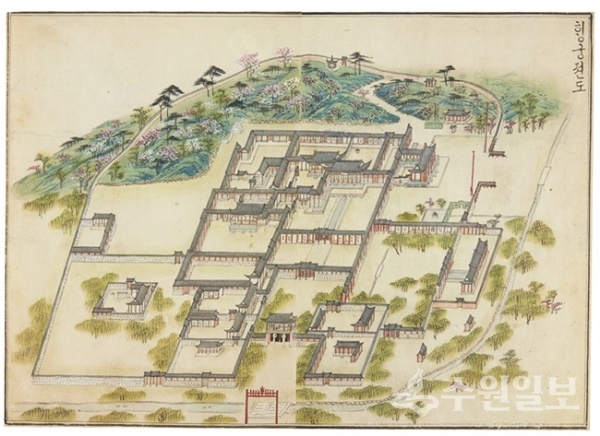
Sim Jae-deok had an instinct that this was the moment he had been waiting for. Together with Yi Seung-eon, he began looking at a photograph labeled in Korean "Hwaseong Haenggung-do (華城行宮圖)." He had seen drawings of Hwaseong Haenggung in the "Hwaseong Seongnyeok Uigwe," but this was the first time he could confirm the clear existence of Hwaseong Haenggung in such detail. In those days before the internet, people had to work hard and search through materials by hand.
Sim Jae-deok said to Yi Seung-eon and the Cultural Center family: "This is the lineage of filial piety in Suwon. Restoring Haenggung is the way to preserve the tradition of honoring our ancestors."
After concluding the Japan-Korea Annexation Treaty in 1910, the Japanese Empire enforced the "Order to Demolish Korean Eup-seong (Fortress Towns)." As a result, approximately 300 fortress towns across the country were demolished. Furthermore, Seoul's five grand palaces were damaged. Hwaseong Haenggung was similarly demolished intentionally in the same context.
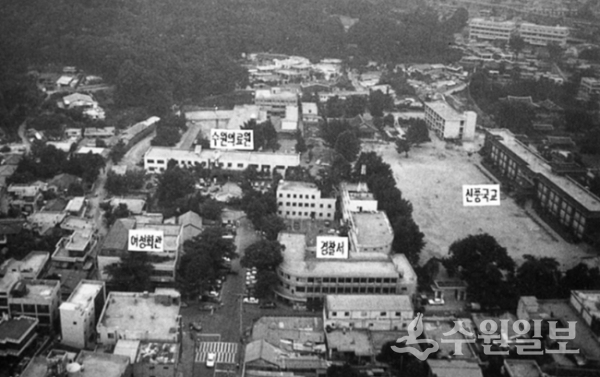
Sim Jae-deok made a firm resolve to officially restore Hwaseong Haenggung. At that time, few people agreed with Sim's thinking. It was rare to find anyone who thought it would be possible to relocate the Gyeonggi-do Suwon Medical Center, Suwon Police Station, Women's Hall, and Shinpung Elementary School that occupied the site of Haenggung and restore Hwaseong Haenggung.
However, Sim Jae-deok's determination was strong. He began persuading those around him. Due to his persistent persuasion, leading figures in Suwon joined the effort one by one. Sim Jae-deok recruited the founding members of the "Hwaseong Haenggung Restoration Promotion Committee." On June 17, 1989, he held the "Founding Meeting of the Hwaseong Haenggung Restoration Promotion Committee" in the conference room on the second floor of Suwon Cultural Center.
The executives elected that day were Committee Chairman Kim Dong-hui, Vice Chairmen Hong Ui-seon, An Ik-seung, and Sim Jae-deok, Director of Promotion Headquarters Lee Hong-gu, Planning Director Lim Byeong-ho, General Affairs Director Song Chul-ho, Historical Materials Compilation Director Yi Seung-eon, Public Relations Director Kim Sang-yong, among others. Additionally, 81 committee members representing various sectors were selected, including Directors Lee Jong-hak, Kim Dong-uk, Kim Hak-du, Lee Je-jae, Song Tae-ok, Lee Sang-bong, Lee Wan-seon, Lee Ho-jeong, Jo Ung-ho, and Choi Hong-gyu (10 people), and Auditors Lee Keun-hwan and Jung Kyu-ho (2 people).
Sim Jae-deok himself did not serve as chairman. The position of chairman was given to Kim Dong-hui, a senior cultural figure in Suwon. This was a very wise choice in promoting the project. Although the Hwaseong Haenggung Restoration Promotion Committee had been established, many citizens viewed it with skepticism, wondering if it would truly be possible. This was because the architectural design for the expansion of the Suwon Medical Center, which was located on the site of Hwaseong Haenggung, had already been completed.
In early June 1989, without prior appointment, Sim Jae-deok visited the Gyeonggi Province Governor's Office together with Kim Dong-hui, Yi Seung-eon (a bibliographer), An Ik-seung (President of Gyeonggi Province UNESCO Association), and Yi Seung-eon (a local historian). The Governor's Secretariat, thinking that the Suwon community leaders had an appointment, guided them to the Governor's office.
Governor Im Sa-bin was reportedly taken aback, as he was resting after lunch. Director Sim Jae-deok and his delegation said to Governor Im Sa-bin: "If the Suwon Medical Center is expanded on the site of Hwaseong Haenggung, which was destroyed by the evil schemes of Japanese imperialism, Hwaseong Haenggung will never be restored. Therefore, please withdraw the plan to expand the Suwon Medical Center."
After listening to Sim Jae-deok's account, Governor Im Sa-bin called the director in charge of the Suwon Medical Center expansion and heard the circumstances. He then deferred that plan and instructed that the Suwon Medical Center be relocated next to the Salt Preparation Factory. This opened the door to the restoration of Hwaseong Haenggung. Although many people's efforts contributed to the restoration of Hwaseong Haenggung, without the wise decision of Governor Im Sa-bin, the restoration would not have been possible.
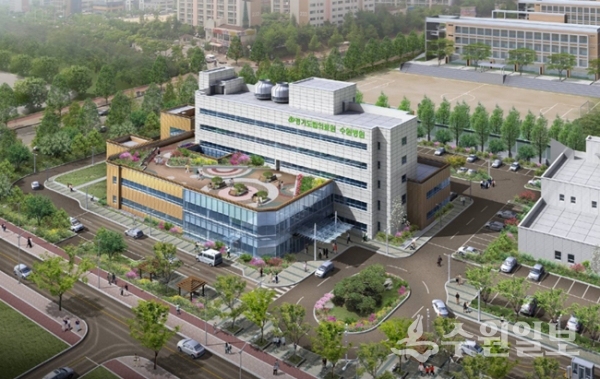
On December 7, 1989, an academic conference was held for the restoration of Hwaseong Haenggung. At this event, the recommendations of the Hwaseong Haenggung Restoration Promotion Committee were announced. These included: "designating the area around the site of Hwaseong Haenggung, including the location of the Suwon Medical Center, Suwon Police Station, and Gyeonggi-do Women's Hall, as a historical site; taking measures to gradually relocate public institutions currently located on the site of Haenggung to create a foundation for its restoration; establishing administrative measures to ensure that natural landscapes, including the Suwon Stream, which harmonize beautifully with Haenggung, are preserved in their original state."
As such recommendations from civic organizations continued, on December 22, 1990, the Suwon Medical Center that had been located at Hwaseong Haenggung was relocated. On August 10, 1993, the restoration of Hwaseong Haenggung was selected as a priority project of Suwon City administration, and a long-term plan for the restoration of Haenggung was established.
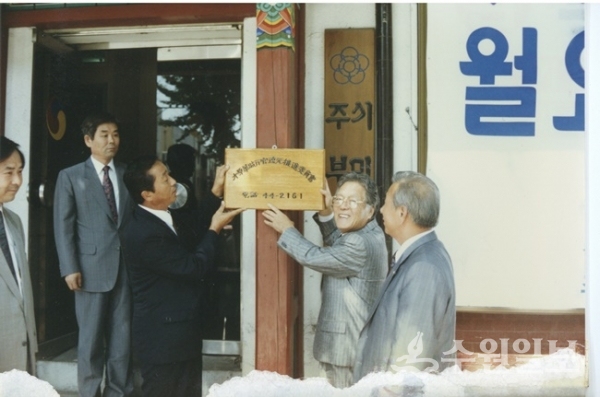
Sim Jae-deok's challenge, which most people had thought reckless, was producing results. This led to joint public-private promotion of the restoration of Haenggung. On December 22 of that year, a public briefing session for the restoration of Haenggung was held. Subsequently, after being reorganized through joint public-private efforts, the "Hwaseong Haenggung Restoration Promotion Committee" was officially launched.
Chairman was Sim Jae-deok, Vice Chairmen were Kim Dong-uk and An Ik-seung, and members included Yi Jong-hak, Cho Jeong-hwan, Kim Yong-gyu, Yu Jae-eon, Choi Bong-su, Song Hu-seok, Nam Woo-chul, Kim Ju-tae, Kim Dong-hui, Lee Sang-hae, Park Eon-gon, Yun Kyu-seop, Lee Je-jae, and Im Taek-myeong. At that time, Sim Jae-deok expressed his resolve in an interview with a media outlet as follows:
"There are plenty of other places to build hospitals or police stations, but given that public institutions were built on the site of Haenggung, it seems that the Japanese Empire deliberately damaged Haenggung as part of its policy of cultural destruction. It is a shame to our cultural nation that even 46 years after the end of Japanese imperial rule, we have not yet restored Haenggung. Restoring Haenggung must be accomplished as soon as possible."
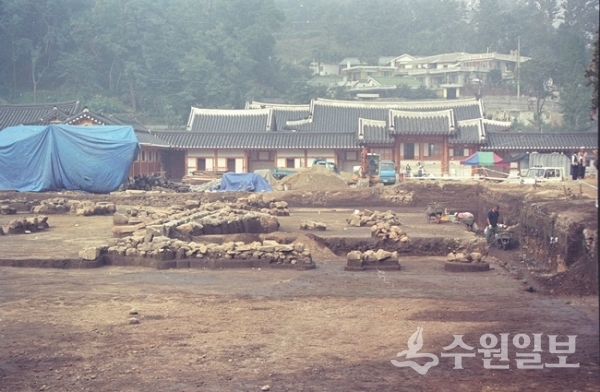
The restoration project of Hwaseong Haenggung progressed more concretely, and in March 1994, a survey of the ruins and surface features of the site of Hwaseong Haenggung was conducted with an investment of 248 million won in city budget. On May 13 of that year, the Suwon Medical Center building was completely demolished. Subsequently, on April 24, 1995, the site of Hwaseong Haenggung was designated as Gyeonggi-do Historical Monument No. 65.
As Sim Jae-deok was elected Mayor of Suwon, the restoration project of Hwaseong Haenggung became the top priority project of Suwon City. In August 1996, a second excavation survey was conducted. In the first excavation survey, the royal path (御道) and stone platform rows (長臺石列) were confirmed. In the second excavation survey, the royal path, Gyeongnyong Hall site, Yuyeo House site, Boknae Hall site, stone water channels, and various other ruins were excavated.
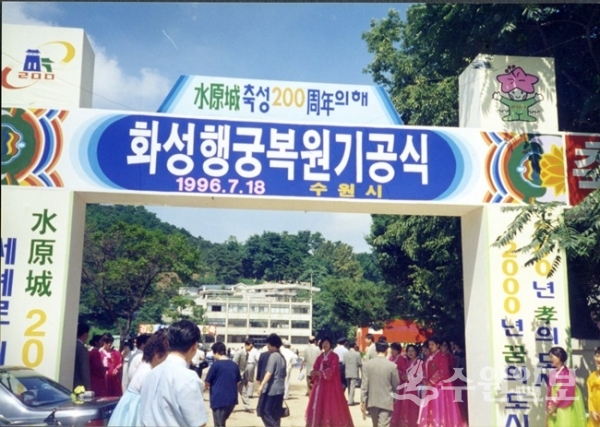
Through the first and second excavation surveys, the locations of the major buildings of Hwaseong Haenggung were confirmed. Based on this, the detailed design was completed on April 25, 1996. The time point for the restoration of Hwaseong Haenggung was set as 1796, as recorded in the "Hwaseong Seongnyeok Uigwe." On May 3, 1996, the design review was received from Gyeonggi Province. On July 18 of that year, the historic groundbreaking ceremony for the restoration of Hwaseong Haenggung was held.
On September 12, 1997, through the beam-raising ceremony of Bongsu Hall (奉壽堂), the main hall of Hwaseong Haenggung, another step was taken in the restoration of Hwaseong Haenggung. Sim Jae-deok was moved to tears upon witnessing the beam-raising ceremony of Bongsu Hall. At the ceremony, Sim Jae-deok declared the historical significance of the restoration of Hwaseong Haenggung.
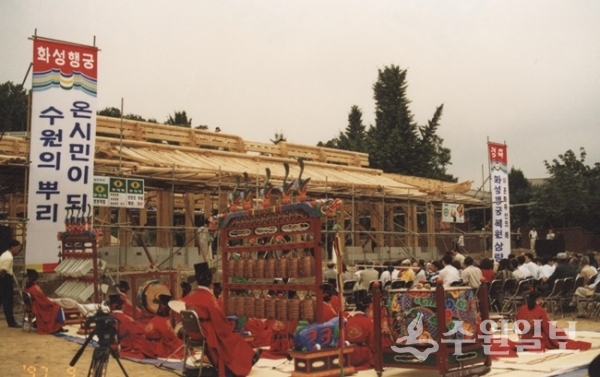
"Hwaseong Haenggung, as the foundation of Hwaseong, represents the restoration of national culture and history and the rectification of national spirit. Now we must cultivate it as a cultural heritage shared by people around the world." Another task awaited Sim Jae-deok, who had brought about these results.
Yi Jong-hak, a bibliographer of Suwon who had participated as a member of the Haenggung Restoration Promotion Committee from the beginning, visited Mayor Sim and argued that the name "Suwon Fortress" was incorrect and should be changed to its original name, "Hwaseong." Upon hearing this proposal, Mayor Sim accepted it on the spot, as it was also something he had wanted to accomplish.
Accordingly, in October 1996, he filed for a preliminary injunction with the court to block the Ministry of Information and Communication's stamp issuance commemorating "the 200th Anniversary of the Construction of Suwon Fortress." The intent was that since the name "Suwon Fortress" was incorrect, stamps should be issued under the original name "Hwaseong (華城)." It was argued that the Cultural Heritage Administration had designated it in 1963 as Suwon Fortress Remains, Historic Site No. 3, so no other name could be used. However, the court did not accept the preliminary injunction to halt stamp sales.
Nevertheless, Yi Jong-hak submitted a proposal to the Cultural Heritage Administration to restore Hwaseong's original name. Mayor Sim expressed active support to the Cultural Heritage Administration for restoring Hwaseong's original name. In response, the Cultural Heritage Administration, through deliberation by the Cultural Heritage Committee, made a final decision to change "Suwon Fortress" to "Hwaseong."
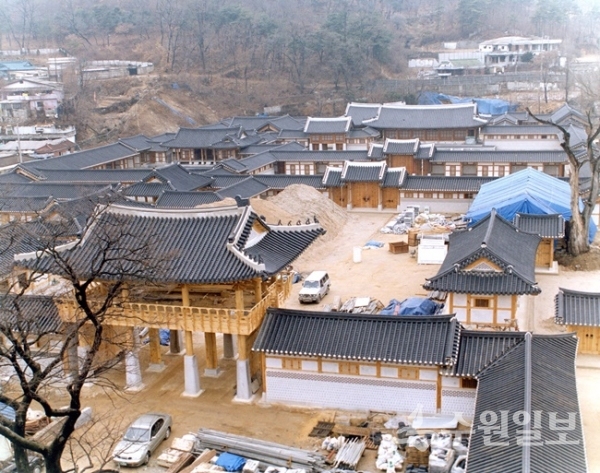
As Mayor Sim Jae-deok promoted the restoration of Hwaseong Haenggung, he initiated the next project: a movement to have Hwaseong registered as a World Cultural Heritage site.