


Choi Hyung-guk's Historical Essays (25) Guan Yu (關羽), Enshrined as a God in Joseon
- Guan Yunchang with the Yuedao Raised Aloft
Standing tall and bold with yuedao held high, his long white beard flowing—Guan Yunchang.
The stories of Liu Bei, Guan Yu, and Zhang Fei from the 'Records of the Three Kingdoms' (三國志) are so widely known that they are read as popular novels not only in China but throughout East Asia. In recent times, they have been adapted into films and television historical dramas, spreading their names across the world. Among them, Guan Yu (關羽), depicted as a master of martial arts and called the "Martial Saint" (武聖), is a fascinating figure with distinctive appearance and an extraordinary bearing.
Such admiration for Guan Yu was abundant during the Joseon period. From the time of the Imjin War, Guan Yu had become a central point of faith among Ming military commanders who came as reinforcements to Joseon. In Seoul, shrines dedicated to Guan Yu's worship were positioned in all four cardinal directions. Seoul's Line 1 subway station, Dongmyo Station (東廟), is in fact a shortened name for the Eastern Guan Yu Temple (東關王廟, Dong Gwanwang-myo). Today, temples venerating Guan Yu remain in several Southeast Asian countries and along Korea's west coast.
To examine this in more detail, the Guan Yu Temple (關王廟; also abbreviated as 'gwanmyo'), where Guan Yu was venerated in Joseon, first appeared during the Imjin War. However, for nearly a century, it was merely a place frequented by those seeking personal blessings through Guan Yu's spiritual efficacy. When King Seonjo first visited this place, it was simply following the royal precedent of a king visiting the Martial Temple (武廟). Subsequently, it was included in the state ritual calendar and only modest sacrificial rites were conducted.
This place took on new significance for the state during the reigns from King Sukjong (肅宗代) to King Jeongjo (正祖代). Specifically, by making Guan Yu an object of political veneration, it was used as a medium to elevate loyalty to the king. The beginning of this is clearly evident from Sukjong's reign. Sukjong impressed upon his ministers an image of Guan Yu as embodying loyalty and righteousness (忠義) and reverence for the Zhou dynasty (尊周).
In the 'Records of the Three Kingdoms', Liu Bei is depicted as a person who valued justice (正義) over worldly expedience. Guan Yu and Zhang Fei witnessed Liu Bei's willingness to risk his life in battle to restore the lost Han dynasty, and thus became sworn brothers with him in the oath of the Peach Garden. The three sworn brothers who made this covenant were perceived by people of the time as generals upholding the "Theory of Shu Han Legitimacy" ('촉한정통론'), which regarded Shu Han (蜀漢) as the most legitimate state. Their splendid deeds were widely disseminated in Joseon through the successful popular novel 'Romance of the Three Kingdoms' (三國演義) by Luo Guanzhong. Sukjong, too, felt something upon witnessing the figure of Guan Yu.
Sukjong built the Guan Yu Temple (關王廟) to perform sacrificial rites, and created shrines dedicated to past loyal ministers throughout the capital city so that the ideology of loyalty and integrity would spread among both civil and military officials as well as the people. Sukjong displayed such affection for Guan Yu that he had poems of his own composition hung in both the Southern and Eastern Guan Yu Temples. He even overrode his ministers' opposition to personally visit the Guan Yu Temple and preside over sacrificial rites, leading both civil and military officials.
Records from Sukjong's reign survive in the form of memoranda (備忘記). "Alas! The loyalty and righteousness of the Martial Security King (武安王, Guan Yu) is truly rare throughout the ages. My visit yesterday to view his portrait (遺像) truly came from a sentiment rarely shared in this world, and was also intended to encourage the military officers—it was never meant as mere sightseeing pleasure for a moment. Ah, you commanders and soldiers must follow this meaning and strive all the more to cultivate loyalty and righteousness to protect the royal house. This is what I wish."
Through the Guan Yu Temple sacrificial rites, Sukjong recommended that his ministers not devote themselves solely to factional interests, but return to loyalty to the royal house and the king. Whenever Sukjong traveled to the royal tombs of previous kings, he would first visit either the Eastern or Southern Guan Yu Temple depending on the tomb's location, conduct sacrificial rites, and pressure the civil and military officials participating in the royal procession to take oaths of loyalty.
Although Sukjong elevated Guan Yu to the status of the Martial Security King (武安王), venerated him as a king-level figure, some civil officials protested because Guan Yu was of military background. Sukjong's reign was a politically turbulent period marked by several rounds of "Succession Changes" (換局) between the Western and Southern factions; therefore, King Sukjong boldly embraced Guan Yu in Joseon as a figure commanding absolute trust.
Sukjong highlighted the existential meaning of Guan Yu's loyalty not as blind allegiance to the king but as devotion to universal justice transcending the state. Furthermore, he presented Guan Yu not merely as a general of superior military prowess but as a general willing to sacrifice his life for justice, one who enjoyed reading various Confucian classics including the 'Spring and Autumn Annals' (春秋). This could serve as sufficient pressure not only for military generals but also for literary officials who wielded the brush.
In this way, Sukjong expounded the legitimacy and righteousness of the "Martial" (武), represented by Guan Yu, in domestic political reality and demanded absolute loyalty from his ministers. Subsequently, Kings Yeongjo and Jeongjo established the Guan Yu Temple as Joseon's Martial Temple. They politically utilized it to such an extent that before the king set out on royal tomb processions or royal inspections, he would personally don armor and first pay respects at the Martial Temple, and would have his ministers do likewise. Imagine the figure of the king dressed in armor like Guan Yu standing in that place!
Furthermore, in 1896 (Gojong 33), when Emperor Gojong was preparing the Korean Empire while proclaiming itself an imperial state, he elevated the Guan Yu Temple rituals—which had not been previously codified—from minor sacrifices (小祀) to medium sacrifices (中祀) in the newly organized 'Korean Ritual Code' (大韓禮典), thereby seeking to officially publicize Guan Yu's loyalty and integrity.
- The Legend of Guan Yu Embedded in the Oguancan-jangse (Five Gates Beheading Generals Posture) of the Yuedao
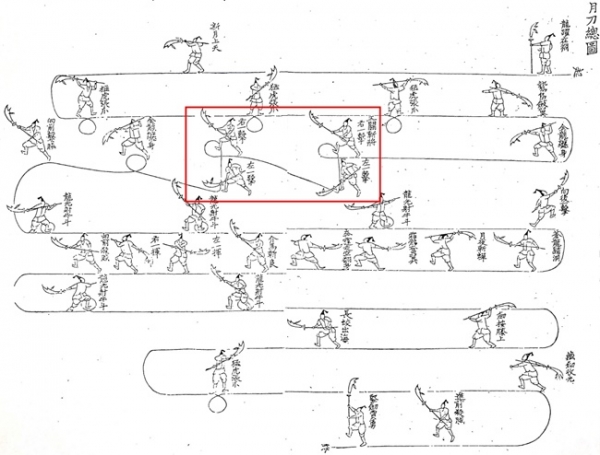
Among the martial techniques recorded in the 'Muye Dobo Tongji' (武藝圖譜通志), the yueDAO (月刀) includes a posture called Oguancan-jangse (五關斬將勢, Five Gates Beheading Generals Posture). This posture, swinging the yueDAO widely left and right to deliver a slash of the most explosive power, carries within it the story of Guan Yu. True to its name, it depicts the posture of Guan Yu beheading the commanders guarding five gates (五關).
The posture corresponds to swinging the yueDAO in a wide rotating motion, slashing horizontally from left to right across the neck, and immediately following with a diagonal sweeping motion downward to knee height (向右回擊-掃左一擊). The historical tale of "Beheading Six Generals at Five Gates" (五關斬六將) is transmitted as a scene displaying Guan Yu's martial prowess and loyal spirit. However, this does not appear in the official history 'Records of the Three Kingdoms' (三國志) but only in Luo Guanzhong's novel 'Romance of the Three Kingdoms' (三國演義). It is likely an embellished account created to highlight Guan Yu's martial skill.
Examining the circumstances in greater detail reveals the following. Under the persistent attacks of Cao Cao, Liu Bei lost many soldiers and took refuge with Yuan Shao in Hebei. Zhang Fei retreated into Mang Mountain. Guan Yu, persuaded by Cao Cao's general Zhang Liao, temporarily placed himself under Cao Cao's command.
At that time, Guan Yu imposed three conditions on Cao Cao: first, his submission was to the Han imperial house, not to Cao Cao personally; second, Cao Cao must care for Liu Bei's two senior sisters-in-law; and third, whenever he learned of Liu Bei's whereabouts, he could leave at any time. Later, upon confirming Liu Bei's location, Guan Yu resolved to depart from Cao Cao, taking the two senior sisters-in-law (Lady Gan and Lady Mi) with him to return to Liu Bei.
In the novel 'Romance of the Three Kingdoms', Guan Yu is depicted as quietly leaving a letter for Cao Cao before departing. As he thus departed from Cao Cao's army to rejoin Liu Bei, passing through five military gates positioned at harsh fortified outposts, he beheaded the commanding generals one after another in single strokes—this scene came to be called "Beheading Six Generals at Five Gates" (五關斬六將). During this passage, Guan Yu rode his horse in the direction of Luoyang to escape.
At the first gate, Dongling Pass, he beheaded General Kong Xiu (孔秀). At the second gate, Luoyang Pass, he killed Generals Han Fu (韓福) and Meng Tan (孟坦) with a single stroke. At the third gate, Sishu Pass, he killed General Bian Xi (卞喜) and all the assassins. At the fourth gate, Xingyang Pass, he beheaded General Wang Zhi (王植), the regional inspector there. Finally, at Huozhou Pass, the gate leading to the Yellow River, he beheaded Qin Qi (秦琪), a subordinate of Xiahou Dun, crossed the Yellow River, and returned to Liu Bei.
However, in the official history, Cao Cao merely expressed regret by saying "Each person has their own master; do not pursue him," and did not send a pursuit force. Had Guan Yu actually breached five strategically important military gates and beheaded their commanding generals, even Cao Cao would not have let such a formidable enemy general depart gracefully.
The various postures of the 24 martial techniques recorded in the 'Muye Dobo Tongji' contain numerous such stories and legends. If one misunderstands the context of these symbols and legends, one arrives at an entirely different conclusion. There is a saying: "Point with your finger at the moon for someone to look at, but they look only at your pointing finger, not the moon you indicate." No matter how correctly you point your finger at the moon, if someone looks only at the finger and says there is no moon there, it becomes quite bothersome. Rather than complain about the finger or its flaws, one must look at the moon. If one still cannot see the moon, there is nothing more to say or do.