


Suwon City's 2025 Living Wage Set at 11,290 Won per Hour, Up 6.8% from This Year
[Suwon Ilbo=Reporter Jeong Jun-seong] The 2025 living wage for Suwon City has been set at 11,290 won per hour (hourly wage), a 6.8% increase from this year. At 112.6% of the national minimum wage announced by the Ministry of Employment and Labor for next year (10,030 won), this translates to 2,359,610 won monthly (based on 209 working hours per month).
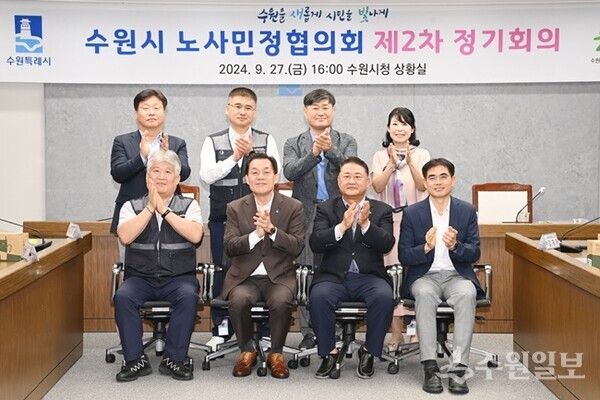
The Suwon City Labor-Management-Civic-Government Council held its second regular session on the 27th at the situation room of Suwon City Hall, chaired by Lee Jae-jun, Mayor of Suwon City and chairman of the council. The council passed a resolution on next year's living wage after considering overall economic conditions including the minimum wage increase rate, workers' average wage increase rate, Suwon City household spending, and fiscal conditions.
The "living wage" introduced by the city in 2014 goes one step beyond the minimum wage to define a wage level that allows people to maintain "a dignified human life." The living wage applies to approximately 2,800 workers, including those employed by Suwon City and its affiliated and invested institutions, workers at agencies and companies that have been entrusted with administrative tasks by Suwon City or provide construction and service contracts to the city, and workers directly employed by subcontractors.
The Suwon City Labor-Management-Civic-Government Council appointed Lee Seon-geun, chairman of the Suwon City School Operational Committee Council, as a new member and presented him with a letter of appointment.
Meanwhile, the Labor-Management-Civic-Government Council is a social dialogue body in which labor (workers), management (employers), citizens, and government (local government) cooperate to invigorate the regional economy and create a "job creation governance" (public-private cooperation system).
Mayor Lee Jae-jun said, "Although our city faces difficult fiscal conditions, we have decided on next year's living wage with an increase rate higher than the minimum wage increase rate to improve the quality of life for workers who bear significant economic burdens due to rising prices. Workers' happiness leads to thriving businesses and a thriving local economy."