'False Precedent' Fine Review at National Assembly … Park Sang-yong Complaint Contains Unrelated Case
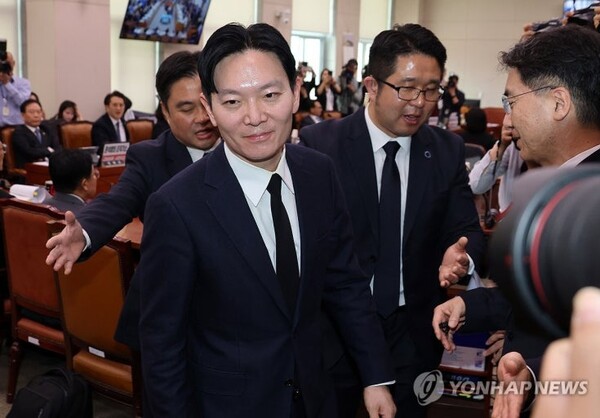
The National Assembly's Judiciary Committee is reviewing a bill imposing fines on defendants and lawyers who cite false precedents or laws in trials. Meanwhile, suspicions have emerged that the National Assembly may have used artificial intelligence (AI) when filing a complaint against Prosecutor Park Sang-yong, citing a precedent unrelated to the case.
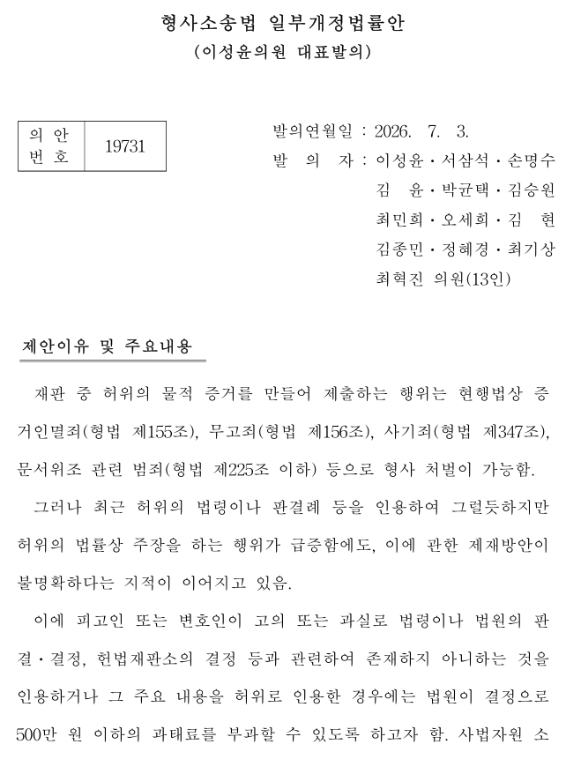
According to the National Assembly on the 27th, 13 legislators including Lee Sung-yun of the Democratic Party submitted an amendment to the Criminal Procedure Act on the 3rd of last month. The amendment is currently pending in the Judiciary Committee.
The amendment allows courts to impose a fine of up to 5 million won through a ruling if a defendant or lawyer knowingly or negligently cites a non-existent law or court judgment, decision, or Constitutional Court decision, or falsely cites its main contents.
Legislator Lee stated in the proposal's rationale that while creating false physical evidence to submit to court can be punished as evidence destruction, false accusation, fraud, and document forgery-related crimes, sanctions for citing false laws or precedents in legal arguments are unclear.
However, the amendment targets cases where defendants or lawyers falsely cite laws or precedents during trials. The complaint submitted by the National Assembly to police or prosecutors is a document to initiate an investigation, but it is not a document filed by a defendant or lawyer in court, so even if the amendment passes, it will not be directly applied.
The National Assembly's Special Investigation Committee cited the ruling '2009do10645' when filing a complaint against Prosecutor Park.
The complaint states that this precedent specifies that "the right to refuse testimony as defined in Articles 148 and others of the Criminal Procedure Act is exercised by a witness regarding individual questions after the oath has already been administered, and cannot be grounds for refusing the oath itself."
However, the ruling '2009do10645' is known to be a labor standards law violation case. Observers point out that the cited ruling text in quotation marks in the complaint cannot be found in that ruling.
The Criminal Procedure Act stipulates the right to refuse testimony in Articles 148 and 149, while Article 156 requires witnesses to be sworn before examination. Meanwhile, Article 3 of the National Assembly Testimony Act separately provides that when grounds for refusing testimony exist under the Criminal Procedure Act, a witness may "refuse to be sworn, testify, or submit documents."
In filing a complaint for violation of the National Assembly Testimony Act regarding testimony before the National Assembly, it appears that legal principles regarding testimony refusal of a general witness appearing in criminal trials were applied.
Kong Bong-sook, a prosecutor at the Seoul High Prosecutors' Office, stated on his SNS that "the ruling 2009do10645 is a labor standards law violation case" and said, "I thought perhaps just the case number was written incorrectly, so I searched for precedents with the same gist, but could not find any."
Prosecutor Kong stated, "When the National Assembly Testimony Act Article 3 recognizes both refusal to be sworn and refusal to testify, I did not understand what the statement meant: 'The right to refuse testimony is exercised by a witness regarding individual questions after the oath has been administered and cannot be grounds for refusing the oath itself.' When the National Assembly's complaint handler could not find a way to explain why Prosecutor Park's refusal to be sworn is a crime, they appear to have delegated the entire complaint drafting to AI, and AI responded with hallucination."
Prosecutor Park also stated on his SNS, "I don't know if it was run through AI, but since the National Assembly's complaint is a public document, this constitutes false public document creation," calling it "a failure beyond imagination."
Prosecutor Park appeared as a witness before the Special Investigation Committee on April 3 and 14 but refused to be sworn. The Special Investigation Committee filed a complaint against Prosecutor Park for violation of Article 12 of the National Assembly Testimony Act, stating that he refused to be sworn without just cause. It also applied the charge of contempt of the National Assembly under Article 13 of the same law for failing to comply with the order to leave and causing disturbance inside and outside the meeting room.
The Seoul Metropolitan Police Agency's Public Crime Investigation Division questioned Prosecutor Park as a suspect regarding the circumstances of his refusal to be sworn.
However, it has not been confirmed whether AI was actually used in drafting the complaint. Related materials such as AI input/output records or document creation history have not been disclosed.
An official familiar with internal National Assembly matters said they were "confirming" the reasons why the precedent was cited in the complaint and whether AI was used in the drafting process.