


Justice Minister Nominee Kim Seung-won Will the First Active Minister Born and Raised in Suwon Emerge?
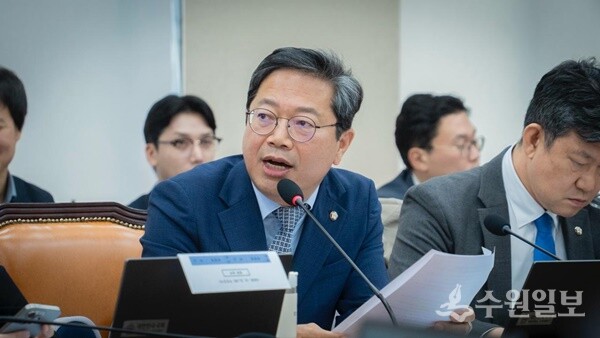
◇ First active official born and raised in Suwon to join cabinet
An active lawmaker who was born in Suwon and represents Suwon as his constituency is now on the verge of joining the cabinet for the first time. It is Rep. Kim Seung-won of the Democratic Party (Suwon Gap), who was nominated as a candidate for Justice Minister just six years after being elected to the National Assembly in 2020.
President Lee Jae-myung nominated Rep. Kim on the 30th as the successor candidate to former Justice Minister Chung Sung-ho. If appointed after a parliamentary confirmation hearing, it will mark the first instance of an active representative from his home constituency who was born and raised in Suwon becoming a government minister.
Suwon's political history is not without ministers.
Lee Byung-hee, one of the prominent politicians representing Suwon, was elected to the National Assembly seven times from Suwon and served as minister without portfolio in the Park Chung-hee administration. Former National Assembly Speaker Kim Jin-pyo served as deputy prime minister for the economy and minister of finance and economy in the Participatory Government, was elected to the National Assembly from Yeongdeung in Suwon in 2004, and the following year entered the cabinet as deputy prime minister for education and minister of education and human resources while serving as an active lawmaker.
Nominee Kim's political trajectory shows differences.
Born in Suwon and attending elementary, middle, and high school there, after becoming a lawyer he returned to serve as a judge at the Suwon District Court. When entering politics, he chose Jangan-gu, where he was born and raised, as his constituency. A local figure progresses through the legal profession and the National Assembly to become the head of a central government ministry.
◇ From Suwon District Court judge to Suwon Gap representative
Nominee Kim was born in Jangan-gu, Suwon in 1969 and graduated from Pajang Elementary School, Suwon North Middle School, and Suwon Sung High School. After graduating from Seoul National University's Department of Public Law, he passed the 38th Judicial Examination and completed the 28th Legal Research and Training Institute course.
After serving as a military legal officer, he began his judicial career at the Jeonju District Court in 2002 and later worked as a judge at the Suwon District Court. In 2009, after leaving the bench, he practiced as an attorney.
His formal connection to politics began during the Moon Jae-in administration. In 2018, he was recruited as an administrator in the Presidential Secretariat's Political Secretary's Office and worked at the Blue House, after which he moved to the National Assembly.
In 2020, he won the Democratic Party primary for the Suwon Gap candidacy and earned his first seat in the 21st general election. He began his political career as a lawmaker in Jangan-gu, Suwon, where he was born and spent his school years.
He won reelection in the 2024 22nd general election.
After entering the National Assembly, he developed his legal expertise into his political identity.
In the 21st National Assembly, he was active in the Democratic Party lawmakers' group "Cheoreumhoe" (Likewise Association), which championed reform legislation including prosecution reform. When President Lee Jae-myung served as Democratic Party chairman, he held the position of party legal affairs committee chairman and participated in the activities of the Special Committee on Prosecutorial Dictatorship, Political Repression, and Countermeasures, raising his profile in party legal and judicial affairs.
His political sphere of activity also expanded from Suwon Gap to all of Gyeonggi Province.
In the 2024 Democratic Party Gyeonggi Province Committee chairperson election, he won with 57.59% of votes. A two-term representative from Suwon rose to lead the party organization of Gyeonggi Province, the nation's largest metropolitan autonomous government. In his acceptance speech at the time, he made clear his commitment to leading prosecution reform.
◇ From 'prosecution reform legislator' to Justice Minister
The decisive venue that elevated nominee Kim to Justice Minister candidate was the 22nd National Assembly's Judiciary Committee.
As the Democratic Party chief negotiator on the Judiciary Committee and chairman of the Bills Examination Subcommittee 1, he led the legislative work for prosecution reform and criminal justice system restructuring pursued by the ruling party.
Particularly after the broad framework for abolishing the prosecutor's office and transitioning to the appellate prosecution system was established, his role became prominent in the subsequent legislative process to reflect this in actual criminal procedures.
A prime example is the abolition of prosecutors' supplementary investigation rights.
Nominee Kim took the lead in processing amendments to the Criminal Procedure Act aimed at abolishing prosecutors' direct and supplementary investigation rights. Instead of prosecutors directly conducting supplementary investigations on police cases, they would request supplementary investigations from police—this was the task of embodying a new criminal justice system that separates investigation and prosecution in law.
On July 30, when the bill was brought to the National Assembly floor, nominee Kim, as the Democratic Party chief negotiator on the Judiciary Committee, took the stage personally to provide the proposal explanation.
A legislator who advocated for prosecution reform as a first-term representative later became a Judiciary Committee chief negotiator who actually created the system, and now has moved to the position of Justice Minister candidate tasked with implementing the systems he dealt with in the National Assembly.
The Presidential Office cited this experience as the background for the appointment. Presidential Chief of Staff Kang Hoon-sik stated that given nominee Kim's deep understanding of the purpose of the criminal justice system reform, he expects rapid stabilization of the new criminal procedure law system.
Before nominee Kim lies an immediate test.
The prosecutor's office will be abolished and the appellate prosecution will launch on October 2. While former Minister Chung established the broad framework of the criminal justice system reform—abolishing the prosecutor's office and launching the appellate prosecution—the successor minister must carry out the task of stabilizing the new system in actual practice.
Beyond reorganizing the organization and personnel system, he must address concerns about investigation delays and vacancies following the abolition of supplementary investigation rights, as well as victim rights issues.
His role transforms from 'prosecution reform legislator' to 'prosecution reform executor.'
◇ After Lee Byung-hee and Kim Jin-pyo...Suwon politics returns to national stage
Local political circles are focused on nominee Kim's designation not only for individual political growth.
Suwon is the nation's largest basic local government with a population exceeding 1.2 million and hosts the Gyeonggi Provincial Government. The National Assembly constituency areas number five. Yet evaluations have consistently noted that compared to the city's scale, Suwon's political representation has had relatively limited presence in the central government and national politics.
There have been times in the past when Suwon politics demonstrated presence on the national stage.
Former Rep. Lee Byung-hee successfully achieved seven terms from Suwon in the 1960s-90s, wielding influence in national politics and serving as minister without portfolio. Former Speaker Kim Jin-pyo advanced through positions as deputy prime minister for economy and education in the Participatory Government, won five consecutive terms from Suwon, and eventually rose to become National Assembly Speaker, head of the legislative branch.
However, since former Speaker Kim took cabinet office as deputy prime minister for education in 2005 while an active legislator, no Suwon constituency representative has joined the cabinet for over 20 years.
When nominee Kim assumes office as minister, he will bridge that gap. In particular, expectations are high in local political circles given that a new precedent will be set of an active representative born and raised in Suwon becoming a government minister.
Those expectations are also connected to local issues.
Major Suwon agenda items such as the relocation of Suwon Military Airport, pursuit of a free economic zone, and expansion of metropolitan transit networks require consultation and support from the central government. While the Justice Minister does not directly handle individual local projects, the prospect that an active legislator with Suwon as his political base will participate in state affairs as a government minister could serve as another conduit connecting the region to the central government.
The larger significance lies in 'connection.'
A political growth path has been created where a figure who grew up locally becomes a home constituency representative, advances through positions as Gyeonggi Province party committee chairman and National Assembly Judiciary Committee chief negotiator to become a government minister.
This is why expectations emerge that nominee Kim's cabinet appointment could transcend the success of one politician and instead open a new pathway for politicians who grew up in Suwon to advance to the national political stage.
A regional political figure stated, "There has been steady discussion about the need for someone from Suwon to play a central role in national politics following former Rep. Lee Byung-hee and former Speaker Kim Jin-pyo," and continued, "Particularly meaningful is that an active representative born and raised in Suwon was nominated as Justice Minister. We hope this cabinet appointment serves not only as one politician's advancement but as an opportunity to open a new path for politicians from Suwon to extend to the national stage."