


Exclusive Gyeonggi Province's Debt Burden: 2.02 Million Won per Four-Member Family
Gyeonggi Province faces principal and interest payments exceeding 7 trillion won through 2038 to repay borrowings from local bonds and various funds. Converted on a simple per-capita basis using the current Gyeonggi population, this amounts to approximately 510,000 won per resident.
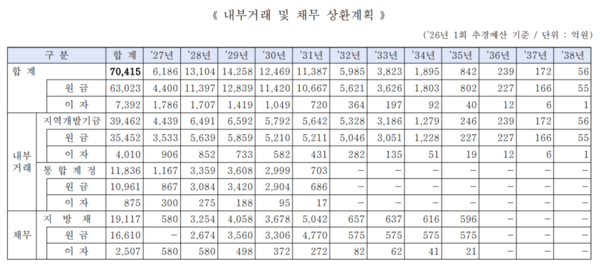
According to materials submitted to Gyeonggi Province by Kim Han-seul, a Gyeonggi Provincial Assemblyman (People Power Party·Proportional Representation), on the 15th, the province must pay a total of 7 trillion 41.5 billion won in principal and interest through 2038 to repay its regional development fund, integrated financial stabilization fund combined account, and local bonds.
The principal amount subject to repayment, as calculated by Gyeonggi Province, is 6 trillion 302.3 billion won. This comprises the regional development fund of 3 trillion 545.2 billion won, the combined account of 1 trillion 96.1 billion won, and local bonds of 1 trillion 661 billion won.
Interest payments to be made in the future are added to this amount. Based on the province's projected annual interest payments, interest charges are expected to amount to 139.1 billion won in 2026, consisting of 81.8 billion won from the regional development fund, 26.8 billion won from the combined account, and 30.5 billion won from local bonds.
In 2027, the interest burden increases to 178.6 billion won. This continues with 170.7 billion won in 2028, 141.9 billion won in 2029, 104.9 billion won in 2030, 72 billion won in 2031, and interest payments are scheduled through 2038.
However, according to Gyeonggi Province's separately prepared principal and interest repayment plan, the total of 7 trillion 41.5 billion won is calculated primarily based on repayment amounts from 2027 onward, which differs in timing from the expected interest payments in 2026. Therefore, the total principal and interest amount including 2026 may vary depending on the province's detailed calculation criteria.
Converting the 7 trillion 41.5 billion won presented in the principal and interest repayment plan using the current Gyeonggi Province population of approximately 13.9 million yields approximately 507,000 won, or about 510,000 won per resident. For a four-member family, this exceeds 2 million won. While this amount is not directly imposed on residents, it represents funds that Gyeonggi Province must repay from its budget, which could impact the fiscal capacity available for other policy initiatives.
The regional development fund constitutes the largest portion of the repayment amount.
Principal and interest for the regional development fund amount to 3 trillion 946.2 billion won, while the integrated financial stabilization fund combined account totals 1 trillion 183.6 billion won. Local bond principal and interest is calculated at 1 trillion 911.7 billion won.
Repayment amounts resulting from internal accounting and fund transactions between the regional development fund and combined account total 5 trillion 129.8 billion won, representing approximately 73 percent of total principal and interest.
However, for this reason, viewing all 7 trillion 41.5 billion won identically to "debt" under the Local Finance Act is inappropriate. The regional development fund and combined account represent internal accounting and fund transactions within the province, whereas local bonds are external debt, each differing in nature. These figures present the concept of principal and interest that the general account must bear in the future, combining all three categories.

Current outstanding borrowings are also substantial in scale.
As of the end of June 2026, the local bond balance stands at 1 trillion 439.3 billion won. The regional development fund borrowing balance is 3 trillion 545.2 billion won, and the general account loan balance in the integrated financial stabilization fund combined account is 1 trillion 131.2 billion won.
Notably, the regional development fund borrowing has grown from 290.8 billion won in 2019 to 1 trillion 39.7 billion won in 2020, 1 trillion 785.3 billion won in 2021, 2 trillion 629 billion won in 2024, 3 trillion 320.6 billion won in 2025, and to 3 trillion 545.2 billion won as of June this year. This represents more than a 12-fold increase compared to 2019.
Local bonds have also increased rapidly since last year. Gyeonggi Province, which had no local bond balance through the end of 2024, issued 943 billion won in 2025 and issued an additional 496.3 billion won through June of this year, bringing the balance to 1 trillion 439.3 billion won.
The combined account loan balance has similarly increased from 455 billion won in 2021 to 985.3 billion won in 2025, and to 1 trillion 131.2 billion won as of June this year.
Recently, regarding Gyeonggi Province's fiscal situation, there is a clear difference in perspective between former and current provincial administrations.
Former Gyeonggi Governor Kim Dong-yeon stated through his SNS on that day, "This is not currently a fiscal crisis," noting that Gyeonggi Province's debt-to-budget ratio in 2025 is 12.86 percent, which is lower than the government's caution threshold of 25 percent. While acknowledging the fact of increased debt, he argued that local bond issuance and fund operations are "investments in the lives of Gyeonggi residents and the province's future."
However, the actual repayment burden remains on the province's future finances. In particular, with both principal and interest accruing based on interest rates, future revenue conditions and securing repayment sources are expected to become key variables in Gyeonggi Province's fiscal management.