


Now is the Age of Culture Though Chuseok Scenes Change, the True Meaning of Hangawi Must Remain Unchanged
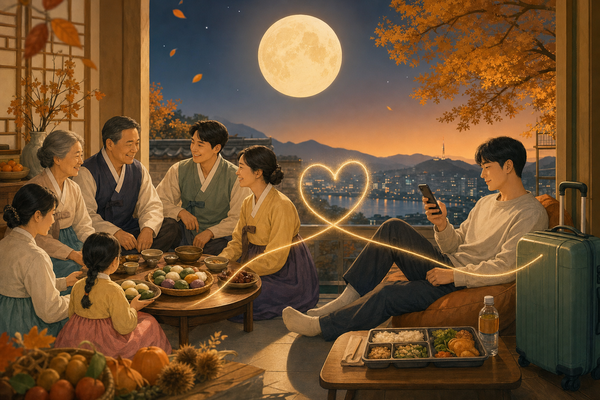
Korea's most important holiday, Chuseok, is approaching. Every year when the Hangawi holiday arrives, enormous traffic flows form on the roads, and department stores and traditional markets bustle with people purchasing holiday goods.
Yet when we look closely at what lies beneath this familiar scene, we can see that both the destinations people travel to and the ways families prepare food have changed dramatically from the past. The excessive household labor and cumbersome procedures are fading, replaced by a "connection of hearts" where family and those around us share warm regards and good wishes.
Hangawi—meaning "the middle of autumn" in "gaui" (가위)—is Korea's most important holiday of the year. The harvest festival of agricultural society that has continued for 2,000 years is now facing a turning point.
A 2,000-Year Agricultural Festival Beginning with Weaving Competitions
Tracing the historical roots of Chuseok clarifies where the true essence of the holiday originally lay. Originating from "gaebae" (嘉俳), a weaving competition during the Silla period, Chuseok was both a ritual of welcoming and honoring ancestors (yeongsin and heonsik) to share the year's harvest, and a festival of community (daedong) where village residents cast off the hardships of labor through wrestling and ganggangsullae (a traditional circle dance). Through the Joseon period, Confucian ritual propriety became established, and ancestral rites and tomb-visiting procedures became more refined. This developed into the modern era as a solid framework of the holiday centered on "large family gatherings at the main house."
Dissolution of Mass Migration...From "Obligation" to "Practicality and Rest"
Until the early 2000s, Chuseok was synonymous with "mass migration" of the nation heading toward hometowns. However, having passed through industrialization and urbanization, with nuclear families and single-person households rapidly increasing today, the way the public celebrates the holidays is undergoing fundamental change.
The most notable aspect is the practicalization of family gathering methods and food preparation. The collective culture centered on extended families and clans has been reorganized into scattered holidays by single households and small families. Holiday table settings that once involved long hours of household labor are now greatly simplified or replaced by convenient foods, meal kits, and catering services. An increasing number of families completely omit ancestral rites altogether.
The purpose of using holiday time has also shifted from "fulfilling Confucian rituals" to "personal recharge." The "chu-cation" (Chuseok+vacation) crowd that travels to domestic and international destinations instead of returning to hometowns has emerged as a major consumer group during the holidays, and the "alone Chuseok" culture of staying home and resting with convenience store holiday meals has become completely established.
This change is the result of parents' proposals for simplification, who experienced the fatigue of holiday household labor, and the pragmatism of younger generations who view holidays as opportunities for rest and self-development.
Values to Preserve Despite Changing Form..."A Time of Connection Caring for Family and Those Around Us"
Some express concerns about the dismantling of traditional culture or weakening of family community consciousness regarding these changes. However, from a cultural anthropological perspective, this interpretation gains more persuasive power—seeing it as a natural evolution adapting to contemporary lifestyles rather than a break with tradition. This is because tradition is not a fixed artifact but a living organism that continuously transforms while reflecting the life of its era.
Yet there is an essential meaning that we must never lose, no matter how much the paradigm of holidays changes. The most noble value that Chuseok holds is not excessive rituals or overflowing holiday tables, but "the connection of hearts—caring for family and those around us, inquiring about their well-being, and wishing for their safety."
While formal procedures and burdensome household labor may fade, the time to pause amid our busy daily lives, express gratitude for the boundless love and dedication our parents have given us, and offer warm regards to those we are grateful for remains something we must never neglect—it is the warmth of our society. When people far apart check on each other's well-being, comfort the hardships of the passing year, and wish for one another's safety—that is where the true meaning of Hangawi, carried forward for 2,000 years, is found.
Though the abundance of the holiday table may have diminished, modern Hangawi is filled with warm regards and affectionate glances toward one another. Though its forms have become more diverse, as long as the spirit of the holiday's true purpose—embracing those around us and sharing warmth—remains alive, Chuseok will continue to be the most abundant sanctuary and guiding light sustaining our lives.