


Pi Healthcare's 'Retinal Complex Disease Separation Diagnosis AI' Accepted at IEEE Academic Conference
Pi Healthcare Co., Ltd. (CEO Lee Young-kyou), a medical artificial intelligence specialist company, announced on the 30th that its jointly developed research paper on artificial intelligence for diagnosing multiple retinal diseases with Georgia State University's Center for Translational Research in Neuroimaging and Data Science (Director-General: Vince Calhoun; Professor Research Team: Ye Dong-hae) has been finally accepted for presentation at 'IEEE MLSP 2026 (International Workshop on Machine Learning for Signal Processing)', a globally authoritative conference in the fields of signal processing and machine learning.
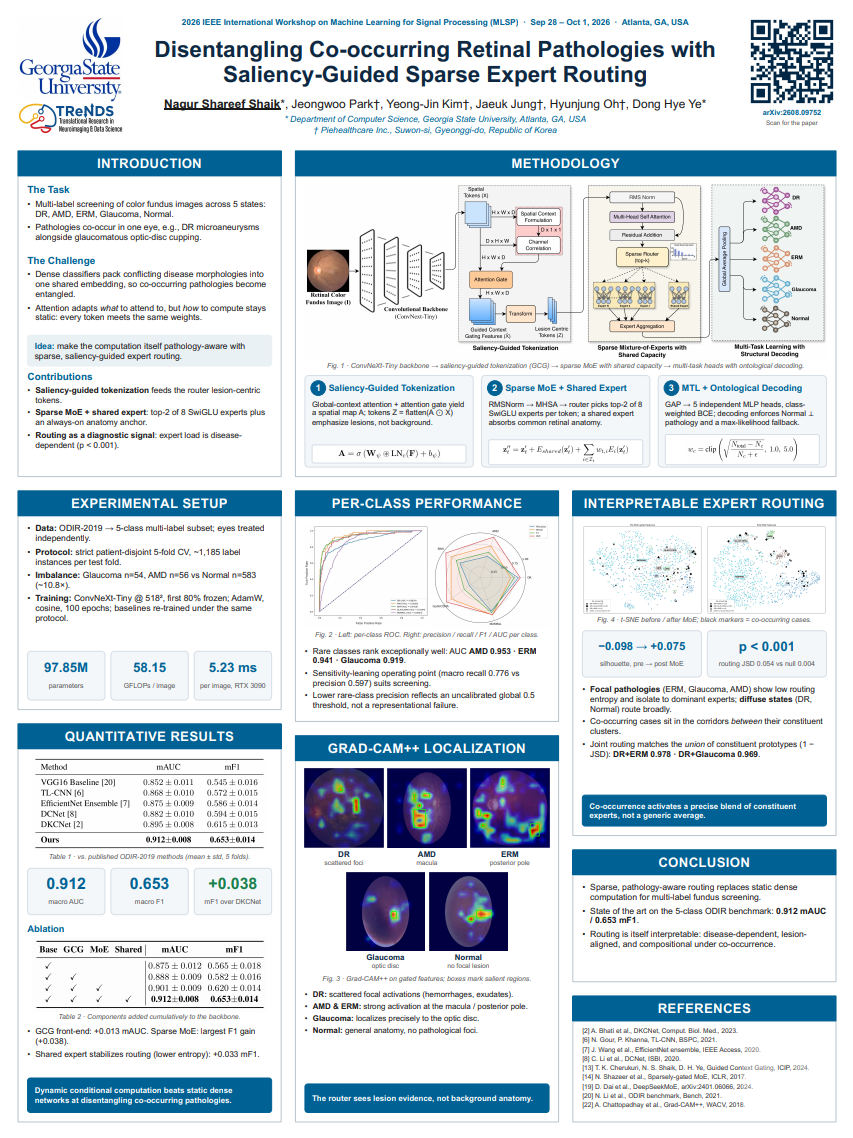
The accepted research is a paper on "Disentangling Co-occurring Retinal Pathologies with Saliency-Guided Sparse Expert Routing."
◇ Clinical Field Challenge 'Mutual Interference of Co-occurring Diseases'…Overcome with Next-Generation MoE Architecture
In actual clinical practice, cases of 'co-occurring diseases' where multiple conditions such as diabetic retinopathy, glaucoma, macular degeneration, and epiretinal membrane are simultaneously observed in fundus images of elderly or chronic disease patients are very frequent.
However, existing deep learning classification models had technical limitations in that they processed features of multiple lesions in a single neural network space, resulting in interference between lesions and signal crosstalk, which lowered accuracy.
The joint research team of Pi Healthcare and Georgia's Center for Translational Research addressed this by newly implementing the 'sparse mixture of experts (MoE)' architecture, a core technology of next-generation large-scale AI, optimized for ophthalmologic medical imaging.
The architecture separates the normal basic anatomical background of the fundus photograph to be handled by a 'shared expert' that is always active, and extracts only regions (tokens) with suspected actual lesions with precision, dynamically allocating them to the top 2 of 8 specialized neural networks with the highest discrimination power.
Through this approach, even if diabetic retinopathy and glaucoma appear together in one person's eye, specialists in each disease work independently yet organically to accurately separate and read the lesions without mutual interference.
◇ Achieves World-Leading Performance (SOTA) on Certified Benchmarks and Validates Commercialization Feasibility
The research team's model achieved an average AUC (Area Under the Curve) of 0.912 and a macro F1 score of 0.653 in evaluation on the 'ODIR-2019' dataset, the global standard benchmark for multi-disease diagnosis in ophthalmology, surpassing the existing top-performing model (DKCNet) and achieving world-leading performance (SOTA).
Notably, it demonstrated overwhelming detection capability even in rare lesions such as macular degeneration (AUC 0.953), epiretinal membrane (AUC 0.941), and glaucoma (AUC 0.919), which are characterized by severe data imbalance and high diagnostic difficulty.
It also demonstrated excellent competitiveness in terms of commercialization and profitability. Designed with a lightweight structure of approximately 97.85M parameters, the processing time per image is only 5.23 milliseconds (ms, approximately 0.005 seconds) based on a standard graphics card (RTX 3090). This level enables direct deployment on fundus cameras or low-cost on-device equipment in small and medium-sized hospitals and clinics without expensive large servers, making immediate commercialization possible.
In particular, Pi Healthcare plans to apply the high-precision multi-lesion separation technology proven in this research not only to its flagship ophthalmology AI platform 'Dr. I (X-EYE)', but also to the 'X-dementia-M' pipeline, a solution for early screening of cognitive impairment and dementia based on retinal vessel and microstructural biomarkers.
Through this approach, the company plans to secure a leading position in the non-invasive screening market, enabling rapid screening of early dementia risk groups with only simple fundus imaging prior to expensive MRI or PET examinations.
Lee Young-kyou, CEO of Pi Healthcare, stated, "Through international collaborative research with Georgia's Center for Translational Research, a world-renowned research institution, we have structurally and mathematically resolved the bottleneck problem in interpreting 'multiple complex retinal diseases' that medical professionals face in actual primary care settings. This research outcome will be a decisive technological foundation for global medical device regulatory approval and commercialization in the U.S., Asia, and other global markets for not only the Dr. I series, our flagship ophthalmology AI platform, but also 'X-dementia-M', an AI for early dementia screening based on ocular biomarkers, as part of our occulomics multi-modal solution."
Meanwhile, the joint research outcome will be formally presented to researchers and medical device professionals worldwide at the '2026 IEEE MLSP' academic conference to be held in Atlanta, Georgia, USA. Pi Healthcare plans to accelerate expansion of global partnerships and establishment of local clinical collaborations starting with this conference presentation.