


Pi Healthcare Knocks on U.S. FDA Door…Signs MOU with University of Utah
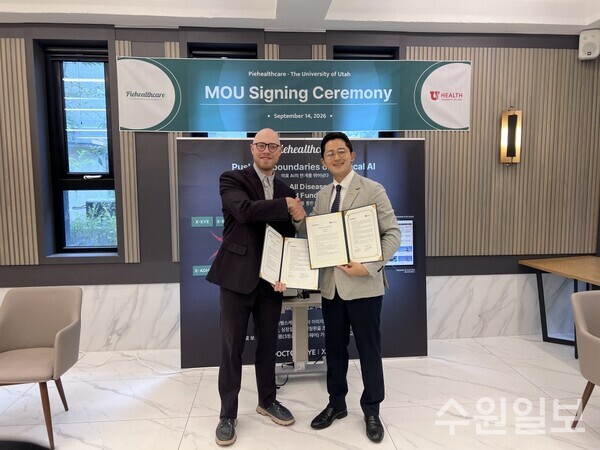
A medical artificial intelligence (AI) company based in Suwon, Gyeonggi Province, is challenging U.S. Food and Drug Administration (FDA) certification.
The company aims to break through the world's most stringent medical device regulatory gate and establish itself in the North American market.
According to Pi Healthcare on the 14th, the company has signed a memorandum of understanding (MOU) with the University of Utah's Center for Medical Innovation (CMI) for global regulatory approval and North American market entry. The University of Utah CMI is a specialized institution in commercializing innovative medical device technologies and providing advisory services for FDA regulatory approval.
Founded in 2014, Pi Healthcare is headquartered at Suseong-ro, Jangan-gu, Suwon. The company has approximately 30 employees. It has primarily developed 'DoctorAI,' a medical AI software that enables early detection of dementia through retinal photography.
In particular, since January, Pi Healthcare has been pursuing FDA De Novo (novel medical device) and 510(k) (premarket approval) procedures for the 'DoctorAI X-Series.'
Under the agreement, the company plans to focus on the approval process for 'X-ANGIO,' a vascular biomarker AI-based product, with the goal of receiving FDA approval between the end of 2027 and the first half of 2028. Additionally, 'X-ADHD,' which assists in diagnosing attention-deficit/hyperactivity disorder (ADHD), will also enter the approval process.
The 510(k) pathway demonstrates equivalence when similar products already exist, while De Novo applies to novel devices with no comparable products and involves more rigorous review. The company plans to pursue both pathways in parallel.
Pi Healthcare emphasizes as a strength its in-house team of regulatory engineering professionals who perform the entire process from planning through medical device approval, going beyond algorithm development.
Building on this infrastructure, Pi Healthcare is rapidly expanding a new business division to enhance competitiveness across South Korea's overall biotech and digital healthcare ecosystem. Beginning in 2027, the company plans to provide one-stop licensing, approval, and commercialization solutions to promising domestic startups that possess innovative technologies but are blocked by complex regulatory barriers.
Support services will cover medical device quality management systems (GMP·ISO 13485) and information security (ISO 27001) certification, Ministry of Food and Drug Safety level 2·3 approval, investigational device exemption (IDE) clinical trial protocol design in collaboration with tertiary hospitals such as Seoul National University Hospital, and sales network connections.
Medical device approval has been identified as a barrier to entry for small and medium-sized developers. Many cases exist where companies acquire technology but fail to reach commercialization due to substantial costs and time required for clinical trials, certification, and documentation. Pi Healthcare aims to reduce the costs and time typically spent with external clinical research organizations (CROs) by leveraging AI agent technology specialized in regulatory and medical documentation.
Lee Young-gyu, CEO of Pi Healthcare, stated: "For domestic medical technology to connect with actual clinical practice and global markets, execution capacity linking regulation and commercialization is as important as technology development. While pursuing U.S. market entry for our own medical AI products, we will become a partner that helps domestic startups achieve commercialization."