


Choo Miae: "We Must Invest in Gyeonggi Province, Which Has Sacrificed While Taking On National Policies"
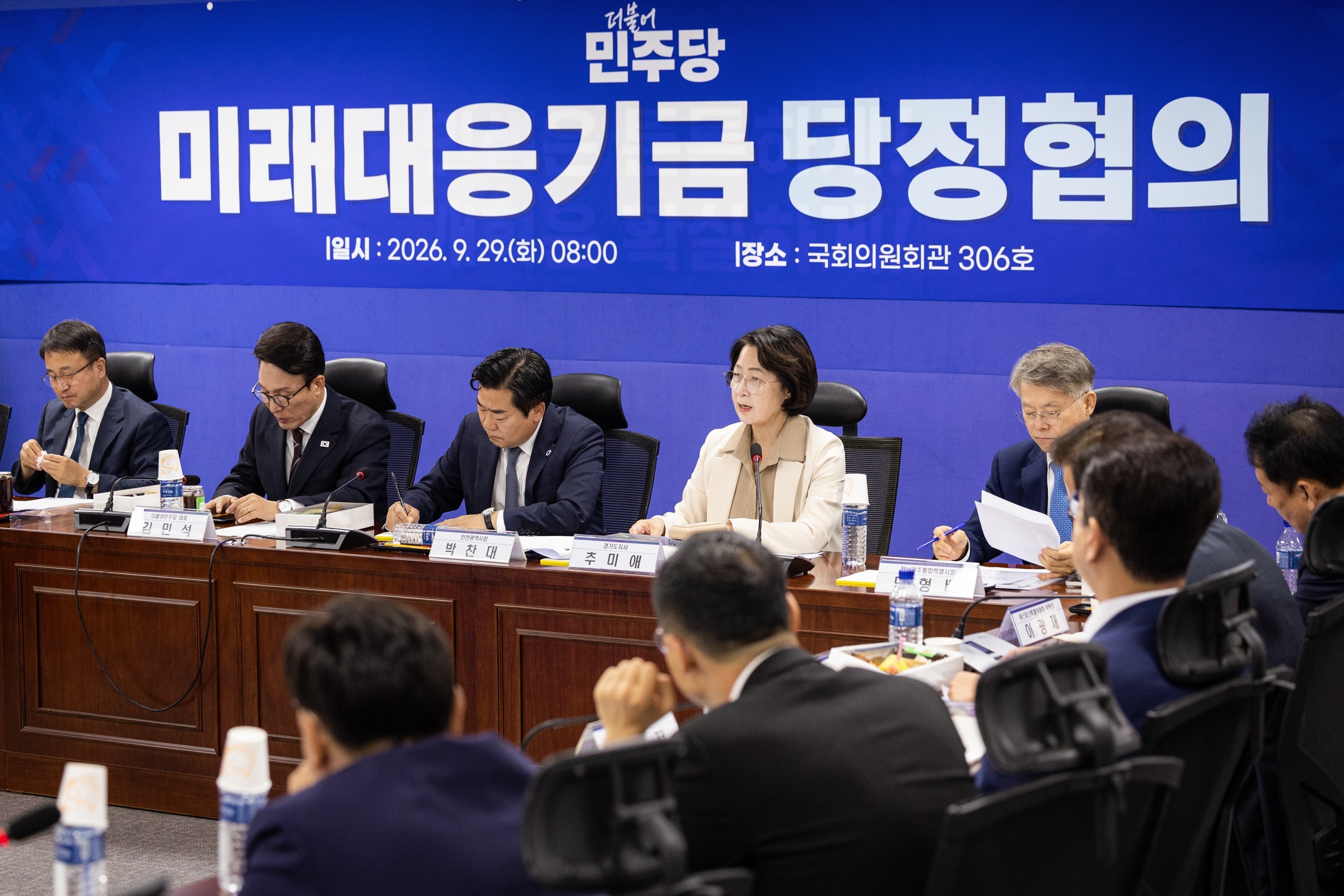
Governor Choo Miae of Gyeonggi Province stated regarding the Future Response Fund that the government is pursuing, "It is necessary to implement reinvestment reflecting the contribution to additional tax revenue creation, convert youth basic income into a national pilot project, and establish rational standards for distributing local future growth support funds."
Governor Choo attended the 'party-government consultation meeting regarding the establishment of the Future Response Fund and reform of local allocation tax' held at the National Assembly on the morning of the 29th, jointly hosted by the Democratic Party and the government, and conveyed these recommendations.
The Future Response Fund is a national fund that the government plans to establish by setting aside additional tax revenues (unexpected surplus revenues from sources such as semiconductor booms) in a separate fund and investing them in four major areas: youth, growth engines, local regions, education, and talent. The primary source of funds is additional tax revenue exceeding the trend line (6.2%) of domestic taxes within the past 10 years, including corporate income tax and income tax. Based on next year's government proposal, the estimated size of the fund mentioned is approximately 162.3 trillion won.
Governor Choo stated, "While I agree with the purpose of establishing a fund that will lead the nation's future, if we turn a blind eye to the contributions and sacrifices of local governments that have substantially underpinned national finances, we can never achieve the original policy objectives," explaining the background for submitting the proposal.
She continued, "It is common sense and a principle of state administration that resources follow where there is burden and that we provide a solid ladder for those who will lead the future. Gyeonggi Province, which has the most population, jobs, and companies in South Korea and implements national policies on the largest scale, must be enabled to fully fulfill its role, and I urge a responsible decision from the government and the party until the end."
On this day, Governor Choo proposed three items related to the operation of the Future Response Fund: ①Growth Engine Account – reinvestment reflecting contribution to additional tax revenue creation ②Youth Account – conversion of youth basic income into a national pilot project ③Local Account - establishment of rational standards for distributing local future growth support funds.
First, she demanded bold reinvestment reflecting the contribution to additional tax revenue creation.
Governor Choo stated, "The source of the 162 trillion won fund is the strength and dedication of Gyeonggi Province's industrial sites such as Yongin, Pyeongtaek, and Icheon, which have tirelessly developed the semiconductor boom, yet the government's future investment fund shows no consideration for regions creating additional tax revenue. Gyeonggi Province is developing large-scale semiconductor clusters in Yongin and Pyeongtaek, but massive financial investment is inevitable for securing electricity and water supply, transportation networks, and creating settlement conditions," raising the issue.
Accordingly, the province recommended that project selection for the fund should reflect ①contribution to tax revenue creation ②national strategic industry investment scale ③related business concentration as major evaluation factors. Additionally, it proposed that the government should increase fund support ratios for large-scale strategic industry infrastructure according to national policies and expand support scale to include full national treasury funding.
Second, she urged a paradigm shift in the Youth Account, which amounts to approximately 13 trillion won.
Governor Choo stated, "Current youth policies target only young people who meet specific purposes and requirements such as employment, housing, and asset formation, and thus cannot fully support the diverse paths and lives of youth. Gyeonggi Province, which has led the way and proven its effectiveness, should introduce 'youth basic income' as a national pilot project to guarantee all young people an equal starting line for preparing their futures."
Youth basic income is a Gyeonggi Province-style basic income system that the province has been implementing first since 2019. Regardless of employment status, income, or assets, young people aged 24 who have resided in Gyeonggi Province for a certain period receive a total of 1 million won in regional currency—250,000 won quarterly over one year. The province's position is that a national youth basic income should be established in the Future Response Fund's Youth Account and common minimum support standards should be set across the country to mitigate disparities in youth support between regions.
Third, she called for rational adjustment of the distribution criteria for 'Local Future Growth Support Funds.'
Governor Choo stated, "Despite additional tax revenue arising from the semiconductor boom, by applying the regular allocation tax distribution formula directly to the fund distribution criteria, Gyeonggi Province, a non-grant-receiving entity, is being excluded from the resource distribution target again. This is clearly a contradiction and reverse discrimination. To ensure at least equal distribution, it is absolutely necessary to establish separate distribution criteria that fairly reflect population, per capita GRDP, future growth investment demand, and contribution to the national economy," she emphasized.
Accordingly, the province requested the adoption of a distribution method for future growth support funds structured as basic distribution (30) + balanced development (40) + future growth demand distribution (30), so that a certain level of resources would be allocated to all local governments including Gyeonggi Province.
Additionally, the province recommended four institutional improvements to secure fiscal soundness of metropolitan local governments: ▲improvement of regular allocation tax calculation criteria ▲increase in local consumption tax rates ▲conversion of tobacco consumption-related local education tax to firefighting-related regional resource facility tax ▲transfer of 5% of corporate income tax (national tax) to metropolitan local tax.
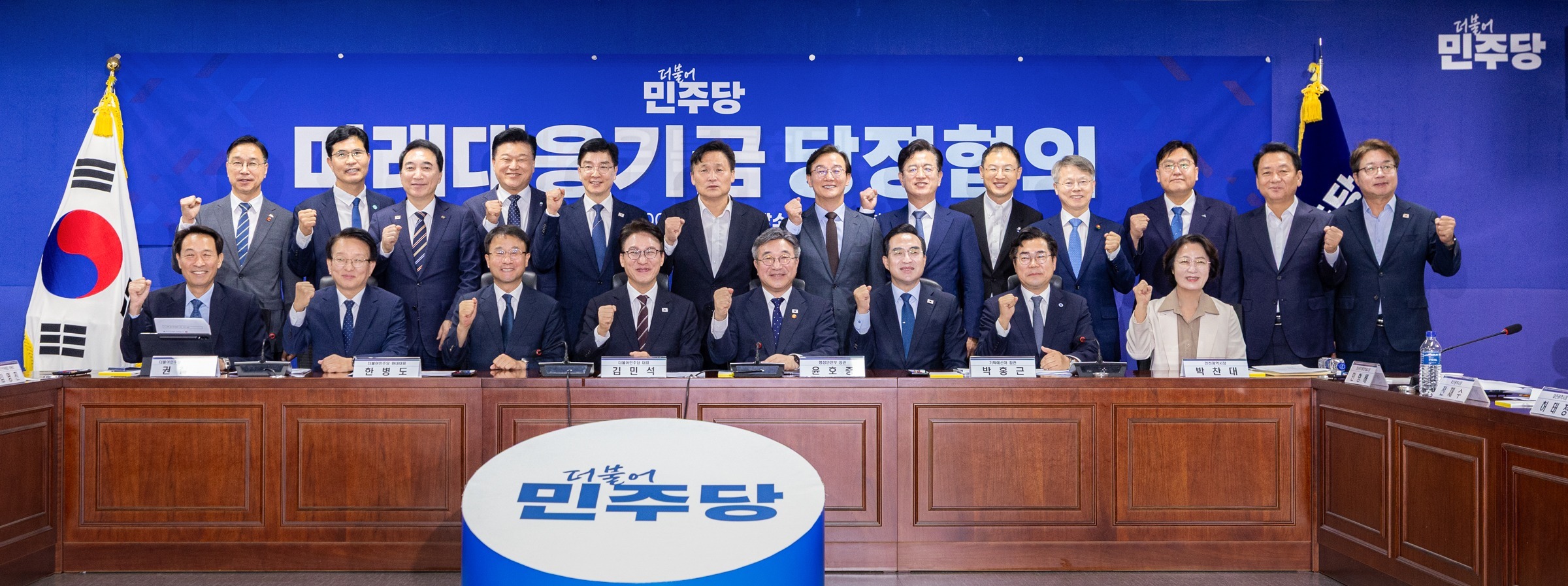
Meanwhile, the meeting was attended by Democratic Party Chairman Kim Min-seok, Floor Leader Han Byeong-do, Policy Committee Chairman Kwon Chil-seung, National Assembly Budget and Accounts Special Committee Chairman Lee Gwang-jae, and Administrative Safety Committee Chairman Kim Young-jin, while the government was represented by Minister of the Interior and Safety Yoon Ho-joong and Minister of Strategy and Finance Park Hong-keun. Twelve provincial governors from the Democratic Party, including Governor Choo Miae of Gyeonggi Province, also participated to discuss the impact of the Future Response Fund on local finances and measures for institutional improvement.