


Team Suwon Assembled by Lee Jae-jun Steadily Fills Key Government Posts
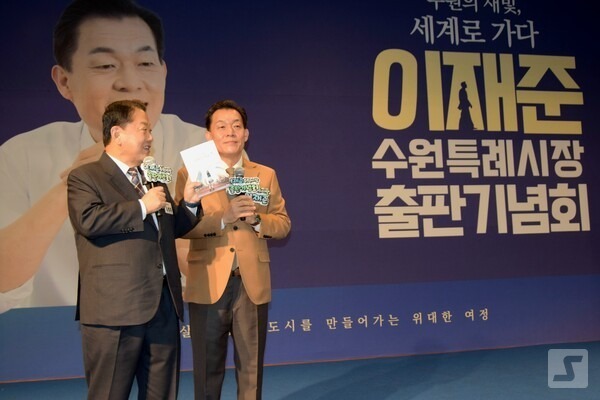
People whom Suwon Mayor Lee Jae-jun has carefully cultivated for the relocation of Suwon Military Airport are steadily taking positions in key decision-making channels of the government and political circles.
On the 1st, President Lee Jae-myung appointed Congressman Kim Byung-ju of the Democratic Party as Presidential Secretary Special Adviser for Defense Policy.
Special Adviser Kim, a four-star general who previously served as Deputy Commander of the Combined Forces Command, is a defense policy expert who has been active in the National Assembly's Defense Committee.
A Blue House official stated, "Special Adviser Kim Byung-ju is a defense policy expert from an Army General background," and explained the personnel decision as follows: "He is the right person to add the voice of the people to state security and defense reform tasks under the banner that strong defense capabilities are a core pillar in protecting national interests."
The relationship between Special Adviser Kim and Mayor Lee dates back to 2022, the mayor's first year in office.
That December, the mayor visited the National Assembly and requested support from Special Adviser Kim for Gyeonggi International Airport construction. At the time, Special Adviser Kim stated, "Gyeonggi International Airport construction will become an agenda item of the Defense Committee next year."
Someone who had put effort into linking international airport construction with military airport relocation from the early days of his tenure has now assumed a position assisting the president's defense policy after more than four years.
The mayor also built relations with Democratic Party Chair Kim Min-seok through military airport relocation.
Last January, when Chair Kim was serving as Prime Minister, Mayor Lee met him directly at Suwon Convention Center to propose pursuing 'civil-military integration, economic international airport' through Suwon military airport relocation as a national strategic project.
In particular, the mayor presented a specific plan to establish a 'Suwon Military Airport Relocation Conflict Resolution Council' under the Office of the Prime Minister, requesting that the central government directly engage in mediating conflicts between local governments.
Former Prime Minister Kim, who received the mayor's proposal at the time, was elected Democratic Party chair last August. The two individuals—Kim Min-seok and Kim Byung-ju—to whom the mayor had directly requested support for military airport relocation are now positioned in key roles as ruling party chair and presidential defense policy adviser, respectively.
The mayor has also consistently invested effort in the National Assembly.
Last year, the mayor worked with Suwon-area National Assembly members of the Democratic Party—Kim Seung-won (Suwon Gap), Baek Hye-ryeon (Suwon Eul), Kim Young-jin (Suwon Byeong), Kim Jun-hyuk (Suwon Jeong), and Yeom Tae-young (Suwon Mu)—to propose expanding the configuration of a 'whole-of-government military airport relocation task force' to the new administration.
At a party and government policy consultation meeting in March this year, they requested support for ensuring Gyeonggi International Airport is reflected in the 7th Comprehensive Airport Development Plan. Subsequently, in July, they officially proposed support for enacting a 'special bill related to Suwon military airport relocation.'
This coordination led to actual legislation.
Congressman Kim Young-jin made representative introduction of the 'Special Bill on Relocation of Suwon Military Airport and Development of Surrounding Areas and Former Sites' on the 30th of last month. All five Suwon-area National Assembly members' names are on the bill.
The special bill contains support grounds for relocation areas, surrounding areas, and former sites, as well as special provisions regarding regulatory relief, designation of economic free zones, and private airport development.
In particular, former Suwon Mayor Yeom Tae-young, now a lawmaker, is currently active in the National Assembly's Land, Infrastructure and Transport Committee.
The current mayor worked with Yeom as deputy mayor during his tenure and dealt with the military airport relocation issue. After succeeding to the mayoral position, he has continuously conducted policy consultations with Councilman Yeom and other area lawmakers, bringing military airport relocation and Gyeonggi International Airport forward as joint agenda items.
At the top of 'Team Suwon' is President Lee Jae-myung.
During his 2022 presidential campaign, President Lee visited Suwon and presented 'completion of Suwon military airport relocation' as a local promise. He promised to smoothly promote military airport relocation and create a 'K-Silicon Valley' at the former site.
The Gyeonggi Province government has also established institutional foundations for promoting Gyeonggi International Airport.
The province established a Gyeonggi International Airport Promotion Team and enacted the 'Gyeonggi Province International Airport Attraction and Construction Promotion Support Ordinance' to conduct related research and projects. It has also proposed Gyeonggi International Airport projects in the 7th Comprehensive Airport Development Plan.
However, the Gyeonggi International Airport policy does not necessarily mean Suwon military airport relocation. Since military airports are excluded from the scope of application in the Gyeonggi Province ordinance, coordinating the two projects requires consultation among the central government, Gyeonggi Province, and related local governments.
The recent case of Gwangju Military Airport relocation demonstrates that active central government mediation can change the pace of long-stalled projects.
Gwangju Military Airport also stalled for a long time due to conflicts between local governments, but reached a turning point when President Lee instructed the establishment of a Presidential Office-led task force last year.
Subsequently, the Presidential Office directly engaged in mediation through consultative bodies involving Gwangju City, South Jeolla Province, Muan County, the Ministry of National Defense, the Ministry of Land, Infrastructure and Transport, and the Ministry of Strategy and Finance, gaining momentum with relocation consensus reached last year and completion of candidate site selection procedures this year.
Gwangju and Suwon differ in terms of relocation area conditions, public acceptance, and project structure, making simple comparison difficult. The Suwon military airport relocation still faces the most challenging hurdle of consultation with relocation areas.
Nevertheless, with the precedent of Gwangju Military Airport relocation, which had long stalled, gaining momentum through direct Presidential Office mediation, Suwon military airport relocation also has the possibility of entering a new phase if the central government actively engages in mediation.
With the connection links of 'Team Suwon' that Mayor Lee has steadily built over the past four years for military airport relocation now extending to the Presidential Office's defense policy line, attention is focused on whether past efforts will translate into results that Suwon residents can experience.