


Suwon Mayor Yim Tae-young: "Fiscal Decentralization with Autonomy and Responsibility is Social Innovation"
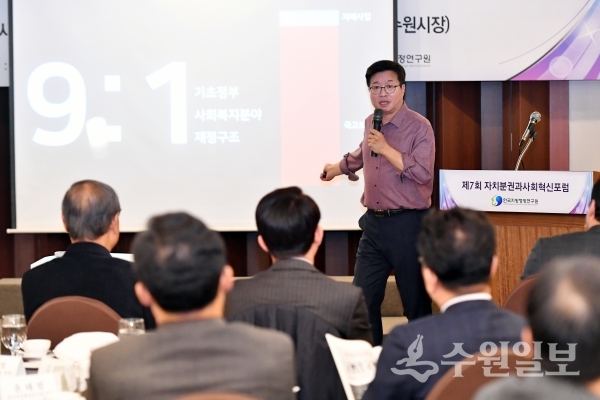
[Suwon Ilbo=Reporter Seo Dong-young] "The engine that can propel us forward in line with the changing times is 'decentralization.'"
Yim Tae-young, Mayor of Suwon City and Chairman of the National Association of Mayors and Governors, delivered the keynote address at the 7th Forum on Local Autonomy and Social Innovation held at the Korea Press Center on the morning of the 20th, speaking on "Decentralized Welfare Grand Bargain as the Engine of Social Innovation."
The forum, hosted by the Korean Institute of Local Administration and Research and organized by the Forum on Local Autonomy and Social Innovation, was held for the seventh time to establish a specialized network of local autonomy experts that includes government, academia, and civil society.
Chairman Yim Tae-young cited the centralized policy structure as the cause of the failure of various innovative policies in Korean society from the perspective of local governments.
He pointed out that while policy direction aims toward local autonomy, implementation methods remain under central leadership, inevitably leading to deterioration of local finances.
Chairman Yim emphasized that "after 25 years of local autonomy revival, only two non-religious organizations remain in local governments, with local government finances on the brink of collapse," and predicted that "if welfare expands but the outdated implementation system persists, unable to respond to social circumstances, local finances will continue to deteriorate as the central government increases welfare policies."
As a solution to address these problems, Chairman Yim presented a model in which policies verified for effectiveness at the local level spread nationwide. He cited the example of Suwon's mandatory installation of rest facilities for workers in multi-unit housing, which is being reflected by the Ministry of Land, Infrastructure and Transport with amendments to the relevant laws, explaining that the spread of successful policies from field-intensive local governments can serve as an alternative to reduce the risk of failure.
In particular, he expressed hope that the "Special Committee on Welfare Grand Bargain," voluntarily initiated by basic local governments to establish sustainable welfare systems, will help create new order among central, provincial, and basic governments, expand public goods, and implement customized projects.
The direction of the welfare grand bargain includes: ▲the central government assumes responsibility for universal welfare projects, while basic governments take charge of community-oriented welfare; ▲provincial governments conduct consultation and coordination procedures in implementing matching projects and recognize basic governments as co-implementing entities; and ▲basic governments should also refrain from hemorrhagic cash welfare.
Chairman Yim stated, "Fiscal decentralization that grants autonomy and responsibility to local governments will be the driving force for social innovation," and added, "the distribution of authority through local autonomy, decentralization, and governance is true innovation."
Meanwhile, the Forum on Local Autonomy and Social Innovation has featured remarks from prominent figures including Sung Kyung-ryung, President of the National Research Council for Economics, Humanities and Social Sciences, since April; Yun Jong-in, Deputy Minister of the Ministry of the Interior and Safety; Park Won-soon, Mayor of Seoul; Yoo Eun-hye, Minister of Education; Song Jae-ho, Chairman of the Presidential Committee on Balanced National Development; and Ha Seung-chang, former Senior Secretary for Social Innovation at the Blue House.