


Korea's Mayors and Governors Association: "Emergency Disaster Relief Funds Should Be Distributed Universally, Not Selectively"
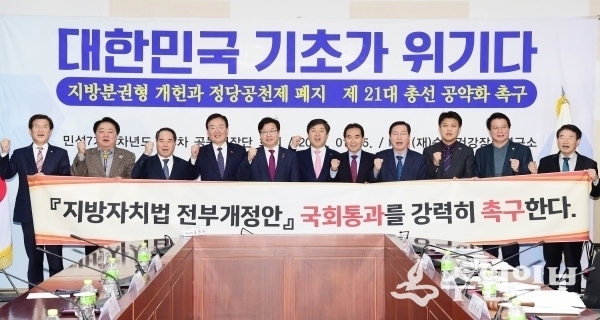
[Suwon Ilbo=Correspondent Seo Dong-young] The National Association of Mayors and Governors (Chairman Yum Tae-young, Mayor of Suwon; hereinafter, the Association) has argued that the central government's emergency disaster relief funds should be distributed universally rather than selectively.
The Association stated that emergency disaster relief funds are aimed at urgent support in response to disasters, making distribution speed a critical factor. In particular, considering the current situation at the frontlines of local governments, the Association emphasized that universal distribution is more practical.
The Association pointed out that selective distribution has many problems in terms of distribution criteria. These include the issue of using data from long before COVID-19 despite income reduction due to the pandemic, excessive administrative costs in the selection process, class division based on eligibility, the impossibility of accurately identifying actual victims in the selection process, and the prolonged asset investigations and lengthy procedures.
While the intention to reduce fiscal burden through selective distribution is understandable, the Association diagnosed that the actual asset investigation process incurs substantial administrative costs and time, making swift and effective distribution difficult.
Estimating the administrative period required for selective distribution, it would take a minimum of two weeks (15 days) or more. Considering complaints and objections regarding ineligibility after notification and judgment, it could take more than a month.
Due to the spread of COVID-19, basic local governments have been in emergency response mode for an extended period, performing diverse and new projects that are difficult to enumerate, already exceeding their operational capacity. As a result, two civil servants from Jeonju City and Seongju County, who worked without weekends, have died.
Already surpassing the manageable workload, the selective distribution of emergency disaster relief funds currently pursued by the central government raises many concerns, the Association noted.
The national association points out that before the general election, broad consensus had already formed in political circles regarding the plan for expanded universal distribution to all citizens, and many experts have suggested that universal distribution is desirable for swift and effective support. Should selective distribution be implemented, the Association predicted that basic local governments at the frontlines of administration could experience paralysis in the provision of other public services given current staffing structures.
Chairman Yum Tae-young stated, "In times of emergency like now, selective support has many problems. In contrast, universal distribution would be meaningful as the state's service to all classes directly and indirectly affected by COVID-19. Therefore, it would be reasonable to implement universal distribution of emergency disaster relief funds for swift and effective support."
Meanwhile, the National Association of Mayors and Governors is an organization to which 228 heads of basic local governments nationwide are affiliated, performing work in autonomy and decentralization, inter-governmental cooperation, and coordination.