


Suwon's 'Emergency Vehicle Priority Signal System' to Begin Full Operation Next Year
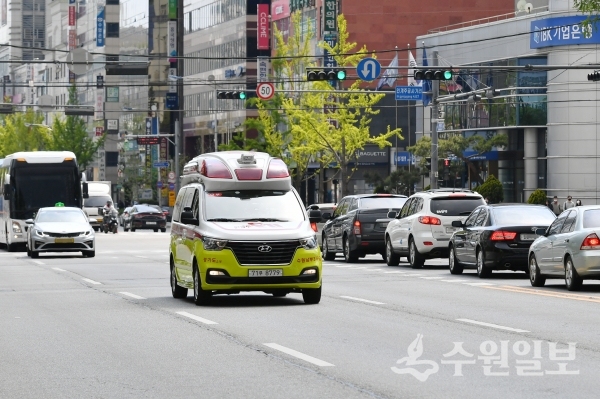
[Suwon Ilbo=Reporter Seo Dong-young] As of the 4th, Suwon City announced on the 6th that 210 emergency patients have been transported to hospitals by ambulances using the 'Emergency Vehicle Priority Signal System' introduced in February.
The Emergency Vehicle Priority Signal System tracks ambulance locations via GPS (Global Positioning System) through Suwon's Integrated Urban Safety Center when transporting emergency patients to hospitals, and automatically provides a green light signal when the vehicle enters an intersection. The Integrated Urban Safety Center provides the emergency vehicle with the optimal route to reach the hospital as quickly as possible.
Using the Emergency Vehicle Priority Signal System has reduced patient transport time to less than half of the previous time.
The average travel time when covering 1 kilometer is 1 minute 27 seconds, a 56.3% reduction compared to when the system was not in operation (3 minutes 20 seconds).
Operating the Emergency Vehicle Priority Signal System allows arrival at Ajou University Hospital or Catholic University St. Vincent's Hospital within 10 minutes from anywhere in Suwon. The system has achieved travel from Deltaplex (Gosaeq-dong, Gwonseon-gu) in West Suwon to Ajou University Hospital (Woncheon-dong, Yeongtong-gu), a distance of approximately 11 kilometers, in 9 minutes 20 seconds.
The city became the first in the nation to establish an emergency vehicle priority signal system throughout the city using the 'center-based method.'
The 'on-site method,' which operates by installing emergency vehicle transmitter devices, signal controllers, and wireless base stations at intersections, can only activate emergency vehicle priority signals at intersections where wireless base stations are installed. However, the 'center-based method' that Suwon City constructed by utilizing the Integrated Urban Safety Center's infrastructure can control signals at all intersections connected to the Integrated Urban Safety Center.
The 'center-based emergency vehicle priority signal system' requires lower system construction costs compared to the on-site control method, and additional equipment does not need to be added when expanding the priority signal zones, providing budget savings benefits.
The Emergency Vehicle Priority Signal System received nationwide attention, including being selected as a 'model case for proactive administration' by the Ministry of the Interior and Safety. Benchmarking by local governments across the nation continues.
A 'technology-sharing business agreement' was concluded with Ulsan Metropolitan City to transfer the system construction technology. Officials from approximately 10 local governments and organizations, including Busan Metropolitan City, Hwaseong City, and Yeoju Fire Station, have visited the Integrated Urban Safety Center to benchmark the system.
The city plans to conduct pilot operations of the Emergency Vehicle Priority Signal System through this year and, after improving the system, to begin full-scale operation starting next year.
A city official stated, "The Emergency Vehicle Priority Signal System is a system that can save the precious lives of emergency patients who are racing against time," and added, "We will actively share related technologies with other local governments."
The official further requested, "As temporary traffic congestion is inevitable when the system operates, we ask citizens for your active cooperation even if it causes minor inconvenience."