


Yongin City Reveals Master Plans for Green Spaces in Giheung, Suji, and Cheonan Districts
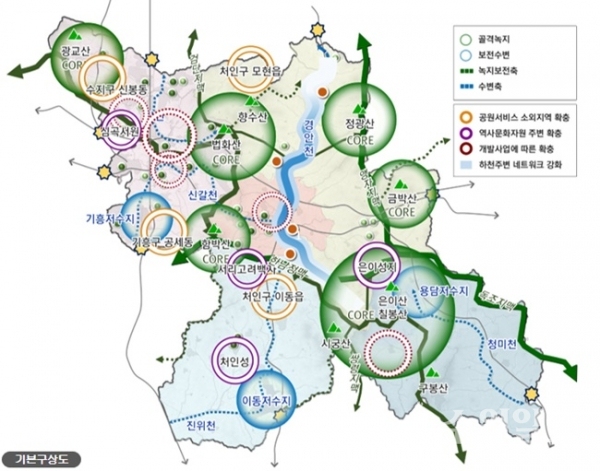
[Suwon Ilbo=Park No-hun] Yongin Special Eunpyeong City is moving forward with concrete design for environment-tailored parks and green spaces within the city.
In the Cheonan district, parks will be expanded in underserved park service areas such as Mohyeon-eup where urban parks fall short relative to population, and themed parks with distinctive features will be created around cultural heritage sites including Cheonan Fortress and Eun-ni Holy Ground.
In the Giheung and Suji districts, park infrastructure will be further developed in areas where parks are lacking relative to population, such as Sinbong-dong, and parks will be created through securing contributions from urban development projects such as Platform City.
Through expanding parks within residential areas, the ratio of the population able to access urban parks within a 10-minute walk from anywhere in Yongin will increase from the current 68% to 82.3% by 2035.
According to Yongin City on the 19th, the "2035 Parks and Green Spaces Master Plan" to implement such measures has passed final review by the Gyeonggi Province Urban Planning Commission in March.
The Parks and Green Spaces Master Plan is a fundamental framework that, in accordance with the "Act on Urban Parks and Green Spaces," presents the direction for expansion, management, and use of parks and green spaces on a 10-year basis.
The core of the 2035 Parks and Green Spaces Master Plan is to secure parks and green spaces that citizens can actually use, increasing per capita park and green space area from the current 6.5㎡ to 15.77㎡ per person by 2035.
Looking at the plan, to preserve green spaces for future generations, six framework green zones centered on ▲Eun-ni Mountain and Chilbong Mountain ▲Geumbak Mountain ▲Jeonggwang Mountain ▲Beopwha Mountain and Hyangsoo Mountain ▲Hambak Mountain ▲Gwanggyo Mountain have been reflected in the designation of Jeonggwang Mountain and Galmi Peak green preservation districts.
▲Idong Reservoir ▲Giheung Reservoir and waterfront spaces along with linear green networks utilizing waterfront axes such as Gyeongan Stream and Jinwi Stream will also be strengthened.
Additionally, urban greening projects utilizing idle spaces such as schools, public institutions, and parking lots will be promoted, and existing parks will be maintained sequentially.
Through wind flow analysis, Pogok-eup and Gilliang-jang-dong in Cheonan-gu and Dongcheon-dong in Suji-gu have been designated as priority greening districts for greening projects including roadside trees.
Prior to submitting the master plan to the Gyeonggi Province Urban Planning Commission in September last year, the city gathered diverse opinions through reviews by Yongin City Council and the Urban Parks Committee, citizen surveys, and online and offline public hearings.
The master plan can be viewed by any citizen who visits the Greenbuild Project Division, Parks and Creation Department. The viewing period runs through May 16.
Yongin City Mayor Paek Kun-gi stated, "This plan is a blueprint for Yongin City to solidify its status as an eco-friendly ecological city," and added, "We will spare no effort in supporting the city to become a premium park city where any citizen can find a park near their living space without regional limitations."
Meanwhile, the city has implemented various policies over the past four years to return green spaces to citizens.
In particular, it launched a Special Committee on Haphazard Development in 2018, strengthening the slope gradient in Suji-gu, which had been marred by haphazard development, to 17.5 degrees, fundamentally preventing indiscriminate mountain development.
Additionally, the city is pursuing a long-term project to advance 13 long-undeveloped urban parks as urban parks, creating living parks that any citizen can easily and freely use.
Through steady financial investment, four parks have completed park development and compensation, and five parks including Goggi Neighborhood Park are securing budgets in stages to proceed with compensation.
Tongsa Neighborhood Park, with a scale of 108,124㎡—equivalent to 15 soccer fields—began civil engineering work in December last year and started full-scale landscaping work from the 13th.
In particular, Sinbong 3 Neighborhood Park, with an area of 73 soccer fields (518,047㎡) and the largest scale among the city's long-undeveloped parks, has been selected for the Korea Land and Housing Corporation (LH)'s public land reserve project, with LH conducting pre-purchase acquisition.
From the city's perspective, this reduces land compensation costs that could skyrocket and allows for installment payments over five years, easing the city's financial burden.