


Kim Dong-yeon Presents 'Human-Centered Economy (Humanomics)' as Priority for Second Half of Term
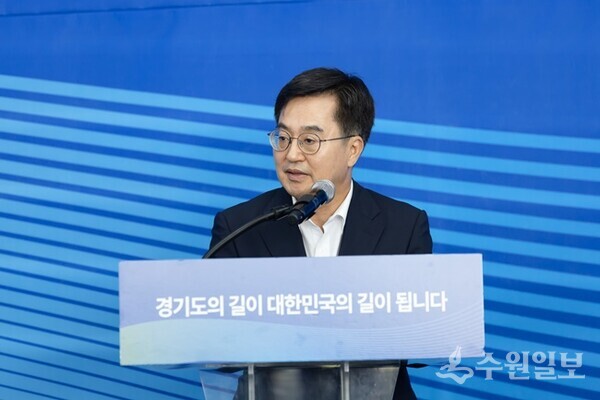
[Suwon Ilbo=Reporter Kim Gap-dong] Gyeonggi Province Governor Kim Dong-yeon stated, "In the second half of my term, I will take on new initiatives and challenges as an 'economic problem-solver' to address the economic, low-birth-rate, and climate issues facing the Republic of Korea through 'Human-Centered Economy (Humanomics).'"
'Human-Centered Economy' is an alternative to overcome the blind spots of existing economics. It is a political philosophy that seeks to overcome problems stemming from conventional economics—such as social inequality and polarization within GDP-focused quantitative growth strategies—by realizing quality of life, enhancement of individual capacity, and happiness.
On the 14th, Governor Kim announced plans for new projects in four economic sectors—opportunity, care, climate, and peace—containing such content as priority tasks for the second half of his term to implement the human-centered economy (humanomics) at a press meeting at Dodamso (the former Gyeonggi Province governor's residence).
Governor Kim Dong-yeon stated, "During the first half of my term, I worked to create more opportunities in various fields including economy, climate, diplomacy, and people's livelihoods," and "In the second half, I will take on new initiatives and challenges as an 'economic problem-solver' to address the economic, low-birth-rate, and climate issues facing the Republic of Korea through 'Humanomics' centered on people."
Accordingly, Gyeonggi Province plans to implement a 4.5-day work week for public institutions and private companies under the province, support caregiving expenses for low-income elderly, and introduce new innovative policies such as a shared benefit system for renewable energy.
Governor Kim also stated, "If the central government does not express its intention to hold a referendum on the Gyeonggi Northern Special Autonomous Province by August 31, we will implement what Gyeonggi Province can do," once again expressing strong determination to establish the Gyeonggi Northern Special Autonomous Province.
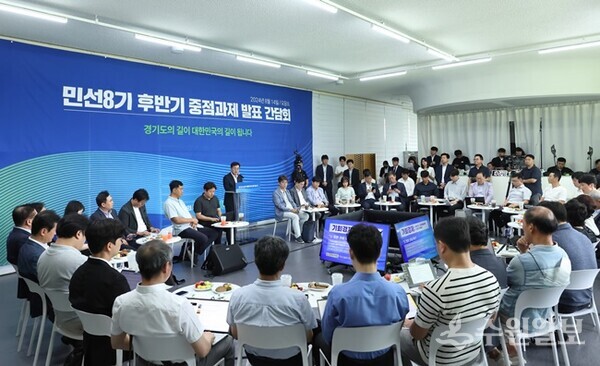
The main projects in four sectors—opportunity economy, care economy, climate economy, and peace economy—announced by Governor Kim are as follows.
■ Opportunity Economy
In the first sector of opportunity economy, a new '4.5-day work week without pay cuts' and a '0.5 & 0.75 job' project without career interruption will be implemented as new projects.
The '4.5-day work week without pay cuts' is a policy for addressing low birth rates and reducing working hours. The province plans to conduct pilot projects targeting 50 private companies in the province and some public institutions under Gyeonggi Province. Employees can choose one of the following through labor-management agreement: ①biweekly 4-day work week, ②35-hour work week, or ③half-day work every Friday. While working hours decrease, wages do not. The government will support the wages necessary for the reduced working hours.
The '0.5 & 0.75 job' project without career interruption complements the shortcomings of existing low-birth-rate measures such as parental leave and birth support funds. It is a policy for people who cannot take parental leave due to concerns about career interruption. '0.5 job' refers to positions with 4 hours of daily work (20 hours per week, 2-3 days per week), and '0.75 job' refers to positions with 6 hours of daily work (30 hours per week, 3-4 days per week). The province plans to conduct pilot projects targeting family-friendly companies among public institutions and private enterprises. It plans to provide system consulting (training), workplace management system installation costs, shared task management support funds, and additional employment incentives.
Additionally, the province will continue major projects from the first half of the eighth popular election term aimed at expanding opportunities, including the creation of innovation clusters in three future industries—semiconductors, biotechnology, and mobility—attracting 'over 100 trillion won' in investment, and six opportunity income programs for artists and people with disabilities.
■ Care Economy
In the second sector of care economy, a new 'Gyeonggi Caregiving SOS Project' will be launched with the goal of providing more equitable opportunities.
As a pilot project to promote the establishment of a national caregiving support system, the target recipients are seniors aged 65 and older with low income and registered residence in Gyeonggi Province who were admitted to a hospital or higher-level medical institution due to injury or illness and received caregiving services. The province plans to provide up to 1.2 million won per person annually for caregiving expenses. This amount corresponds to two months of caregiving fees for a six-person shared hospital room (20,000 won per day × 60 days).
The '360° Care' project, a signature welfare policy of the eighth popular election term, will also be prioritized along with the introduction of family caregiving allowances, expansion of 400 public and national daycare centers, and AI+ care, an artificial intelligence-based elderly care policy.
■ Climate Economy
In the third sector of climate economy, new projects including the 'Gyeonggi RE100 Fund,' a publicly-led renewable energy benefit-sharing system, 'Gyeonggi Climate Satellite Launch,' and 'Climate Insurance Enrollment' will be pursued.
The Gyeonggi RE100 Fund is a policy that installs solar power plants in unutilized state and public land in Gyeonggi Province, supplies the generated electricity to RE100 companies, and returns a portion of the generation profits to citizens participating in the fund.
The project period runs from 2025 to 2045, with plans to construct renewable energy power plants with 15MW capacity in parking lots, vacant roadside land, bicycle paths, and university grounds. Gyeonggi Province plans to establish a renewable energy-specialized Special Purpose Company (SPC) under Gyeonggi Province Inc. to handle power plant construction and fund operations. When establishing the Special Purpose Company (SPC), the province plans to encourage participation from local energy cooperatives, city and county subsidiaries, and financial institutions, and will coordinate with the Gyeonggi Provincial Assembly to pursue ordinance amendments in the second half of this year.
The Gyeonggi Climate Satellite is being pursued to establish a differentiated Gyeonggi Province climate change response strategy through securing independent climate data. It will be promoted as a public-private partnership project, with preparations beginning in 2025 and the satellite launch targeted for 2026. Through the climate satellite, Gyeonggi Province plans to secure high-resolution data and strengthen the province's climate crisis response capacity.
The Gyeonggi Climate Insurance aims to resolve climate disparity (climate divide) resulting from climate change and establish a social safety net through health damage relief. Climate disparity refers to the gap between prepared sectors—such as developed and developing countries adapting to climate change, and large enterprises and SMEs—and unprepared sectors, similar to the 'Digital Divide.' This is a concept first presented by Governor Kim at the 'Climate Reality Leadership Training' held at Goyang KINTEX in August 2023.
When Gyeonggi residents are diagnosed with climate disaster-related illnesses (infectious diseases, heat-related illness, cold-related illness), a certain amount will be paid, with additional support for vulnerable groups. Implementation is planned to begin next year.
Additionally, the province plans to pursue projects such as creating a RE100 special zone by converting the Siheung Lake area into a renewable energy complex to achieve renewable energy expansion equivalent to one nuclear reactor, creating a Gyeonggi RE100 garden, and implementing public electricity rate systems for apartments and other facilities.
■ Peace Economy
The fourth peace economy is an economic strategy of coexistence and cooperation to resolve 'Korea Discount.' For Gyeonggi Province, with the largest demilitarized zone contact area, 'peace is economy' is not merely a slogan. When inter-Korean tensions ease and a peace system is established, growth potential including DMZ ecological and tourism resources can be realized.
To this end, the province will focus on the establishment of Gyeonggi Northern Special Autonomous Province and accelerating major development in northern Gyeonggi. Gyeonggi Province believes that the establishment of the Gyeonggi Northern Special Autonomous Province is for residents, and since it is not actually proceeding, it considers it the responsibility of the central government. If the government does not express its intention to hold a referendum by August 31, Gyeonggi Province will implement what it can.
Major development in northern Gyeonggi will continue to be pursued, including relocation of public institutions, regulatory relaxation, and expansion of SOC (social overhead capital) investment.
■ First Half Achievements - Forward Movement in Economy, Future, Diplomacy, and People's Livelihoods
Governor Kim cited forward movement in the economy, future, diplomacy, and people's livelihoods as major achievements of the first half, in contrast to the central government's backward movement.
Investment attraction, which the governor announced as an 'money-earning governor' aiming to achieve over 100 trillion won during his term, has reached 69.2 trillion won, already approaching 70% of the goal. Taking on the role of 'climate governor,' Governor Kim declared the 'Gyeonggi RE100 Vision' across four sectors—public, business, residents, and industry—and established the Republic of Korea's first 'Climate Change Platform.'
Over two years, he met with national leaders, government officials, and business people from 37 countries totaling over 160 individuals, leading innovation alliances and economic and talent exchanges, demonstrating the face of a 'global governor.'
Additionally, programs unique to Gyeonggi Province such as artist and disability opportunity income, 360° care, and youth three-tier opportunity packages were policies to fulfill his promise as a 'people governor' to deliver on people's livelihoods.