


Editorial Gyeonggi Province in 'Fiscal Emergency,' Provincial Council Going Against the Grain with Jeju 'Getaway'
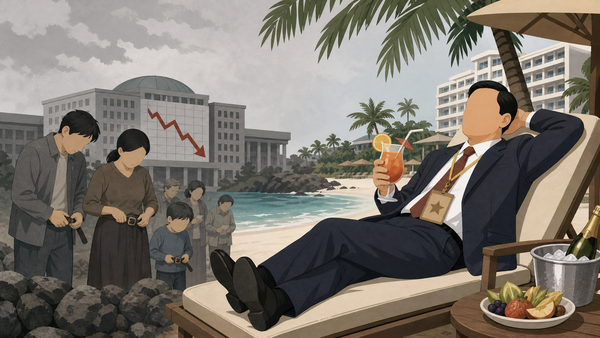
It has not been long since Gyeonggi Province declared a 'fiscal emergency situation' by implementing large-scale spending restructuring. A budget of 546.5 billion won has been cut, and with livelihoods and welfare budgets directly related to residents' lives facing reduction, residents are being forced to share the burden.
Already, workers at provincial agencies are taking to the streets amid concerns about wage arrears to urge resolution. Yet it has been revealed that during this grave period, some standing committees of the Gyeonggi Provincial Council have been visiting four-star hotels in Jeju to receive or push forward 'work briefings.' It is difficult to avoid criticism that a representative body that should care for residents' lives is instead marching in the opposite direction with anachronistic conduct.
Executive tightening belts, representative body going backward
The essence of this incident lies in 'moral complacency born of overlooking the crisis' by thoroughly ignoring the weight of suffering residents endure. The Education Planning Committee already stayed at a four-star hotel in Jeju for two nights and three days and completed work briefings from the provincial education office, while the Health and Welfare Committee and the Economic and Labor Committee have also pursued similar on-site policy meetings.
The provincial government is exerting all efforts on austerity management by controlling unnecessary business trips and reducing administrative operation expenses. In such circumstances, for council members to take public servants from supervised agencies to resort destinations under the pretext of work briefings and spend tens of millions of won in taxpayer money represents a complete loss of sensibility about public resources.
Why at tourist destinations?... The recurring evil of 'taxpayer-funded tourism'
Why must work briefings be held at tourist destinations in other regions? The council claims 'communication among members and smooth schedule management,' but this is merely a flimsy excuse. In fact, the practice of council members bringing numerous civil servants from supervised agencies to hold meetings at luxury hotels, filling schedules primarily with banquets and visits to local attractions rather than substantive meetings, has drawn criticism not just recently but for some time. It is an established reality that such 'taxpayer-funded tourism' continues unabated across metropolitan and municipal councils throughout the country, even amidst budget crises and public hardship.
If the council truly wishes to enhance policy capabilities and listen to voices in the field, it should visit urgent livelihood sites within the province rather than resort destinations in other regions that consume large budgets and administrative resources. The fact that even on the provincial government's internal bulletin board, self-deprecating criticism emerges such as "Why are we receiving work briefings at resort destinations during a fiscal emergency?" demonstrates the extent of the gap between the council and public sentiment.
Local council losing trust must seize this as an opportunity for transformation
The reason for a local council's existence lies in checking the executive branch and serving as a voice for residents. Yet now the Gyeonggi Provincial Council has become a subject of rigorous scrutiny and criticism in its own right. The manner in which it reluctantly broaches schedule reviews or cancellations as criticism intensifies also falls short of the conduct of a responsible politician.
The Gyeonggi Provincial Council must seize this incident as an opportunity for painful self-reflection. Rather than attempting to escape blame through one-time excuses, it must fundamentally reexamine the practice of business trips to other regions for publicity and tourism purposes and establish strong self-help measures to block such practices institutionally. When residents and workers at subordinate agencies are tightening their belts amid existential crisis, the council, as a representative body, must remember that it should be the first to tighten its belt.