


37th Anniversary Special Series AI Great Transformation, Asking for Direction 1 - "AI in My Life," The Game of the Consumer Market Changes
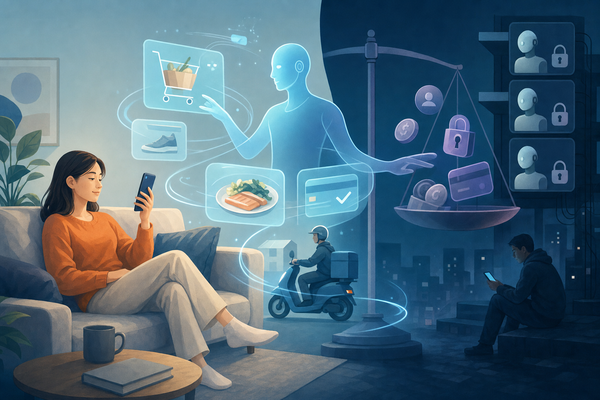
"What should I eat for dinner tonight?"
Rather than individually searching for restaurants on a smartphone to end the day, turning on an AI assistant application has now become routine. AI recommends the optimal dinner menu by synthesizing the user's diet, current location, and health-related data. It then automatically applies the lowest-price coupon through a delivery app and completes payment all at once. All the consumer does is respond to AI's suggestion with "Yeah, let's go with that."
The paradigm of consumption is fundamentally changing. Beyond the era of simply searching and comparing information, the age of 'proxy consumption (Agentic Commerce)' is in full swing—where AI learns consumer preferences and patterns to make optimal choices on behalf of consumers and even process payment.
The End of Search and the Assault of 'Frictionless Commerce'
Major global economic institutions like McKinsey forecast that AI-based proxy consumption and commerce markets will grow into a key pillar that will fundamentally reshape the distribution landscape. 'Frictionless Commerce'—which technologically eliminates all the hassles consumers face from product discovery to payment—is reorganizing the distribution ecosystem.
From the consumer's perspective, purchasing fatigue has decreased and efficient consumption that doesn't miss out on lowest-price benefits is now possible. However, the distribution industry faces an emergency. This is because whether a brand 'is selected by AI algorithms' has emerged as the critical variable that determines survival, rather than brand recognition or conventional advertising. As AI assistants select products based solely on price and efficiency, traditional marketing formulas are rapidly losing effectiveness.
Backlash of Convenience…Global Major Nations vs. Korea's 'AI Tax'
The problem is that advanced AI services come with substantial economic costs. As technology penetrates deeper into daily life, consumers must bear increasing burdens. As customized and real-time functions become essential beyond simple free services, monthly 'AI subscription fees (AI Tax)' are becoming a new fixed expense item in household budgets.
When compared to the digital subscription status of major global nations, domestic consumers show several distinctive characteristics in their subscription experience.
North American consumers, such as those in the U.S., primarily pay directly for single big tech AI services like ChatGPT Plus or Copilot Pro as needed. With relatively clear boundaries between productivity-focused work AI and entertainment subscriptions, consumption patterns of flexibly canceling or resubscribing as needed have taken root.
In contrast, regions such as the European Union tend to be more conservative in household adoption of paid AI due to strong personal data protection regulations and AI-related legislation. With higher usage of free open-source models or pre-installed device features, the rate of household subscription spending increases relatively gradually.
The domestic consumer market, by comparison, combines payment for original AI services from global big tech companies with densely interwoven subscription products combining shopping and membership offered by portals, e-commerce platforms, and telecom companies. In addition to exposure to exchange rate volatility when using overseas services, as domestic platforms' subscription economy ecosystems interlock, the perceived subscription fatigue is rising sharply.
'AI Divide' and Wavering Consumer Sovereignty
Subscription fee burdens go beyond simple spending increases, leading to social polarization called the 'digital class gap (AI Divide)'.
Those with the ability to pay enjoy the benefits of multiple AI subscriptions—personal assistants, automatic lowest-price searches, and customized care benefits—saving time and money. Conversely, economically disadvantaged populations or those unfamiliar with digital device operation face information inequality issues, excluded from these 'algorithm benefits' while paying relatively higher costs and consuming under unwanted conditions.
Additionally, concerns have been raised that 'consumer sovereignty'—where consumers actively compare and choose through their own will—may be shaken by real-time variable pricing (dynamic pricing) or platform algorithms, as consumers passively purchase only products recommended by AI algorithms.
"Consumer Must Keep Hold of 'Proactive Consumption' Amid Convenience"
It is undeniable that AI provides groundbreaking convenience to consumer life. However, in the shadows of convenience lie household spending pressures, digital gaps, and overdependence on algorithms.
Experts are united in saying that both consumers and social safety nets must take proactive measures during this period of technological transformation.
Distribution and consumption experts suggest: "AI is a useful tool that enhances consumption efficiency, but the final decision-making and economic spending must ultimately remain in human hands. While reviewing indiscriminate subscription burdens, institutional safeguards are urgently needed to protect consumers from unfair AI algorithm recommendations and price discrimination."
In the sweet convenience offered by an AI assistant, at a moment when deep reflection is required on how to preserve 'consumer sovereignty' without becoming a passive object of algorithms, wisdom is called for.