


Ruling Party Leader Looking Down at Regions, Gyeonggi Province Governor Looking Up at Central Government
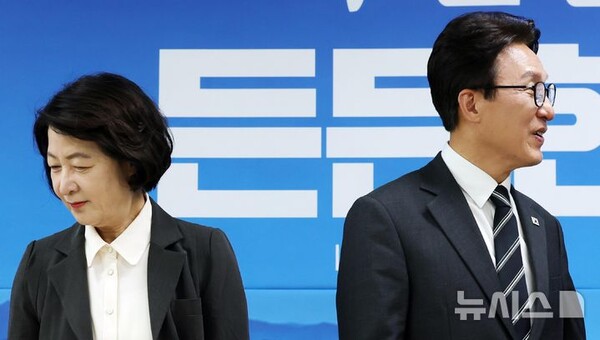
A rivalry between Democratic Party Leader Kim Min-seok and Gyeonggi Province Governor Choo Mi-ae is escalating across both central politics and provincial affairs.
As Governor Choo publicly criticized President Lee Jae-myung and the government over central political issues including the Chief Prosecutor appointment and prosecution reform, Leader Kim has countered by repeatedly raising issues with Governor Choo's election consulting contract and the DMZ International Documentary Film Festival and other Gyeonggi Province matters. The political battle lines are expanding from national affairs to provincial governance.
Governor Choo raised her voice on central politics early on.
On the 10th, Governor Choo evaluated President Lee's nomination of Kim Ji-yong as the inaugural Chief Prosecutor candidate as "the height of contradiction" and publicly raised concerns. When asked about causes of the president's falling approval rating, she also directly addressed prosecution reform issues and criticized the government's reform direction.
The tone of her remarks intensified afterward. Governor Choo criticized President Lee, saying in effect "Why are you living in fear of these forces?" while discussing the Chief Prosecutor appointment and responses to seditious factions.
While it is not unusual for provincial governors from the Democratic Party to express opinions on government policy, the fact that the head of the nation's largest metropolitan region has repeatedly and publicly criticized the president's personnel decisions and national governance direction has escalated the dispute into party infighting.
Leader Kim directly applied the brakes.
On the 14th, Leader Kim responded to Governor Choo's remarks by saying it was "a time to unite our strength" and referenced the impeachment of former President Roh Moo-hyun. He requested an explanation, suggesting it was difficult to accept Governor Choo's remarks as statements from a senior Democratic Party member or provincial governor.
Up to this point, it appeared the ruling party leader was managing criticism of the president from within the party, but Leader Kim's subsequent concerns shifted to provincial affairs for which Governor Choo is responsible.
On the 18th, Leader Kim stated he would examine the appropriateness of the price and contract terms for the political consulting firm agreement Governor Choo entered into during the June 3 local elections.
With national tax revenue involved in the contract, he indicated the party also has public responsibility. He said he would review whether the consulting price corresponds to the value of services actually provided and the transparency of the contracting process. He also indicated the party could be involved if problems are identified.
A day later, he directly targeted the province's cultural policy.
On the 19th, Leader Kim met with young filmmakers in Gwangju and criticized Gyeonggi Province's downsizing of the DMZ International Documentary Film Festival due to financial circumstances, calling it "in some sense a breach of contract" and stating "there is a problem."
Gyeonggi Province immediately countered.
The province pushed back, stating that the film festival operates under a high-cost structure dependent on provincial funding and that audience performance relative to budget investment has been poor, characterizing the downsizing as a necessary measure to normalize the project. The conflict between the party leader and the provincial governor has expanded beyond prosecution reform and presidential personnel to encompass disputes over the validity of specific Gyeonggi Province projects.
The two figures' actions also show a symmetrical pattern.
Governor Choo, as a provincial governor responsible for Gyeonggi Province's finances and people's livelihoods, has been repeatedly raising her voice on central political issues such as prosecution reform and presidential appointments. Conversely, Leader Kim, who leads the ruling party as a whole, has been publicly raising issues with Governor Choo's election consulting contract and the management approach of the province's cultural projects.
The more intense Governor Choo's remarks on central politics become, the deeper Leader Kim's response focuses on provincial governance.
However, despite the political conflict between the two, the situation does not allow them to turn their backs on each other administratively.
Gyeonggi Province is demanding from the government and political circles an increase in the local consumption tax rate and a distribution of a portion of the national corporate tax to metropolitan areas to secure local finances. On the 26th of last month, Governor Choo also proposed at a Central-Local Cooperation Conference presided over by President Lee raising the local consumption tax rate from the current 25.3% to 40% and distributing a portion of corporate tax to metropolitan areas.
Governor Choo needs cooperation from the government and ruling party, and Leader Kim must also continue policy and budget coordination with Gyeonggi Province, the nation's largest metropolitan region.
A political insider said, "They need to achieve results in their respective domains and combine their efforts to create synergy, but they are failing to do so. If senior figures do not step in to resolve this early, the conflict could extend through the general election."