


Nobel Prize 2026 Nobel Physics Prize Francis Halzen Expands Cosmic Horizons with 'Ghost Particles'
The Nobel Committee of the Royal Swedish Academy of Sciences announced on the 6th (local time) that Professor Francis Halzen has been selected as the sole recipient of the 2026 Nobel Prize in Physics.
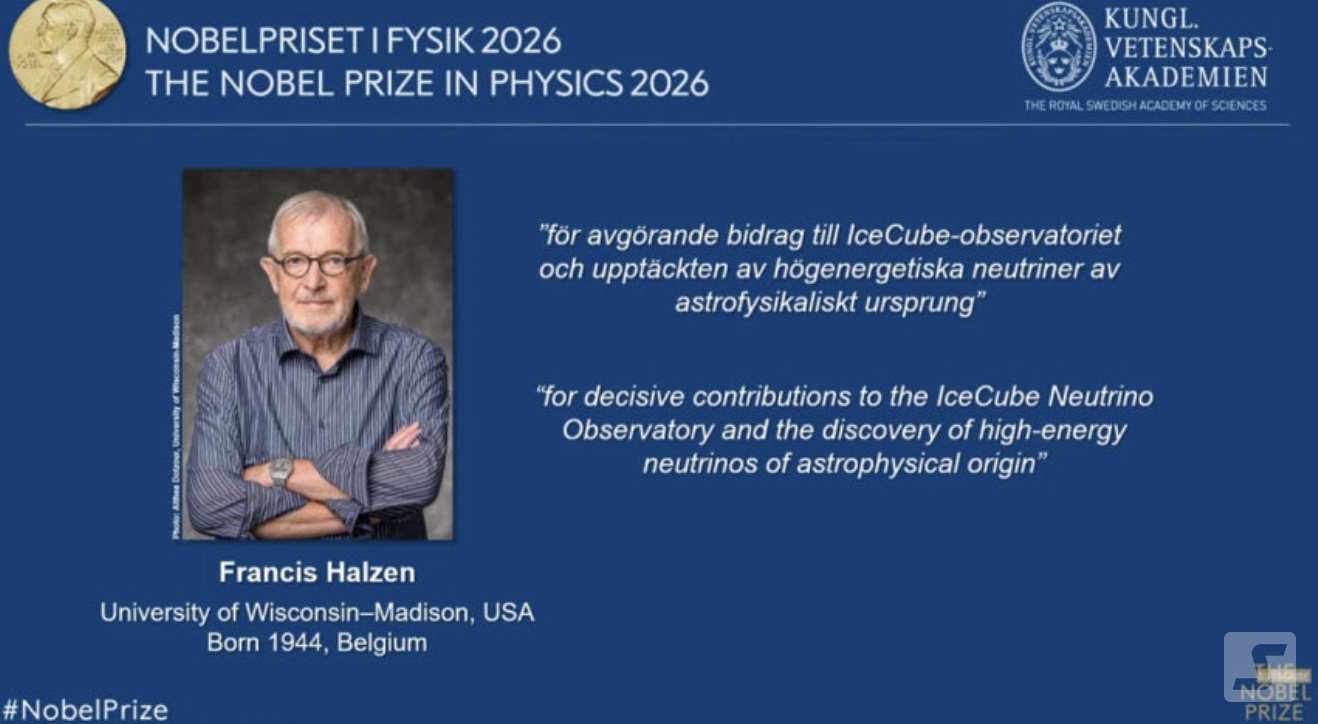
This year's Nobel Prize in Physics went to Professor Francis Halzen of the University of Wisconsin-Madison in the United States, who detected high-energy 'ghost particles' arriving from space and expanded humanity's cosmic observation horizons. It is regarded as an achievement that transcended the limitations of existing cosmic observation, which had primarily relied on electromagnetic waves, and opened a new era of astronomy.
The Nobel Committee stated the selection rationale: "He made decisive contributions to the construction of the IceCube Neutrino Observatory and discovered high-energy neutrinos of astrophysical origin, providing a new key to unlocking the secrets of the universe."
Capturing 'Ghost Particles' with a Massive Telescope within Antarctic Glaciers
Neutrinos are called 'ghost particles' because they have almost no mass and no electric charge, passing through the universe with minimal interaction with matter. While light and X-rays are blocked by cosmic dust and gas, neutrinos can travel in straight lines from where they are generated to Earth, making them key clues for tracing the origins of the universe and high-energy celestial phenomena.
Professor Halzen led the 'IceCube' project, which transformed the thick ice of Antarctica into a massive astronomical observatory. By embedding thousands of optical sensors deep within a cubic kilometer of ice at the South Pole, he successfully detected the faint blue light (Cherenkov radiation) generated when high-energy neutrinos arriving from space collide with atomic nuclei in the glacial ice.
Inauguration of Particle Astronomy Beyond 'Observing the Universe through Light'
The academic community regards this award as marking the firm establishment of 'neutrino astronomy' utilizing neutrinos as a mainstream branch of physics.
Research into uncovering the secrets of the dark universe—such as violent phenomena around black holes and the acceleration mechanisms of cosmic rays—that could not be observed with conventional optical and electromagnetic wave telescopes is expected to gain significant momentum.