


Kim Woo-young's Gwanggyo Column Suwon Hwaseong Haenggung Restoration Project Finally Completed
Complete restoration of all facilities damaged by Japanese colonialism after 119 years
I remember October 9, 2003, when music and martial arts performances gradually began, and the main gate of Shinpungru, the front gate of Hwaseong Haenggung, slowly opened.
An actor portraying King Jeongjo smiled broadly and said:
“Welcome! My descendants. I greet you warmly...”
That day, the opening ceremony of Hwaseong Haenggung was held. More than 2,000 citizens gathered at Hwaseong Haenggung. Those unable to enter Bongsudang, where the event was held, watched this historic moment through a large screen installed in front of Shinpungru.
The master of ceremonies was Professor Kim Jun-hyuk, who garnered much attention in the election and was elected to the National Assembly. He explained the significance of the restoration, saying “Hwaseong Haenggung is a space of hope for all people, and like a new hometown.”
I was happy. Something everyone had thought impossible had been accomplished.
Yet at the same time, my heart felt heavy.
Because the figure of the person who made this possible was not visible. Shim Jae-deok, the former mayor who achieved this historic undertaking, was not present. Instead, Kim Yong-seo, the new mayor who defeated Mayor Shim in the Third National Simultaneous Local Elections held on June 13, 2002, greeted guests as the guest of honor at the celebration. Of course, I too stood at a distance, feeling both moved and bitter.
Because among the main figures who should have sat at the very front of this occasion, there were those who were not visible. Former Mayor Shim Jae-deok and the late Lee Seung-eon, who passed away without witnessing this moment, and many members of the Hwaseong Haenggung Restoration Promotion Committee who were not invited for various reasons...
I too served as publicity director as one of the promotion committee members at that time.
In October 1989, 42 people from various sectors—including the late Shim Jae-deok, then director of Suwon Cultural Center, regional elders such as the late Lee Jong-hak, the late Kim Dong-hui, the late Lee Seung-eon, and Lee Hong-gu, as well as representatives from cultural and artistic circles, academia, community organizations, and the press—formed the ‘Suwon Hwaseong Haenggung Restoration Promotion Committee.’ As mentioned earlier, I participated as a promotion committee member following my role as founding member and took on the important position of publicity director.
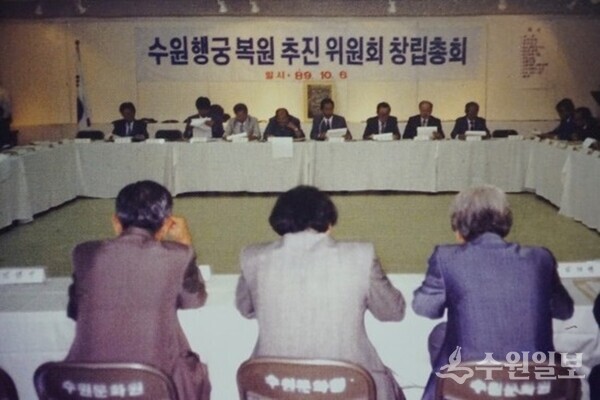
The promotion committee met with then-Gyeonggi Province Governor Lim Sa-bin to relocate Suwon Medical Center, which was planned to be newly built on the Hwaseong Haenggung site. Committee members including Shim Jae-deok, then director of Suwon Cultural Center, Kim Dong-hui, An Ik-seung, and Lee Hong-gu explained to Governor Lim the rationale for restoring Hwaseong Haenggung and proposed relocating and rebuilding Suwon Medical Center. Since Governor Lim readily accepted this proposal, Hwaseong Haenggung was able to emerge from the shadows of history to the forefront. Suwon's history must never forget Governor Lim Sa-bin.
Whether it was heavenly blessing, Shim Jae-deok, who was the core of the restoration project, ran in the 1995 National Simultaneous Local Elections as an independent candidate and, breaking through strong party winds, was elected as the first popularly elected mayor of Suwon. Naturally, the restoration project proceeded smoothly. The first phase of Hwaseong Haenggung restoration began in 1995 and was completed in 2003, with the opening ceremony held on October 9 of that year.
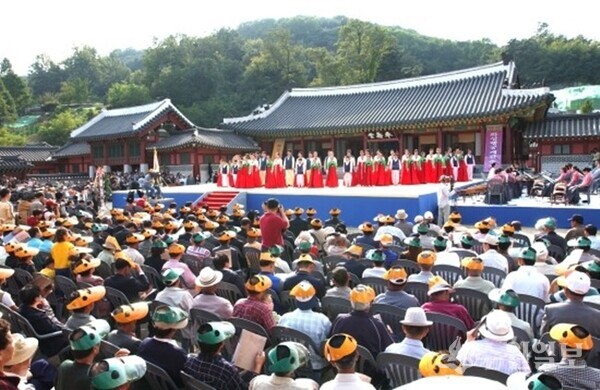
However, in the first phase restoration work, only 482 out of a total of 576 structures were restored.
The second phase restoration project began in 2021. It involves restoring facilities that could not be restored in the first phase, including Uhwagwan on the site of the former Shinpung Elementary School and Byeolju at the site of the haenggung parking lot.
Hwaseong Haenggung was the largest haenggung of the Joseon dynasty and was used each time King Jeongjo visited Suwon. It was also a space created for him to spend his later years in Suwon after retirement. It was a historic place where the 60th birthday celebration of King Jeongjo's mother, Hyegyeong Gung, one of the greatest court events of the Joseon dynasty, was held. It was also a place where rice was distributed to poor people and porridge was cooked for them, and where elderly people from the Suwon region were invited for a longevity banquet.
However, most buildings were demolished during the Japanese colonial period.
Now the second phase restoration project is completely finished.
A few days ago, I received a call announcing the opening ceremony. They asked me to provide my address as they wanted to send an invitation. They also asked for contact information for several people who were promotion committee members at the time. I was pleased.
On April 24 at 2:30 p.m., the ‘Opening Ceremony for the Restoration of Suwon Hwaseong Haenggung Uhwagwan and Byeolju—Hwaseong Haenggung Returned in Its Complete Form Following Completion of Phase Two Restoration’ will finally be held.
‘Uhwagwan, where ceremonies were held monthly in honor of the wooden tablet symbolizing the king, and Byeolju, which prepared food for the 60th birthday celebration of King Jeongjo's mother, Hyegyeong Gung in 1795, have regained their original appearance at the time of their establishment. Hwaseong Haenggung, which was damaged and disappeared during the period of Japanese colonial rule, has been completely restored after 119 years, and we are holding this opening ceremony. We sincerely hope you will attend and grace this historic occasion.’
Such was the content of the invitation that was sent.
Thirty-five years have passed from 1989 to this year, 2024. It has been a long journey. During this time, many people, including former Mayor Shim Jae-deok of Suwon and former Gyeonggi Province Governor Lim Sa-bin, have passed away. I too have aged and my hair has turned completely white.
Many Suwon citizens have waited for the complete restoration of Hwaseong Haenggung. My heart, which has a special connection with Hwaseong Haenggung, is now beating vigorously.