


Suwon, Environmental Capital, Offers Green Healing Spots Throughout the City
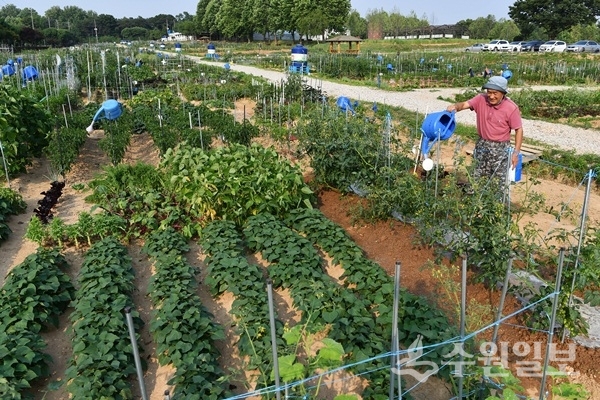
[Suwon Ilbo=Seo Dong-young] Suwon City, a metropolitan city of 1.25 million people that positions itself as an 'environmental capital,' is providing citizens with rest through nature via green healing spots located throughout the urban area.
▲Wise Rural Living, Citizens Farms
The city rehabilitated damaged state-owned land in Dangsudong in 2012 and established a citizens farm with an area of 326,555 square meters, which has been operating since 2013.
When the Dangsudong farm site was designated as a public housing development district, the citizens farm was relocated to Tapdong at the end of 2018.
The Tapdong Citizens Farm covers an area of 119,635 square meters with 1,800 vegetable garden plots where family-based farming experiences are conducted, and scenic areas and rest areas featuring water lilies, buckwheat, sunflowers and other seasonal plantings have been created.
Citizens can easily cultivate plants themselves and reconsider the environment and life. This year's general allotment recorded a competitive ratio of 2.5 to 1. Given the COVID-19 situation, this represents considerable enthusiasm.
In addition, small-scale citizens farms such as Dureteul Park, Mulhyanggi Park, and Youth Culture Park have been created and operate 391 plots, and a fruit orchard is also being operated by planting about 900 fruit trees of 10 varieties in Homaesil-dong.
▲Accessible Green Healing, Urban Agriculture
Urban agriculture is also being well cultivated in apartment complexes and schools.
The city supported vegetable garden cultivation through apartment healing agricultural education and community activation, and over the past five years, green spaces have been created in 42 apartment complexes.
Urban agriculture education was provided to about half of the 57 school garden plots among 111 schools in the Suwon area where educational gardens have been created.
Thirteen sites with unused land, including the Jangan-gu Citizens Hall, had garden parks that enhance the urban appearance created to function like gardens.
Urban agriculture academies, healing agriculture utilizing facilities for dementia elderly care, urban agriculture expert training, distribution of garden boxes, fruit experience education and more were carried out, and this year, an early childhood garden program featuring eco-friendly ecological childcare has been planned for daycare centers.
Previously, the city established an ordinance to promote urban ecological agriculture in 2010 and has continuously pursued efforts to revitalize urban agriculture by nurturing related professional personnel and organizations.
As a result, as of 2019, approximately 64,000 Suwon citizens, accounting for 5.3% of the total population, were found to be participating in urban agriculture. This is higher than the national average of 4.1% and Gyeonggi Province's 4.5%.
The area of urban vegetable gardens has increased about threefold from 15 hectares based on 2013 figures to 44 hectares last year.
▲Environmental Experience Education for Future Generations
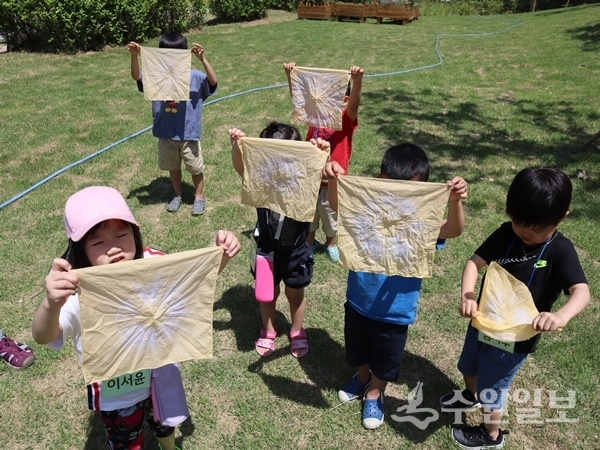
In efforts to bring the city closer to nature, the city has also focused on environmental experience education for future generations.
This is through the Chilbo Ecological Environment Experience Educational Center established in the West Suwon area and the Gwanggyo Ecological Environment Experience Educational Center set up in Gwanggyo, a new city.
The Chilbo Ecological Environment Experience Educational Center, which opened in March 2014, operates nature experience group excursions composed of three courses including five-sense experiences that match seasonal changes; forest after-school classes conducted through paddy field ecology observation and research as well as garden experiences; ecological environmental classes featuring traditional games, wildlife and bird watching activities; and visiting environmental classes.
In particular, the "Waggul Waggul Paddy Program" conducted at the eco-friendly rice field experience area has become a signature program by providing city children with opportunities to experience rice planting and harvesting.
Including this, more than 600 programs per year are conducted, and approximately 110,000 citizens and children have used the facility through last year.
The Gwanggyo Ecological Environment Experience Educational Center, which opened last year, also operated 20 programs in seven themes—the path to learning nature, the path of biodiversity, the path of sharing together, the path of walking together, the path of containing the environment, the path of talent development, and the path of carrying forward the environment—for a total of 857 sessions attended by 14,000 people.
In particular, by establishing a tree frog wetland and garden and utilizing them as permanent educational experience spaces, the center has instilled awareness of environmental conservation among local children.
In addition, more than 100 environmental education programs are operated at 22 hub locations including the educational center.
▲Healing and Prevention of Environmental Diseases
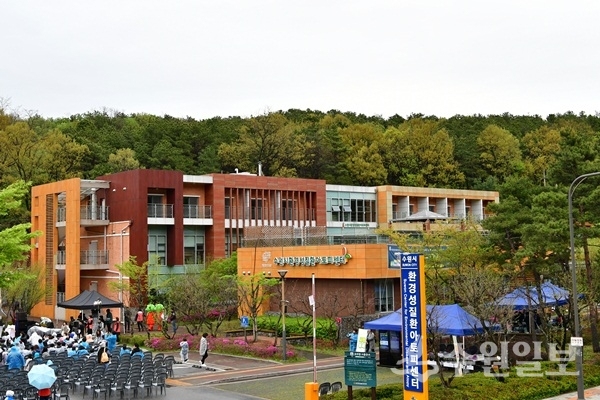
The city has also established infrastructure for people suffering from environmental diseases such as atopy and allergies caused by pollution. The center of this is the Suwon City Environmental Disease and Atopy Center located in Chowon-dong, Jangan-gu.
The Suwon Atopy Center, established on the slopes of Gwanggyo Mountain in 2014, is distinguished as the only environmental disease center in southern Gyeonggi Province and as an urban-type center. It is characterized by eco-friendly elements such as hinoki cypress trees, clay wallpaper, and Korean paper flooring, as well as on-site allergist specialists who provide professional consultations.
The function of the Suwon Atopy Center is divided into two branches: education that teaches patients and families about their disease, treatment, and self-management methods, and prevention-focused group education for infants and citizens.
In particular, customized prevention programs targeting young children, children, adolescents, and guardians have been strengthened. For children aged 3 to 4, picture book play and garden experiences are linked, while for children aged 5 to 7, puppet shows and ecological experience education on medical care, environment, and nutrition enhance environmental sensitivity.
Moreover, satisfaction with visiting prevention education programs that directly visit institutions and organizations is high.
The Suwon Atopy Center, which has gained popularity through word of mouth, has attracted considerable attention from urban residents, increasing from 44,058 visitors in its opening year to 125,420 in 2019.
The city in particular has established and operates the 'Suwon Atopy Cluster' with the Suwon City Environmental Disease and Atopy Center, Namchang Elementary School (atopy-specialized school), and Yeongdeunggu Health Center (atopy prevention and management project health center) to build an urban safety management network for atopy disease.
The three institutions collaborate on medical support through patient referrals, provision of prevention education, programs linking affected families, and identification of vulnerable patients, serving as a model for other local governments.
A city official said, "Through Suwon's environmental policies connecting agriculture, ecological experiences and healing, environmental education and beyond, from the past and present to the future, citizens will be able to feel nature more closely."