Pyeongtaek Mayor Jung Jang-seon Proposes Fine Dust Solutions at Special Countermeasures Committee
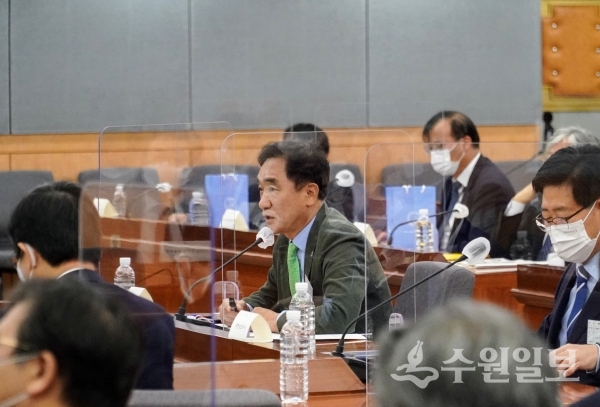
[Suwon Ilbo=Reporter Seo Dong-young] Pyeongtaek Mayor Jung Jang-seon attended the 4th Special Fine Dust Countermeasures Committee presided over by the Prime Minister on the 2nd.
Mayor Jung presented progress on Pyeongtaek City's comprehensive fine dust countermeasures, the 'Pyeongtaek Blue Sky Project,' and strongly urged government support for 'joint cooperation body support among 12 local governments' and 'marine ecological park development in the Pyeongtaek Port hinterland' to resolve the fine dust problem in Pyeongtaek City.
Pyeongtaek City is adjacent to the West Sea and serves as a junction area connecting the capital region and provincial areas. Near the city, major government industrial facilities are concentrated, including coal-fired power plants, Pyeongtaek Port, Hyundai Steel, and large-scale national industrial complexes. Fine dust generated from these facilities is affecting Pyeongtaek City and nearby local governments via westerly winds.
To address the fine dust problem, Pyeongtaek City established a comprehensive fine dust reduction plan, the 'Pyeongtaek Blue Sky Project,' in July 2018, and is implementing comprehensive fine dust countermeasures across internal and external sectors.
In internal sectors, the city has developed multifaceted fine dust reduction policies by subdividing areas including transportation, greenery, agriculture, education, and carbon reduction.
The city is promoting the largest hydrogen vehicle supply in Gyeonggi Province, securing hydrogen infrastructure including hydrogen production facilities and hydrogen charging stations, urban forest development, and environmental academies for public awareness.
Additionally, through frequent meetings with the Prime Minister, ministers from various departments, governors, and lawmakers, the city has discussed fine dust countermeasures and achieved results including designation of the Pyeongtaek Port management area and reflecting shore power supply systems (AMP). In particular, Korea Western Power Co., Ltd.'s transition to clean fuel through coordination with the Ministry of Trade, Industry and Energy is one of the major fine dust reduction achievements.
As a result, Pyeongtaek City achieved a 32% reduction rate in fine dust compared to the same period last year (January to September). This is the highest reduction rate in Gyeonggi Province.
Minister of Oceans and Fisheries Moon Sung-hyuk, who attended the meeting, stated, 'The Ministry of Oceans and Fisheries' view and Pyeongtaek City's view are aligned,' and promised active review going forward.
Private committee members also agreed with Pyeongtaek City's proposals. Bae Gwi-nam, a Korea Institute of Science and Technology (KIST) member who attended, said, 'I greatly empathize with the damage suffered by residents of local governments adjacent to large-scale fine dust emission facilities like Pyeongtaek City,' and 'If the government derives solutions tailored to the characteristics of regions like Pyeongtaek City where fine dust damage is concentrated, it will have greater policy ripple effects than other regions.'
Mayor Jung Jang-seon of Pyeongtaek stated, 'Since the causes of fine dust in Pyeongtaek City share the major causes of fine dust in the capital region and Chungcheong Province, intensively addressing Pyeongtaek City's fine dust problem can prevent fine dust damage to the capital region, Chungcheong Province, and 27 million people—accounting for half the nation.' He added, 'To do so, active support at the government level is essential, including developing marine ecological parks at Pyeongtaek Port and supporting joint cooperation bodies.'