Gyeonggi Province Accelerates Development of 'Hydrogen Convergence Themed Cities' to Position Itself as Leader in Hydrogen Economy
 \r\n
\r\n[Suwon Ilbo=Park No-hun] As the government announced a hydrogen economy activation roadmap including the supply of 6.2 million hydrogen vehicles by 2040 and construction of 1,200 hydrogen charging stations, Gyeonggi Province is moving forward with the development of 'region-customized hydrogen convergence themed cities' in line with this initiative.
\r\n\r\nThe province will concentrate investment by linking hydrogen, a next-generation energy source, with region-specific industries. Through economies of scale and implementation of low-carbon cities, investment attraction, change in provincial residents' awareness, and expansion of the hydrogen ecosystem are expected.
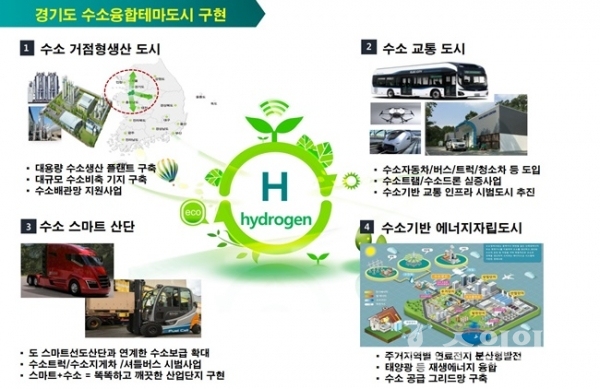
\r\n\r\nGyeonggi Province announced on the 5th that it is pursuing the 'hydrogen convergence themed city project,' which includes the development of an Ansan hydrogen pilot city, construction of a Pyeongtaek hydrogen transportation complex base and hydrogen production facility, and discovery of a Gyeonggi-type hydrogen convergence cluster.
\r\n\r\nCurrently, some local governments are carrying out projects focused on individual infrastructure installation such as hydrogen charging stations, but they are facing difficulties due to unconfirmed economic feasibility and low community response.
\r\n\r\nIn response, the province presented the concept of hydrogen convergence themed cities through a 'basic plan for hydrogen energy ecosystem development' in September 2019. The aim is to discover large-scale hydrogen-linked specialized industries by region (cities, transportation, etc.) to attract government funding and private investment.
\r\n\r\nThe province has been implementing four projects related to hydrogen convergence themed cities since last year. First, it attracted the hydrogen pilot city project (a national competition project led by the Ministry of Land, Infrastructure and Transport) to Ansan, the first of its kind nationwide, and has been developing it with a budget of 29 billion won since last year.
\r\n\r\nThe project involves installing hydrogen production facilities using LNG at Ansan Urban Development Co., Ltd. site and actively utilizing hydrogen as an energy source for the city's transportation (hydrogen buses and charging stations), residential areas (heat and electricity supply through hydrogen fuel cell power generation), and industrial complexes (fuel cells, hydrogen forklifts, and demonstration of hydrogen production through electrolysis using surplus power from the Sihwa Tidal Power Plant). It is scheduled for completion in 2022.
\r\n\r\nIn Pyeongtaek, a hydrogen transportation complex base construction project and hydrogen production facility project are being pursued in parallel.
\r\n\r\nAt Pyeongtaek Port, a logistics and transportation hub, hydrogen production facilities (21 billion won scale) are being developed in the second half of this year. The plan involves building a complex infrastructure that consolidates ancillary facilities such as hydrogen vehicle maintenance and validates the effectiveness of hydrogen transportation.
\r\n\r\nTo this end, the province was selected last year as the first nationwide for the Ministry of Land, Infrastructure and Transport's hydrogen transportation complex base competition project (160 billion won scale) and is expecting project completion in 2023.
\r\n\r\nThe province is also pursuing 'discovery and fostering of Gyeonggi-type hydrogen convergence clusters,' a concept of specialized industrial complexes for developing, demonstrating, and utilizing the entire hydrogen industry.
\r\n\r\nA research project for site selection will run through June of this year, and the province plans to accelerate project realization by participating in government competition projects in the future.
\r\n\r\nIn addition to the existing four projects, the province plans to organize a consultation body to respond to the Ministry of Land, Infrastructure and Transport's additional hydrogen city designation next year and will continue follow-up projects such as discovering Gyeonggi-type eco-friendly hydrogen transportation models in representative regions for transportation, logistics, and ports.
\r\n\r\nPark Sung-nam, head of the Gyeonggi Province Environment Bureau, said, "The economic effect of the domestic hydrogen industry is estimated at 70 trillion won annually, and Gyeonggi Province is recognized as the region with the highest hydrogen demand nationwide, accounting for 25% of population, 35% of manufacturers, and 24% of automobiles." He added, "We will prepare to have Gyeonggi Province lead the domestic hydrogen industry by building a hydrogen economy ecosystem centered on hydrogen, a clean energy source."