Gwanggyo New City, Korea's First Locally-Built New Town, Completes Development 20 Years After Start
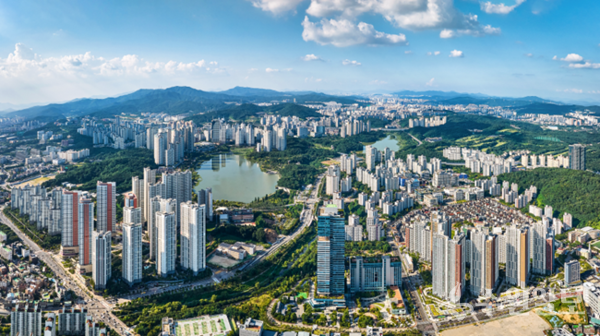
[Suwon Ilbo=Reporter Kim Gap-dong] Gwanggyo New City, Korea's first new town built by a local government (joint project operators: Gyeonggi Province, Suwon City, Yongin City, and Gyeonggi Housing & Urban Development Corporation), has been completed 20 years after development began.
According to Gyeonggi Province on the 6th, the Ministry of Land, Infrastructure and Transport announced through a notice on January 31 that the completion date of the Gwanggyo district housing site development project is December 31, 2024.
Gwanggyo New City began when the Ministry of Construction and Transportation designated it as a planned housing site development district on June 30, 2004. After the government confirmed and announced the development plan in December 2005, making it the first case in Korea where a local government would oversee the project, work proceeded sequentially through completion of phases 1-7 by 2023.
The completion follows the completion of the final phase 8 process, including the completion of site development for the Gyeonggi Convergence Town, the exclusion of the Yeongdong Expressway site, and the completion of the handover to Suwon City of the green space next to the road.
Housing site development projects involve converting former agricultural and paddy lands to new green spaces and lots, constructing basic infrastructure such as roads and water supply and sewage systems, and then supplying them. The province explained that the development of Gwanggyo New City means that the creation and supply of such basic infrastructure has been completed.
Gwanggyo New City was developed over an area of 10.8km² (3.26 million pyeong) in the Uidong, Woncheon, and Hadong areas of Yeongdeungpo-gu, Suwon, and Sanghyeon-dong, Suji-gu, Yongin. Suwon accounts for 88% and Yongin 12%. It is a second-phase new town in the Seoul metropolitan area, developed alongside Wirye, Dongtan, and Pangyo new towns. As of the end of last year, the population is 78,571, making it an eco-friendly city with the highest green space rate (44.1%) and the lowest population density (72.8 people/ha) among domestic new towns.
In the Gyeonggi Convergence Town in Gwanggyo New City, the Gyeonggi Provincial Government, Gyeonggi Provincial Assembly, Gyeonggi Provincial Office of Education, Bank of Korea Gyeonggi Branch, Gyeonggi Housing & Urban Development Corporation, and Uidi 119 Safety Center have completed their moves. The Gyeonggi Credit Guarantee Foundation is scheduled to move in this year, and the Gyeonggi Library will open. The Suwon Convention Center, equipped with an exhibition hall and small conference rooms, and the Gwanggyo Legal Town, including the Suwon District Court and Prosecutors' Office and the High Court and Prosecutors' Office, were completed in 2019 and are supporting self-sufficient city functions.
Through eco-friendly urban planning, the residential area ratio was limited to around 19% to preserve green space corridors, and the green space area ratio was set at 44.1% of the total city area. This is significantly higher than Pangyo (35%), Bundang (20%), Ilsan (22%), and Gimpo (28%). The city features nature-friendly parks embracing the Woncheon and Sindae lakes and has a circulation system that purifies and supplies the lake water upstream. It won the 'Republic of Korea Landscape Award' in 2014.
With the opening of the Shinbundang Line extension, a wide-area transportation facility, commute times to Gangnam have been shortened to approximately 30 minutes. Traffic conditions have improved through the expansion of the Sanghyeon interchange on National Route 43, the opening of the North Suwon private-funded road, and the opening of roads between Sanghyeon IC and Sammakgok.
Son Im-sung, director of the Province's Urban Housing Division, said, "Gwanggyo New City was developed by broadly collecting opinions from experts and residents in various fields from the planning stage through development, completion, and supply," adding, "We will continue to pay close attention and make our best efforts in systematic urban management and development."
Kim Se-yong, president of Gyeonggi Housing & Urban Development Corporation (GH), stated, "Based on diverse experience and know-how accumulated through the development of Gwanggyo New City, we will play a central role in the third-phase new town project currently underway," adding, "We will not only create sustainable cities but also strengthen our role as urban operators and managers in the future."