Yangpyeong County Accelerates Smart Future City Construction through Public Transportation Restructuring
[Suwon Ilbo=Reporter Eom In-yong] Yangpyeong County has experienced rapid population growth over the past decade, with the population increasing from 100,000 in 2014 to approximately 129,000 as of 2024. This ranks first among county-level local governments nationwide.
Accordingly, as transportation demand expands and vehicles increase in urban areas due to population growth, Yangpyeong County recognizes the need to improve existing transportation systems. The county is making all-out efforts to create a sustainable transportation environment through more systematic expansion of public transportation infrastructure.
- Making the region more closely connected with launch of Yangpyeong downtown circular bus
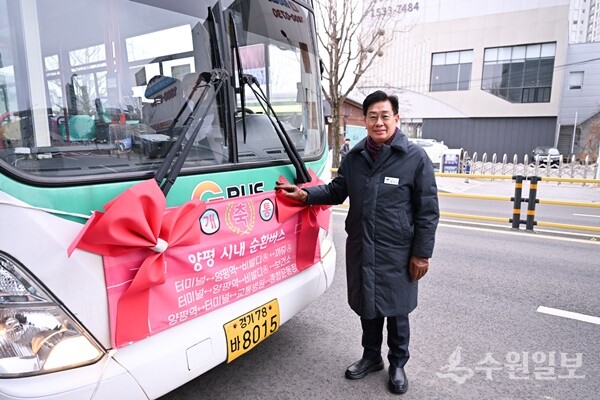
As residents moved into newly completed apartment complexes, the Gangsang circular bus was launched in 2023 to respond to residents' transportation needs. This year, the Yangpyeong downtown circular bus has begun operations to more densely connect major areas within Yangpyeong.
The route departs from Yangpyeong Bus Terminal at 6:40 a.m. and circulates through four routes, with concentrated operations during morning commute and school hours to improve residents' mobility convenience. This is expected to improve residents' travel convenience and resolve existing transportation dead zones.
- Yangpyeong Station transformed into transportation hub, becoming smarter and more convenient
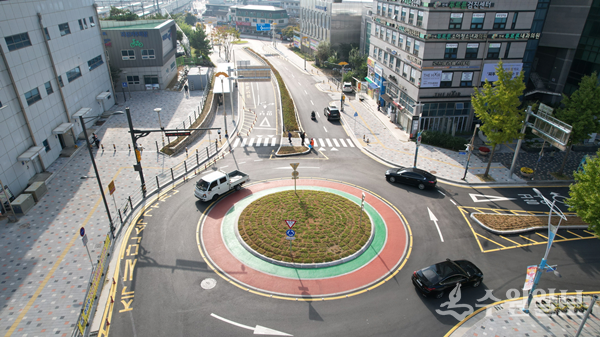
The Yangpyeong Station area is where major roads intersect, and had experienced chronic traffic congestion. To address this, the county has expanded the roundabout and improved nearby road environments. The area in front of the station has been designated as a no-parking zone and transfer boarding/alighting areas have been newly established to smoothen vehicle flow.
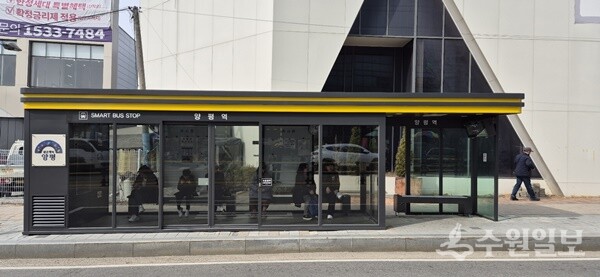
In particular, the installation of smart bus shelters equipped with heating and cooling systems, heated and cooled seats, air purifiers, and free Wi-Fi has made transfer waiting spaces more pleasant, further enhancing residents' convenience when transferring between transportation modes. Smart bus shelters are currently installed at the Yangpyeong Market entrance and Yangpyeong Station. The county is securing budgets through national and provincial subsidies and proposal-based projects to install at least one smart bus shelter in each township this year.
The small roundabout in front of Yangpyeong Station, where chronic vehicle congestion had occurred, has been restructured through the Yangpyeong Urban Planning Road Improvement Project, allowing large vehicles to pass through smoothly in an efficient structure. Centered on Yangpyeong Station, transfer vehicle parking zones have been designated to construct a seamless transfer system connecting railways, taxis, and buses, thereby increasing transportation satisfaction.
- Getting closer to residents with efficient routes, pursuing bus route system restructuring project
The county's existing bus routes have drawn complaints that in some areas, frequencies are low and the number of routes is excessively high relative to available vehicles. Currently, Yangpyeong County operates 162 routes with 47 buses under a course-based system where one vehicle operates multiple routes. The public transportation mode share is only 3.5%, compared to the Gyeonggi Province average of 15%. Additionally, over 90% of all routes operate fewer than five times per day, resulting in low mobility convenience for residents.
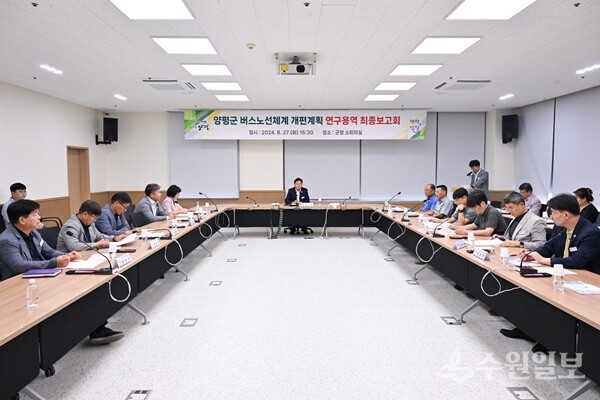
In response, the county conducted a 'bus route system restructuring research project' in 2024 to more systematically and efficiently restructure bus routes. The plan under review involves reducing 162 routes to approximately 60 and increasing daily operations from the existing 374 trips to over 700.
Through this, the county plans to clearly analyze problems in the municipal public transportation system, including wide intervals between buses, overlapping routes, poor accessibility to railway stations, and low transportation mode share. It will strengthen connections between buses, trains, taxis, and other public transportation modes and establish a convenient public transportation system for residents and tourists through efficient restructuring based on big data analysis. The county is also conducting detailed implementation plan studies this year to reflect changed routes from the second half of next year.
- Train pass ticket subsidy support, realizing residents' tangible transportation welfare
The county is implementing a train pass ticket subsidy project to reduce the transportation cost burden on residents who commute or attend school outside the county. This project, which began in October 2023, is being pursued with the goals of promoting public transportation use and expanding transportation welfare.
Last year, the county provided train fare subsidies to 1,228 residents, with a total support amount of approximately 102 million won. This has significantly alleviated the economic burden on residents who commute or attend school over long distances using railways and has received strong positive response from residents.
- Laying foundation for systematic transportation infrastructure construction, foundation for sustainable Yangpyeong
The county believes that for the region to become sustainable, systematic improvement of existing transportation and creation of forward-looking infrastructure are essential.
Accordingly, the county has signed agreements with Korea Electric Power Corporation and telecommunications companies to undertake an 'underground power line street environment improvement project' in approximately 450 meters around Yangpyeong's clean market area. Additionally, projects befitting the county's goal of creating a 'safe' city are underway, including establishment of a roundabout beneath the Gyeongui-Jungang Railway line and improvement of imbalanced sidewalk widths between roadways and pedestrian paths.
The project is scheduled for completion in April. With the removal of utility poles cluttering existing sidewalks and the connection of east-west axis roads between Yanggun-ri and Changdae-ri, residents will be provided with a safe and pleasant walking environment and a more convenient transportation network.
The county views the transportation system restructuring as the foundation for creating a public transportation-oriented smart city environment in the future and plans to continue establishing more convenient and safe transportation systems through various transportation policies.
County Governor Jeon Jin-seon stated, "This public transportation improvement project is not a short-term solution, but rather a foundation for building more sustainable and systematic transportation infrastructure," and added, "Going forward, I will establish transportation policies that reflect the demands of county residents and create an attractive Yangpyeong where public transportation use is even more convenient."