Gyeonggi Province Proposes State Agenda Items Including 'Future Growth Project' to Presidential Policy Committee
[Suwon Ilbo=Reporter Kim Gap-dong] Gyeonggi Province submitted issues and suggestions to the Presidential Policy Committee to ensure that major proactive provincial initiatives being pursued, such as the construction of a semiconductor megacluster and a 4.5-day work week, can be reflected in state agenda items.
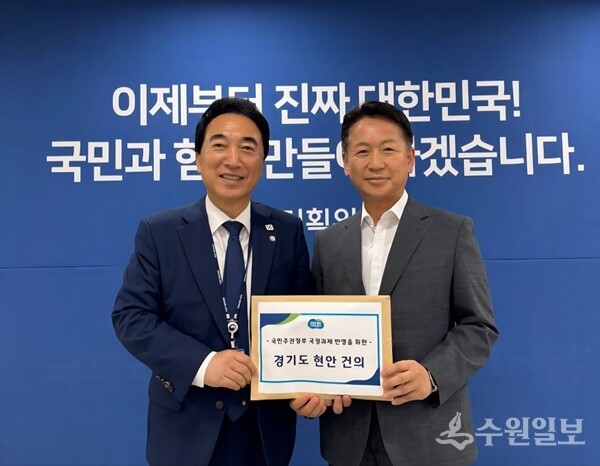
Deputy Governor for Economy Ko Young-in met with Park Su-hyun, Chairman of the National Balanced Growth and Development Special Committee, at the State Agenda Committee located in the Changseong-dong annex of the Government Seoul Office on the morning of the 3rd, and submitted and personally explained 'Gyeonggi Province Issues and Suggestions' that include the 'Three Major Future Growth Projects,' people-oriented policies such as the 4.5-day work week and climate insurance, and the sharing of labor inspection authority with local governments.
The 'Three Major Future Growth Projects' that Gyeonggi Province is focusing on are △Construction of K-Semiconductor Megacluster △Creation of Climate Tech Cluster and RE100 Conversion △Private Recruitment of AI Computing Centers and Designation of AI Leading Business Special Zones.
First, the 'K-Semiconductor Megacluster' aims to establish a special economic zone centered on the semiconductor value chain in Yongin, Hwaseong, Pyeongtaek, and Icheon, and to promptly enact a 'Semiconductor Special Act' to secure both industrial competitiveness and supply chain stability. Through this, government support will be attracted for infrastructure development, tax incentives, and preliminary feasibility study exemptions, establishing the foundation for a leap forward as a global semiconductor hub.
Second, the 'Climate Tech Cluster' for responding to the climate crisis is planned to be developed within the Peace Economy Special Zone, and it will establish an advanced ecosystem encompassing technology demonstration, business incubation, and regional energy independence in connection with RE100-exclusive industrial complexes and large-scale renewable energy clusters. To this end, the province also requested the enactment of a 'Climate Tech Special Act' and government budget support.
Third, the designation of private recruitment of AI computing centers and AI leading business special zones includes plans to establish region-specific specialized clusters (Siheung AI-Bio, Hanam AI Services, etc.) centered on Pangyo and to attract AI computing centers based on AI highway construction and data infrastructure development. Gyeonggi Province included legal and financial support for the designation of an 'AI Leading Business Special Zone,' GPU (Graphics Processing Unit)/NPU (Neural Processing Unit) cloud support, and an AI talent training program for 4,000 people to realize this plan.
The 'People-Oriented Policies' encompass 10 current issues across 5 themes that Gyeonggi Province is leading, including elderly care systems, state responsibility for long-term care, reduction of working hours, youth opportunities, and climate welfare.
The province has been conducting a pilot project for a 4.5-day work week since June targeting 68 companies in the province to reduce working hours. As a microcosm and testbed of the Korean economy and labor market, the province plans to share results of policy experiments on working hour reduction for the successful implementation of the new government's pledges and requested government budget support for nationwide expansion and institutional establishment of the 4.5-day work week.
Regional development and balanced growth measures include railway network expansion, startup and job creation infrastructure, development plans for northern Gyeonggi Province, and GTX integrated network construction.
In addition, the province suggested legal and institutional improvements including the sharing of labor inspection authority with local governments. The content states that standards requiring nationwide uniformity should be set by the central government, and labor supervision and inspection authority at worksites should be shared between the central and local governments, requiring amendments to the Labor Standards Act. The province also requested amendments to the 'US Forces Provided Land Act' to promote the development of returned US military bases in Uijeongbu and Dongducheon. Additionally, the province requested government budget support for pending issues including expansion of public children's rehabilitation hospitals in southern Gyeonggi Province, baby boomer light jobs, and fire insurance for small business owners.
Gyeonggi Province's issues and suggestions were also mentioned at President Lee Jae-myung's press conference marking his 30 days in office held on the day. President Lee stated that the government would spare no investment in advanced technology industries such as AI and semiconductors and renewable energy-related industries, and expressed his intention to gradually pursue the 4.5-day work week through social dialogue. Emphasizing the construction of a safe society by mentioning industrial accidents and measures for truth-finding and prevention of recurrence, the possibility of realization of Gyeonggi Province's issues has increased. President Lee also instructed at a recent State Council meeting to proactively review the issue of handling returned US military bases in northern Gyeonggi Province, making it possible to expect resolution of this matter as well.
The province plans to continue submitting issues and suggestions through meetings with members of the National Assembly.