Kim Dong-yeon, "4.5-Day Work Week is a Social Experiment to Redesign Work Style and Life Balance"
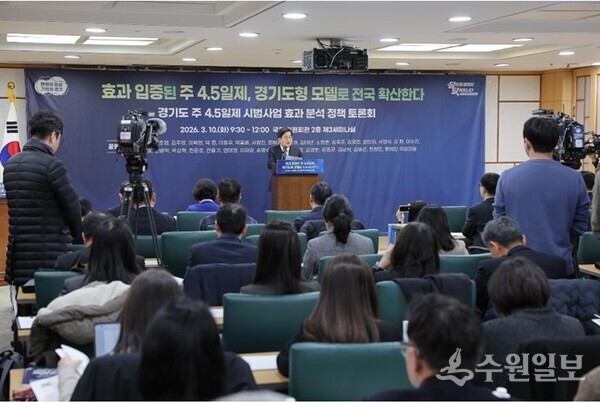
[Suwon Ilbo=Reporter Kim Gap-dong] Gyeonggi Province Governor Kim Dong-yeon strongly stated that the effects of Gyeonggi Province's 4.5-day work week have been proven and expressed his commitment to nationwide expansion and adoption of a coexistence and cooperation model between large and small-medium enterprises.
Governor Kim Dong-yeon attended the 'Policy Forum on Effect Analysis of 4.5-Day Work Week Pilot Project' held on March 10 at Seminar Room No. 3 of the National Assembly Members' Hall, emphasizing that "the 4.5-day work week is not simply a policy to reduce working hours" and is "a social experiment to redesign work style and life balance."
Governor Kim stated, "We are now living in an era of AI transformation. Work styles are changing very rapidly. In this period of change, the standard of labor is shifting from how long one works to how one works and how one lives," and "in response to this change, Gyeonggi Province was the first in the nation to implement a 4.5-day work week without wage reduction."
"As a result of analyzing the effects of the pilot project over one year, employees' life satisfaction increased, and corporate sales and customer satisfaction also increased," he said, adding "people became happy, which increased productivity. This can lead to enhanced corporate competitiveness."
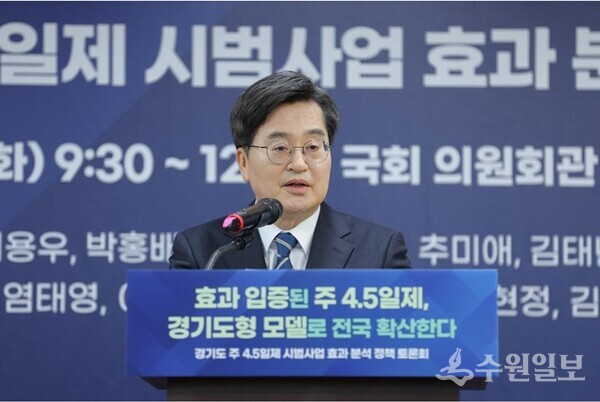
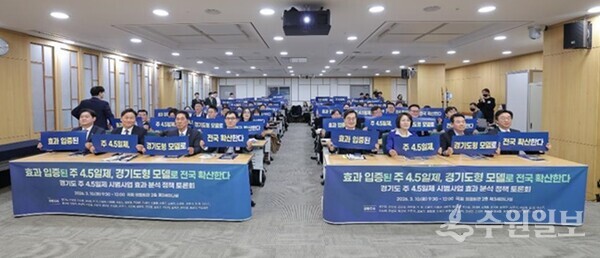
Governor Kim stated, "The citizen-centric government has presented labor hour reduction as a state policy and is promoting nationwide expansion of the 4.5-day work week," adding, "As the government's primary partner, Gyeonggi Province will cooperate with the government and National Assembly. Gyeonggi Province, which has first accumulated experience and data from the field, will lead the change."
Today's forum participation was arranged as part of Governor Kim Dong-yeon's second livelihood economy field tour that began in February, and discussions were held on development plans for the 4.5-day work week that Gyeonggi Province implemented nationwide for the first time starting in 2025.
Gyeonggi Province's 4.5-day work week pilot project is a policy that shortens employee working hours without reducing worker wages. As of December 2025, 107 organizations (106 companies and 1 public institution) are participating.
Starting with this forum, the province plans to expand social discussion about the '4.5-day work week,' a model of labor hour reduction without wage reduction, nationwide. In particular, in addition to the existing model that provides wage compensation incentives of up to 270,000 won per worker per month (based on 5 hours reduction per week), the province plans to implement a coexistence cooperation model with large and small-medium enterprises from this year. This approach involves large enterprises contributing to a coexistence cooperation fund, with Gyeonggi Province adding additional resources to broadly support small-medium enterprises in reducing labor hours. This is to overcome structural limitations of the small-medium enterprise sector where labor hour reduction is difficult based solely on individual company will. Specific directions and details are under discussion.
At today's event, Gyeonggi Province and 33 National Assembly members including Ahn Ho-young, Kim Ju-young, Lee Hak-young, Park Jung, Lee Yong-woo, Park Hong-bae, Seo Wang-jin, Jung Hye-kyung, Choo Mi-ae, Kim Tae-nyeon, So Byung-hoon, Song Ok-joo, Kim Young-jin, Choe Min-hee, Seo Young-seok, Kim Hyun, Lee Su-jin, Kim Seung-won, Min Byung-deok, Park Sang-hyuk, Han Jun-ho, Jeon Yong-ki, Yeom Tae-young, Lee Jae-gang, Son Myung-soo, Kim Jun-hyuk, Kim Hyun-jung, Kim Young-hwan, Yun Jong-gun, Kim Nam-hee, Kim Yong-man, and Han Chang-min jointly hosted the event. Additionally, approximately 100 labor, management, and government officials participated, including Gyeonggi Chamber of Commerce and Industry Chairman Kim Chun-ho, Korean Confederation of Trade Unions Gyeonggi Regional Headquarters Chairman Kim Yeon-poong, and Democratic Labor Federation Gyeonggi Headquarters Policy Planning Director Han Sang-jin.
According to the 'Effect Analysis of Gyeonggi Province 4.5-Day Work Week Pilot Project' presented by Gyeonggi Jobs Foundation CEO Yun Deok-ryong and 'Implications of Effectiveness Review of Gyeonggi Province 4.5-Day Work Week Pilot Project' presented by Work Citizen Research Institute Director Kim Jong-jin at today's forum, working hours decreased by 4.7 hours per week, showing the possibility of approximately 240 hours of reduction annually. From a corporate perspective, labor productivity per worker is estimated to have increased by 2.1%, the recruitment competition rate increased from 10.3:1 to 17.7:1, and the turnover rate decreased by 5.4 percentage points from 22.8% to 17.4%. From the worker perspective, stress awareness decreased by 6.9 points to 58.5 points, showing clear improvements in quality of life.
However, some workers felt increased workload compared to before the reduction, and job commitment showed a slight decline, indicating the need for business process redesign and motivation strategies suited to the labor hour reduction environment.
In comprehensive discussion chaired by Seoul National University of Science and Technology Professor Jung Heung-jun, labor, management, and government officials including Ministry of Employment and Labor Wage and Working Hour Policy Division Director Han Jin-seon, Korean Confederation of Trade Unions Gyeonggi Regional Headquarters Education Division Director Lee Soon-gap, Democratic Labor Federation Gyeonggi Headquarters Policy Planning Director Han Sang-jin, and Gyeonggi Chamber of Commerce and Industry Standing Director Kim Jin-woo discussed institutional improvements and expansion plans and gathered on-site opinions.
The province places significance on the fact that this pilot project was adopted as a state policy of the citizen-centric government and became an impetus for the Ministry of Employment and Labor's 'Work-Life Balance Plus 4.5 Project.' Despite the short implementation period, the province confirmed that both maintenance of corporate productivity and improvement of workers' quality of life were achieved. Going forward, the province plans to strengthen cooperation with the government and National Assembly to ensure that the Gyeonggi Province model is adopted when the 4.5-day work week is implemented nationwide.
Meanwhile, inquiries regarding Gyeonggi Province's 4.5-day work week pilot project can be made to the Gyeonggi Jobs Foundation Northern Broad-area Business Team (031-270-9839).