


Op-Ed Gwangju Mayor Park Gwan-yeol's Claim of 'One-Sided Sacrifice' of National Industrial Complex Resonates
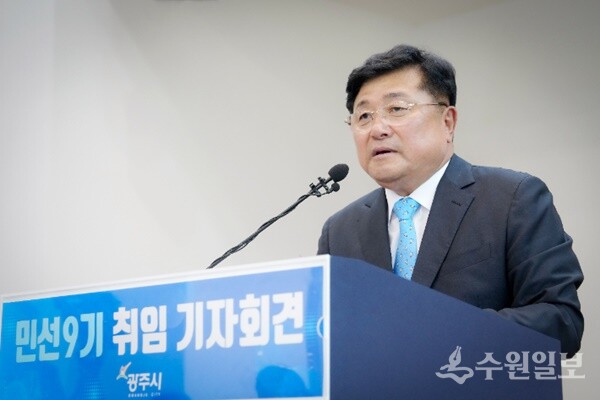
Gwangju Mayor Park Gwan-yeol of Gyeonggi Province held his first press conference at City Hall following his inauguration and revealed the core values of his municipal administration. His policy direction prioritizes 'communication, results, and pragmatism' as the top agenda to bring about changes in citizens' lives before the city's external appearance. Mayor Park stated, "Although the population of Gwangju is continuously increasing, the quality of life that citizens feel has not yet sufficiently changed," pledging to implement administrative measures that bring about change in citizens' lives. (Related article: Suwon Ilbo, 21st edition, 'Gwangju Mayor Park Gwan-yeol's 9th Mayoral Term Core Values as 'Communication, Results, and Pragmatism')
The goals for Gwangju that he outlined are 'a direct connection city where communication flows smoothly' 'a Gwangju where parents raising children are relieved of childcare concerns and youth prepare for their futures' 'a convergence city where urban AI technology and urban development advance together, and where energy and industrial complexes are simultaneously established, where citizens learn, research, and start businesses' 'promotion of Gyeonggang Line commuter shuttle trains, introduction of Gwangju-style night owl buses, and phased expansion of railroad and road networks' 'research and development functions for semiconductors and AI, and human resource development'.
It will be interesting to see in four years how much of Mayor Park's promise—to foster 'a city where citizens become happy,' 'grows through convergence,' 'has improved transportation,' and 'where work and life harmonize'—based on 'a direct connection city where communication flows smoothly,' can be realized.
On this occasion, Mayor Park mentioned the region's most pressing issue: the water supply pipeline problem for the Yongin semiconductor national industrial complex. Mayor Park pointed out, "Out of the total 46.9 km of industrial water supply pipelines to be supplied to the Yongin semiconductor national industrial complex, 16.5 km—one-third of the total—passes through the heart of Gwangju." He emphasized that large-scale government investment commensurate with Gwangju's sacrifice is necessary.
Recalling the fact that Gwangju has made sacrifices for over 50 years through overlapping regulations to preserve the water quality of Paldang Lake, he clearly stated that the city cannot once again accept unilateral sacrifice. After clarifying, "This does not mean we will refuse to cooperate for national industrial development," he firmly stated that since co-prosperity begins with regional cooperation, justified demands must be reflected and practical co-prosperity measures must be established.
In the Gwangju area, there is pushback against what is viewed as the government forcing one-sided sacrifice in relation to the integrated water supply project for the Yongin Advanced System Semiconductor Cooperation Complex that the government is promoting. In connection with this, Mayor Park, as the mayor-elect from June 17th, conducted solo sign-holding protests in front of Samsung Digital City in Suwon, where Samsung Electronics headquarters is located, urging the government, Gyeonggi Province, and Samsung Electronics to establish co-prosperity measures.
The government compensation measures that Mayor Park is officially requesting are △establishment of an artificial intelligence (AI) smart city of 30,000 units △attraction of AI and semiconductor research and development (R&D) and talent cultivation institutions △investment in smart water industry, among others. These are also the wishes of Gwangju citizens.
Mayor Park plans to continue consultations with relevant agencies so that Gwangju's position can be reflected and will continue external activities to urge the establishment of co-prosperity measures. Mayor Park's argument that practical co-prosperity measures must be established is absolutely not excessive.