


EXCLUSIVE Government Says No, but Gyeonggi Province Declares "Factual Default" — Crisis or Exaggeration?
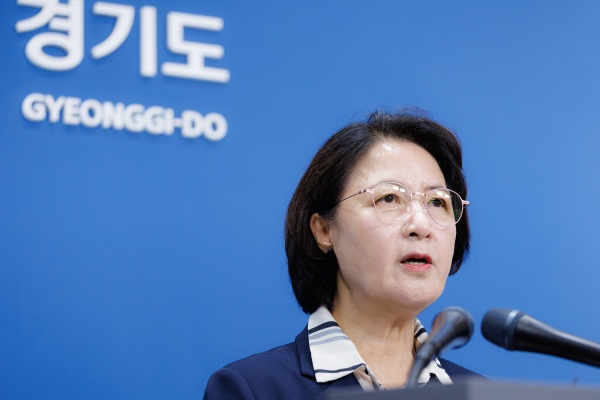
Gov. Choo Mi-ae of Gyeonggi Province diagnosed the province's finances as being in a "state of factual default,"but it has been confirmed that this does not meet the fiscal risk warning standards under the government's local financial risk management system.
According to the Interior and Safety Ministry on the 10th, the ministry conducts quarterly inspections of fiscal risk levels for local governments nationwide. Currently, Gyeonggi Province headquarters does not meet the criteria for either "fiscal caution entities" or "fiscal crisis entities" under the Local Finance Act.
In the case of Gyeonggi Province, all six fiscal indicators checked by the Interior and Safety Ministry are below the "caution level." An official from the Interior and Safety Ministry stated, "Currently, Gyeonggi Province headquarters, based on risk level inspection results, does not fall under the caution level or crisis level." When asked about specific figures, the official said disclosure was difficult, noting that "we only inspect internally," but when asked again about the six indicators for Gyeonggi Province, the official said "all indicators are below the caution level."
Article 65-3 of the Enforcement Decree of the Local Finance Act sets fiscal caution and crisis standards for each of six financial indicators. The indicators are ▲consolidated budget surplus/deficit ratio ▲debt-to-budget ratio ▲debt service ratio ▲local tax collection ratio ▲treasury balance ratio ▲public enterprise debt ratio, etc.
For the debt-to-budget ratio, if it exceeds 25% and is 40% or less, it meets the fiscal caution standard; if it exceeds 40%, it meets the fiscal crisis standard. For the consolidated budget surplus/deficit ratio, if it is a negative value with an absolute value exceeding 25% and 30% or less, it is caution level; if it exceeds 30%, it is crisis level.
The debt service ratio is caution level if it exceeds 12% and is 17% or less; crisis level if it exceeds 17%. The local tax collection ratio is caution level if it is 70% or above and below 80%; crisis level if below 70%.
The treasury balance ratio is caution level if it is 10% or above and below 20%; crisis level if below 10%. The public enterprise debt ratio is caution level if it exceeds 400% and is 600% or less; crisis level if it exceeds 600%.
However, meeting the standard in an individual indicator does not automatically designate an entity as fiscal caution or crisis. An Interior and Safety Ministry official stated, "We conduct quarterly inspections of local fiscal risk levels" and "being at caution or crisis level does not immediately result in designation; we comprehensively review future sustainability and other factors before designating caution or crisis status."
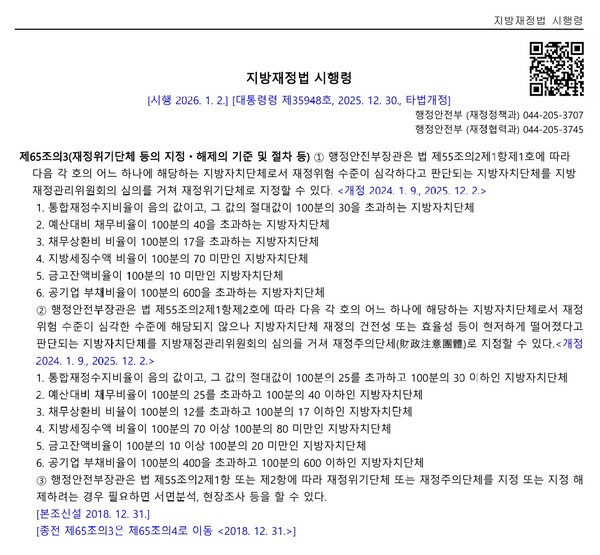
Gyeonggi Province was also aware that it does not meet the criteria for fiscal crisis entities under the current Local Finance Act. An official from Gyeonggi Province's Planning and Coordination Office stated, "We are aware that we do not meet the criteria for fiscal crisis entities under Article 65-3 of the Enforcement Decree of the Local Finance Act."
However, when asked what criteria Gyeonggi Province used to determine a separate "fiscal emergency situation" when all six indicators checked by the Interior and Safety Ministry are below the caution level, the official did not provide an answer.
In the fiscal situation disclosed by Gyeonggi Province on the 5th, indicators showing fiscal strain were presented. Gov. Choo declared the fiscal emergency situation on that day and revealed that Gyeonggi Province issued approximately 943 billion won in local bonds over three occasions last year. This represents 99.6% of the local bond issuance limit of 946 billion won. According to Gyeonggi Province, this was the first local bond issuance in 20 years.
The annual budget for the current fiscal year does not reflect all necessary livelihood and essential projects. Gov. Choo stated, "In the 8th term of civilian government, due to insufficient budget, this year's budget for a significant number of livelihood and essential projects was compiled for only nine months instead of twelve months."
The scale of the supplementary budget reduction that Gyeonggi Province is currently implementing is approximately 770 billion won. Gov. Choo noted that if the current situation continues, debt service could require issuing new local bonds again in two to three years.
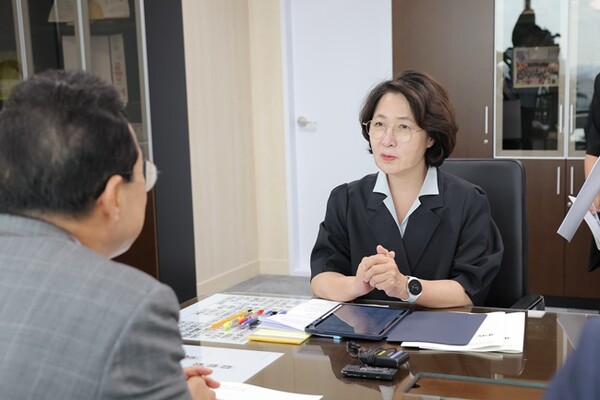
A person (referred to as A) involved in Gyeonggi Province's finances during the 8th term of civilian government agreed with the fiscal strain factors presented by Gov. Choo but offered a different view on the expression "factual default." A stated, "All the contents that Gov. Choo presented as evidence are correct," and "It is true that acquisition tax, the main source of provincial revenue, has decreased due to sluggish real estate transactions, and that we are a non-allocation entity that does not receive ordinary transfer grants."
However, citing the fiscal risk standards in the Enforcement Decree of the Local Finance Act, A said, "Gyeonggi Province does not reach the high-risk standard" and "We need to look at the facts—based on standards set nationally by the government—on whether this is insolvency or crisis."
Gyeonggi Province's revenue structure is also pointed to as one cause of fiscal strain. Cities and counties have tax sources generated at the property ownership stage, such as property tax, whereas Gyeonggi Province relies heavily on acquisition tax, which is sensitive to real estate transaction volume changes, as one of its main revenue sources.
Meanwhile, welfare expenditure is increasing. According to Gov. Choo, Gyeonggi Province's welfare budget accounts for approximately 49% of the total budget. Gyeonggi Province currently projects this could rise to as high as 60% if the increasing trend continues.
There is also a burden of local fund matching for central government projects. A explained, "Since Seoul and Gyeonggi Province do not receive ordinary transfer grants, when the central government increases national treasury projects and requires local fund matching, we must spend our own money," and "Money coming in does not increase, but money that must be spent does."
Within the province, there are also opinions that current local financial risk management standards need to be clarified. A Gyeonggi Province official stated, "The government's statutory alert is not sounding at all, yet local governments cannot even allocate budgets for essential projects," adding "For administrative stability and continuity, the criteria must be clarified on what state should be called a 'crisis' in local finances."
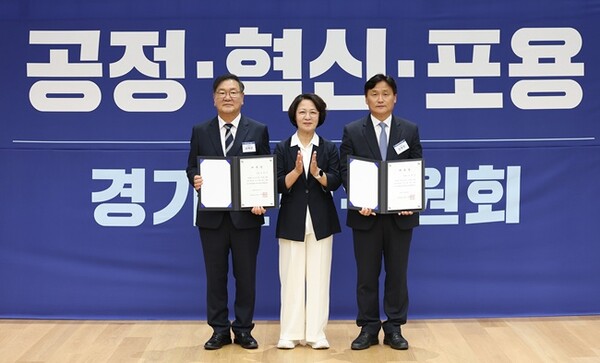
The National Assembly is also planning to review and respond to related matters. Rep. Kim Young-jin, chair of the National Assembly's Committee on Administration and Safety (Democratic Party, Suwon District B), stated regarding Gyeonggi Province's fiscal situation, "I plan to look into response measures," and regarding the difference between the current risk standards under the Local Finance Act and the fiscal situation announced by Gyeonggi Province, he said, "(After receiving information from the Interior and Safety Ministry and Gyeonggi Province), I will confirm once more."
Rep. Kim served as vice chair of the "Fair, Innovative, and Inclusive Gyeonggi Preparatory Committee," which was preparing for the launch of the 9th term of Gyeonggi Province government.