
Gyeonggi Province Conducts 'Safety and Health Management Officer Training' to Prevent Major Industrial Accidents
Gyeonggi Province Governor Choo Mi-ae instructed safety and health management officers in Gyeonggi Province to strengthen field-centered major industrial accident prevention activities, including conducting direct inspections of workplaces and implementing unscheduled checks.
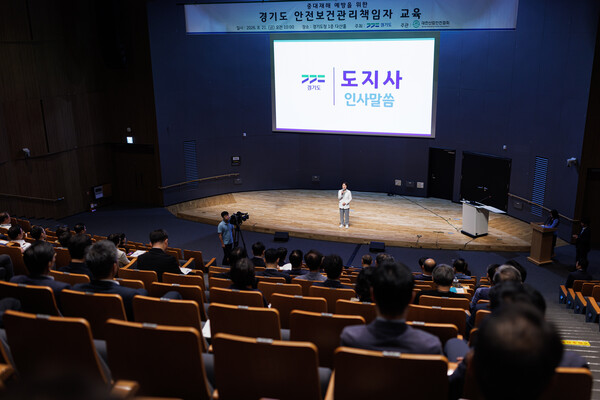
Gyeonggi Province conducted statutory job training for safety and health management officers at the provincial government office on the 21st.
At the training session, Governor Choo Mi-ae, who participated in the education, stated, "I hope you will approach safety issues with action and implementation commitment. Regardless of budget allocation, safety is the most fundamental element." She added, "Of course, focusing on safety does not earn great praise or points, nor does it shine. However, the reason for the province's existence is to organize and guide work that does not shine, and to supplement it."
She continued, "When I served as Minister of Justice and the National Assembly rushed to pass the Serious Accident Punishment Act, I applied the brakes and said that safety aims to secure safety itself, not punishment for its own sake." She explained, "The intention was that detailed manuals should be prepared first, administrative checks and supplements should follow to verify compliance with those manuals, and severe punishment should come as a last resort. I also said that establishing an on-site safety management and supervision system and an administrative system to oversee and supervise it should be a priority task."
Governor Choo added, "Safety accidents occur as a result of our negligence and failure to invest resources in advance, not by chance." She emphasized, "It is not too late now. I urge you executives once again to pay closer attention to the field, conduct unscheduled inspections, and systematically implement measures appropriate to each workplace."
Approximately 70 people, including Governor Choo, provincial department and bureau heads, and heads of public institutions, attended the training. The program was designed as statutory job training pursuant to Article 32 of the Occupational Safety and Health Act to enhance the roles of safety and health management officers and improve field safety management capabilities.
The training was conducted by the Korea Industrial Safety Association, a job training institution designated by the Ministry of Employment and Labor. Major content included key provisions of the Serious Accident Punishment Act and the Occupational Safety and Health Act, major accident cases and prevention measures, risk assessment and safety and health management systems, and the roles and on-site safety management of management officers.
Gyeonggi Province did not limit itself to completion of statutory training but focused the training on spreading a safety management culture in which managers and workers together improve risk factors identified in the field while prioritizing life and safety as core values. Public institutions and publicly-funded organizations, which are separate mandatory compliance entities under the Serious Accident Punishment Act, were also provided with opportunities to apply for and complete the training.
Gyeonggi Province plans to continue improving the safety and health management systems at provincial workplaces and expanding major industrial accident prevention activities so that the province's safety and health management practices can be disseminated to private sector workplaces.