


Exclusive Suwon City Failed to Purify 'Carcinogenic Substances' Despite Securing 4.3 Billion Won…Why Did They Buy Contaminated Land?
Suwon City established a 4.3 billion-won scale land acquisition and purification plan to prevent contamination spread and purchased the land, but it was confirmed that the city has not actually carried out purification since then.
According to Suwon City officials on the 10th, the city entered into a contract in October 2018 to purchase land and buildings designated as pollution sources for approximately 1.6 billion won and acquired ownership.
The city's stated reason for the purchase at the time was swift purification to prevent contamination spread.
In a proposal titled "Purchase and Purification of Soil Contamination Sites" submitted to the Suwon City Council in March of that year, the city explained that soil and groundwater at the site had been contaminated due to past petroleum sales facility operations. It determined that contaminated groundwater was spreading, and soil contamination was gradually expanding to the agricultural and aquatic products wholesale market and nearby private land.
The city stated, "There is no prospect of prompt purification by the current party responsible for purification," and announced its policy to negotiate a purchase of the land, first purify the contaminated soil, and then claim recovery costs from the party responsible for purification. According to the plan, total project costs amounted to 4.3 billion won, including land and building purchase costs of 1.82 billion won and purification work costs of 2.48 billion won.
At that time, a facility modernization project using the existing site was being promoted at the wholesale market. Second Vice Mayor Yi Jae-jun at the time (current Mayor of Suwon City) explained through interviews that the relocation plan for Gokbanjung-dong had been changed due to fiscal constraints and real estate market downturn, and the project was selected as a facility modernization project target, securing 34 billion won in government funding.
Before purchasing the contaminated site, Suwon City had pursued purification orders and complaints against the landowner and past petroleum sales facility operators. In addition to the purchase, there were procedures to promote purification, but as purification was delayed due to lawsuits over purification responsibility, the city chose to directly purchase the land and carry out purification first.
This policy was reflected in the actual sales contract.
Article 6 of the contract stated, "The purchaser, Suwon City, shall carry out purification measures at its own responsibility and cost." Purification measures stipulated in the contract referred to removal and purification of soil contaminants on the land.
Cost recovery was determined as a separate condition. If the responsibility for purification by the seller is acknowledged based on the confirmed judgment in the related case, Suwon City can claim recovery of costs up to the land purchase price after completing purification. To secure this, the parties agreed to establish a pledge with Suwon City as the creditor in the account where land payment is deposited for claims of deposit return and interest payment.
The structure was for the city to purify first, and if the seller's responsibility is acknowledged, claim costs afterward.
After purchase, the city demolished the building. In the 2019 October City Council business report, the city reiterated that it would prevent contamination spread and secure resident safety by acquiring the land where purification was delayed due to lawsuits concerning purification responsibility and swiftly promoting purification projects. At the time, the city had secured 2.602 billion won in purification project costs and planned to promote purification projects upon completion of precision surveys.
The city's policy on purification became clear in an official document sent to a nearby gas station.
In September 2019, in a "Response Regarding Soil Contamination Site Purification," the city stated, "Should contamination be confirmed limited to the groundwater contamination assessment results of the gas station site, Suwon City will carry out purification."
The official document also presented simultaneous purification of three sites: the city-purchased land, a nearby gas station, and an agricultural and aquatic products wholesale market.
Measures following purification completion were also included. The city stated it would cooperatively conduct verification of soil and groundwater purification completion at three sites, and if re-contamination caused by petroleum contaminants from the source site is confirmed after purification, the city would also carry out purification.
The purification plan presented by the city included not only contaminated soil at the purchased site but also groundwater on adjacent sites and re-contamination treatment.
Nevertheless, purification has not been carried out, and the government also stepped in.
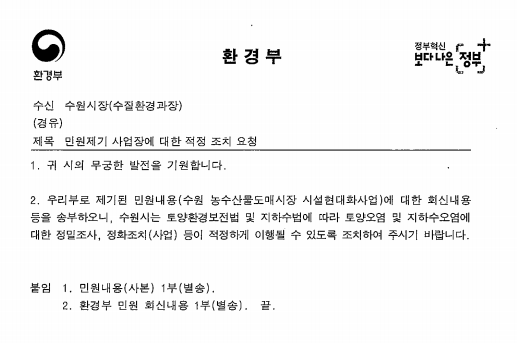
The Ministry of Environment (now Ministry of Climate Energy and Environment) sent an official document to the Suwon City Mayor in February 2020 titled "Request for Appropriate Measures for Business Facilities with Civil Complaints," requesting that soil and groundwater contamination precision surveys and purification measures in accordance with the Soil Environment Conservation Act and Groundwater Act be appropriately implemented in relation to the facility modernization project of the agricultural and aquatic products wholesale market.
The Han River Basin Environmental Office under the Ministry of Climate Energy and Environment is the agency delegated authority to issue purification order measures under the Groundwater Act. If one receives a purification order under the Groundwater Act and fails to implement it, penalties of up to three years imprisonment or fines of up to 30 million won may be imposed. Under the Soil Environment Conservation Act, failure to implement purification order measures carries penalties of up to two years imprisonment or fines of up to 20 million won.
However, it was found that during the facility modernization project, purification was carried out for some soil, but purification measures for entire soil and groundwater were not implemented.
A Suwon City official stated, "We were unable to take purification measures because lawsuits were ongoing," and added, "Unlike the private sector, the government must go through procedures to secure budgets and take actual measures, which requires time."