


Now Is the Age of Culture As Film Industry Faces Crisis, Can the Korea-France 'Lumière Alliance' Illuminate the World?
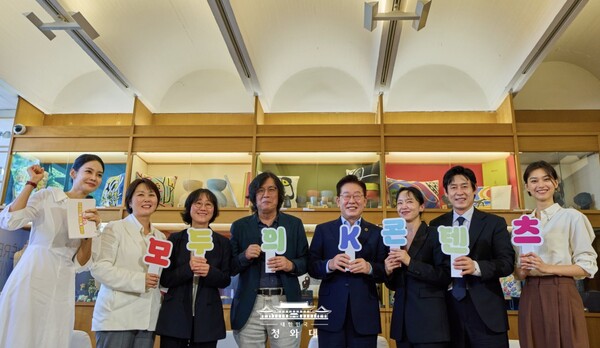
In the early 2000s, when the K-cinema renaissance was in full bloom, the global stage—not yet confined by the grammar of capital—consistently showered deep praise on the sharp ‘wildness’ and originality that Korean cinema possessed. It was thanks to the vision of masters like Bong Joon-ho, Park Chan-wook, and Lee Chang-dong, and the dynamism of an ecosystem where large-scale capital and non-commercial artistic realms maintained balance.
However, in recent years, the currents in Korea's film industry have shifted dramatically. Diagnoses from industry insiders have been uniformly bleak. Declining cinema attendance, monopolistic market restructuring by global OTT platforms, and the emergence of generative AI that produces scripts and visuals in mere seconds are shaking the roots not only of Korean cinema but of the global audiovisual industry. Capital has become extremely conservative, and the space for original experimentation is rapidly disappearing.
Against this backdrop of stagnation, news from Saint-Paul-de-Vence in southern France carries significant weight in cultural circles. It is the story of the launch of the ‘Lumière Partnership’ announced on the 7th (local time) when President Lee Jae-myung and French President Emmanuel Macron presided over the ‘Lumière Summit.’ While the scale is noteworthy—massive funding of 1.6 trillion won (one billion euros) to be invested over five years—what deserves greater attention is the symbolism of ‘Lumière’ (Light) presented in the opening remarks.
Named after the French Lumière brothers, who presented the world's first film to the world in 1895, this partnership goes beyond mere financial collaboration. It carries a cultural declaration that accompanies the message—"endless innovation and creativity are the key to turning crisis into opportunity"—to protect human creative rights amid technological upheaval and revive the roots of independent and art cinema.
The combination of Korea's technological and content capabilities as a key player in the AI supply chain, and France's expertise in traditional art film policy, is deeply significant. It is tantamount to establishing a concrete cultural breakwater in the global film landscape that had been swept up by capital logic. The industry also anticipates that Korean creators will have wider access to global stages through European local tax incentives and distribution networks.
However, from the perspective of someone who has long observed the trajectory of the film industry, I cannot refrain from adding a sobering caveat. This is because film history has witnessed countless instances where grandiose funds and splendid declarations between leaders have failed to translate into tangible results for creators in the field, disappearing without real effect.
The massive 1.6 trillion won in seed funding must not be concentrated in the interests of major production companies or large OTT platforms, but must seep all the way down to young directors still writing screenplays late into the night in cramped rooms and to the grassroots of independent cinema. For the promise of becoming "a reliable partner of independent cinema" to bear fruit, meticulous guidelines for fund distribution, coupled with weighty follow-up work in domestic legal and institutional reform, are absolutely essential.
In French, ‘Lumière’ means light. Just as the Lumière brothers first cast the light of cinema upon the world, we hope this Korea-France partnership will become not merely a one-time news story, but a tangible ‘light of salvation’ for the film industry passing through a dark tunnel. We look forward to the day when the originality of Korean cinema that the world praised twenty years ago becomes a light unto itself, illuminating all the screens of the world once again.