


Constitutional Reform Debate Stuck on 'Lee Jae-myung Reelection'... Power Structure and Basic Rights Sidelined
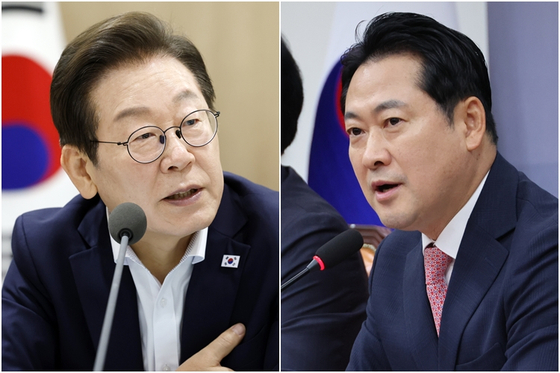
Constitutional reform discussions that have languished for nearly 40 years are now trapped in a single question—"Can the sitting president run again?"—unable to move forward even one step.
According to political circles on the 10th, President Lee Jae-myung stated at a fellow Koreans luncheon held in Paris, France on the 9th (local time), "My term is clearly limited under the Constitution."
This was his first direct comment on the recently surfaced controversy over a "constitutional amendment for Lee Jae-myung's reelection."
The presidential office quickly offered support.
Sung Ki-hong, the president's spokesperson for communications at the presidential office, said on MBC Radio on the 10th in response to a question asking whether the president's remarks could be interpreted as meaning he won't seek reelection, "That interpretation is possible."
However, the Democratic Party seized on the fact that the president never actually said he "won't seek reelection."
Democratic Party leader Jang Dong-hyeok said at the party's supreme council meeting that day, "No matter what the president says, we won't believe it, but he still hasn't said 'there's no scheme for reelection' or 'I won't seek reelection.'"
He continued, "He wasn't answering a question about whether he'll seek reelection, but rather answering a question about 'why do you travel abroad so frequently?' by saying 'my term is clearly limited under the Constitution.' How long must we listen to the president's word games?"
While the president mentioned "constitutionally limited term" and the presidential office explained this as meaning "he won't seek reelection," the opposition came back with "he didn't directly say he won't seek reelection," bringing the argument full circle.
The problem is that as political circles focus the constitutional reform debate on whether the sitting president will seek reelection, the substantive issues of constitutional reform are being pushed aside.
Regarding the current Constitution, which has been maintained for nearly 40 years since the 1987 constitutional amendment, political circles have raised various needs for reform: restructuring the power system starting with the five-year single-term presidency; dispersing presidential powers; checks and balance between the National Assembly and the executive branch; strengthening regional decentralization; and expanding basic rights reflecting changing society.
The president's constitutional reform vision is not limited to reelection alone.
On the 14th of last month, the president stated, "My pledge and consistent position has been to amend the constitution by changing the presidential term to a four-year two-term or reelection system, enabling responsible politics through mid-term evaluation, and strengthening local autonomy and citizens' basic rights." He also raised the need for power dispersion by transferring some of the president's authority, such as appointment power, to the National Assembly.
A four-year two- or three-term presidential system is ultimately a matter of restructuring power structure that must also consider presidential accountability, policy continuity, and checks and balances—beyond whether a specific president can run again.
The public's demands for constitutional reform are also not limited to "presidential reelection."
In a national perception survey released by the National Assembly Secretariat in February, 68.3% of respondents supported constitutional reform. Among supporters, 70.4% cited "the need to respond to social changes and new issues" as their reason.
When asked which agenda should be prioritized if constitutional reform is pursued in stages, adding basic rights such as right to life and safety rights led with 35.1%, followed by restructuring the power system regarding presidential authority and term (26.0%), and strengthening regional decentralization and balanced regional development (24.9%).
However, when looking solely at the presidential term system reform that has recently become controversial in political circles, public opinion is more complex.
In a survey conducted by Realmeter on behalf of Energy Economy News from the 18th to 19th of last month targeting 1,017 adults nationwide aged 18 and older, support for a four-year two-term or reelection system constitutional amendment stood at 46.0% in favor and 50.9% opposed, with opinion evenly split within the margin of error.
However, when asked about allowing the current president to run again by applying a constitutional amendment on presidential terms to him, only 34.7% supported while 61.7% opposed—a 27.0 percentage point gap favoring opposition.
This suggests that public judgment on "how to change the presidential system" does not necessarily align with judgment on "whether to allow this president to run again."
Nevertheless, recent political debate appears focused on "Can the president run again if we amend the constitution?" rather than on "How should we structure the constitution?"
Some in political circles point out that both the ruling and opposition parties should step back from the "Lee Jae-myung reelection" controversy and engage in substantive constitutional reform discussions.
One political figure said, "While controversy may arise regarding the president's reelection, the president can simply clarify that he won't seek reelection, and Leader Jang can either win the election against the president or whoever runs. Looking at how both sides are fixated on reelection bickering rather than statesmanlike constitutional reform discussions, one can't help but question whether there's genuine will for constitutional reform," he said.
The Realmeter survey was conducted using wireless 100% RDD automated response methods with a response rate of 3.7% and a sample error margin of ±3.1 percentage points at a 95% confidence level. For detailed information, refer to the Central Election Opinion Poll Deliberation Committee website.