


'Line to Be Protected' Selected as Grand Prize in 20th Public Design Competition
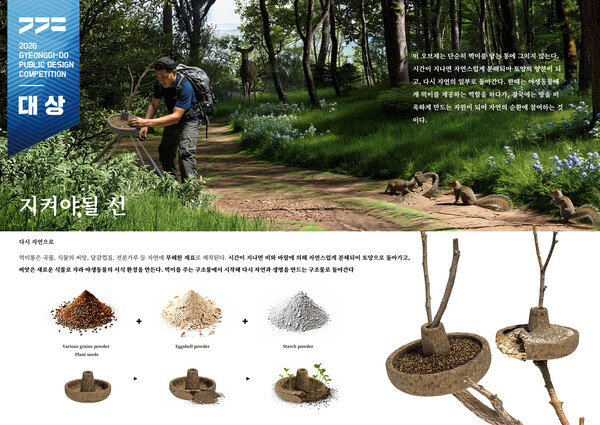
Gyeonggi Province announced on the 14th that it has selected 'Line to Be Protected' by Lee Chan-yang, which proposes a wildlife feeder made from naturally degradable materials, as the grand prize winner of the '2026 Gyeonggi Province Public Design Competition.'
The grand prize work 'Line to Be Protected' is an idea to create wildlife feeders using materials that are minimally harmful to nature, such as grains, plant seeds, and cornstarch powder. The feeder is designed to naturally decompose over time, with seeds inside exposed to grow into plants.
A distinctive feature is that rather than directly approaching or controlling wildlife, people place the feeder and maintain a certain distance to observe the animals. The judging panel highly evaluated how the design applied the principles of natural circulation, expressing a way for humans and wildlife to coexist while each respecting the other's territory through public design.
Two works were selected for the silver prize: 'SENTINEL: AI-Based Smart Road-Kill Prevention System' by the Chung-Ang University team of Kim Seung-soo and Lee Jeong-min, and 'Pet Etiquette Station for Coexistence of Humans and Animals' by Seo Jeong-yong. The grand prize winner receives the Minister of Culture, Sports and Tourism Award and 5 million won in prize money, while silver prize winners each receive 3 million won.
A total of 195 entries were submitted to this year's competition. The province selected 20 winning works through a first-round online review, and for the top 10 among them, conducted consultations with external design experts to enhance the completeness of the works.
At the final round held on August 28, professional judges and citizen evaluators selected through public recruitment evaluated the completeness, creativity, and feasibility of the works to determine the final rankings.
The theme of this year's 20th Gyeonggi Province Public Design Competition is 'Public Design for Coexistence of Humans and Animals.' It was organized to discover public design ideas in everyday life that enable humans and animals to live together while considering the welfare of various animals including pets and wildlife. Gyeonggi Province hosted the event with sponsorship from the Ministry of Culture, Sports and Tourism.
Kang Gil-soon, head of the Architectural Policy Division of Gyeonggi Province, stated, "Public design can be a method to discover various problems in daily life and solve them," adding "We will continue to discover innovative ideas that improve residents' quality of life and create a clean and safe Gyeonggi Province where people and nature coexist."
All 20 winning works from the 20th Gyeonggi Province Public Design Competition can be viewed as electronic documents on the Design Gyeonggi website (www.gg.go.kr/design/main.do) from November onwards.